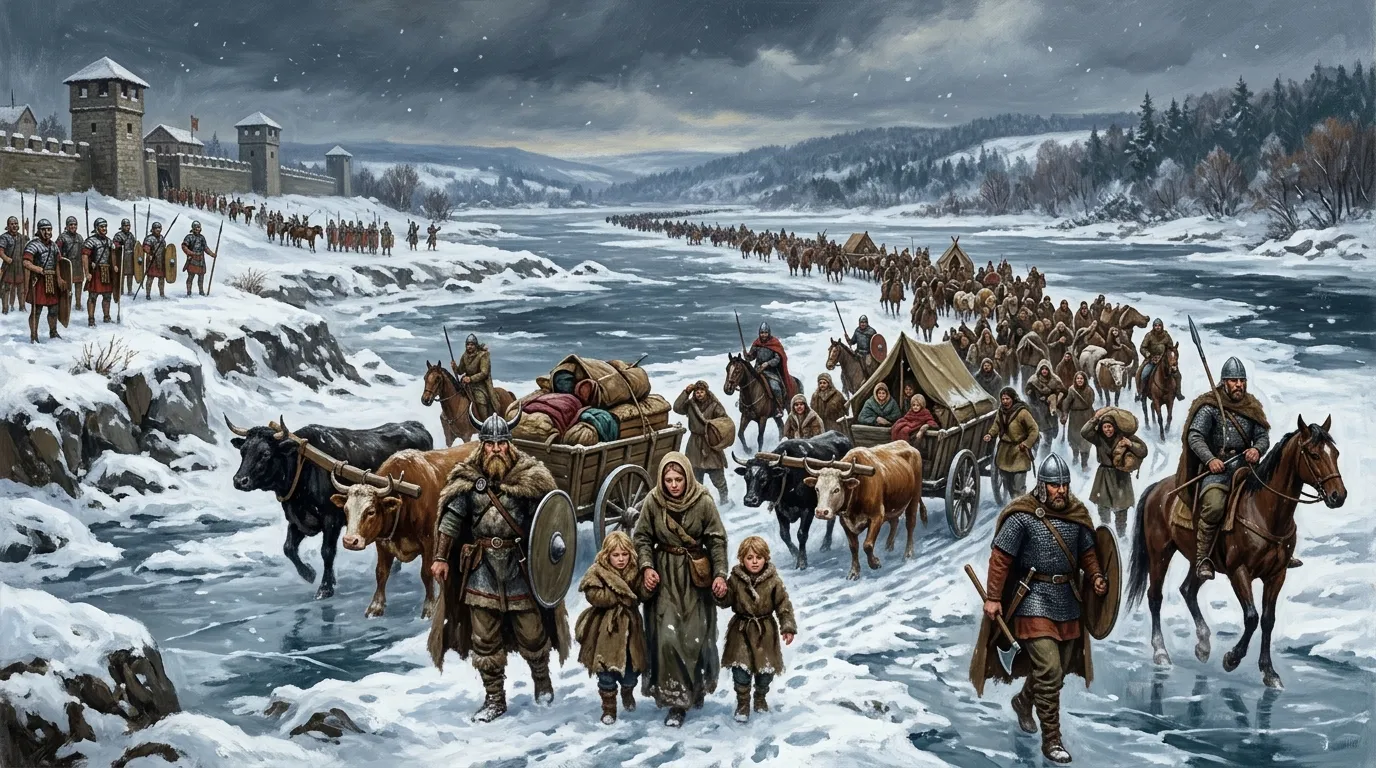
The crisis began when Fritigern - Fritigern was a clever leader of the Goths. When his people were in danger because of the Huns, he led them into the Roman Empire. He hoped they would be safe, but the Roman governors were very greedy and even took Gothic children as slaves. To save his hungry and suffering people, Fritigern started a rebellion. At the Battle of Adrianople, he used smart tactics with his cavalry to surprise the Romans. His victory secured a place for his people to live inside the empire and changed history forever. and the Thervingi Goths, fleeing the terrifying Huns - The Huns were a nomadic people from the Eurasian Steppe who appeared in Europe in the late 4th century. Their origins remain the subject of scholarly debate, with some linking them to the Xiongnu who ..., crossed the Danube seeking refuge. However, corrupt Roman officials exploited the refugees, forcing them into starvation. This mistreatment sparked a massive revolt that culminated in the Battle of Adrianople (378 AD). Emperor Valens - Eastern Roman emperor who fought Gothic and Persian threats and died at Adrianople in 378., eager for glory, attacked without reinforcements and was killed, destroying two-thirds of the Eastern Roman army. This catastrophic defeat shattered the myth of Roman invincibility and opened the empire's borders.
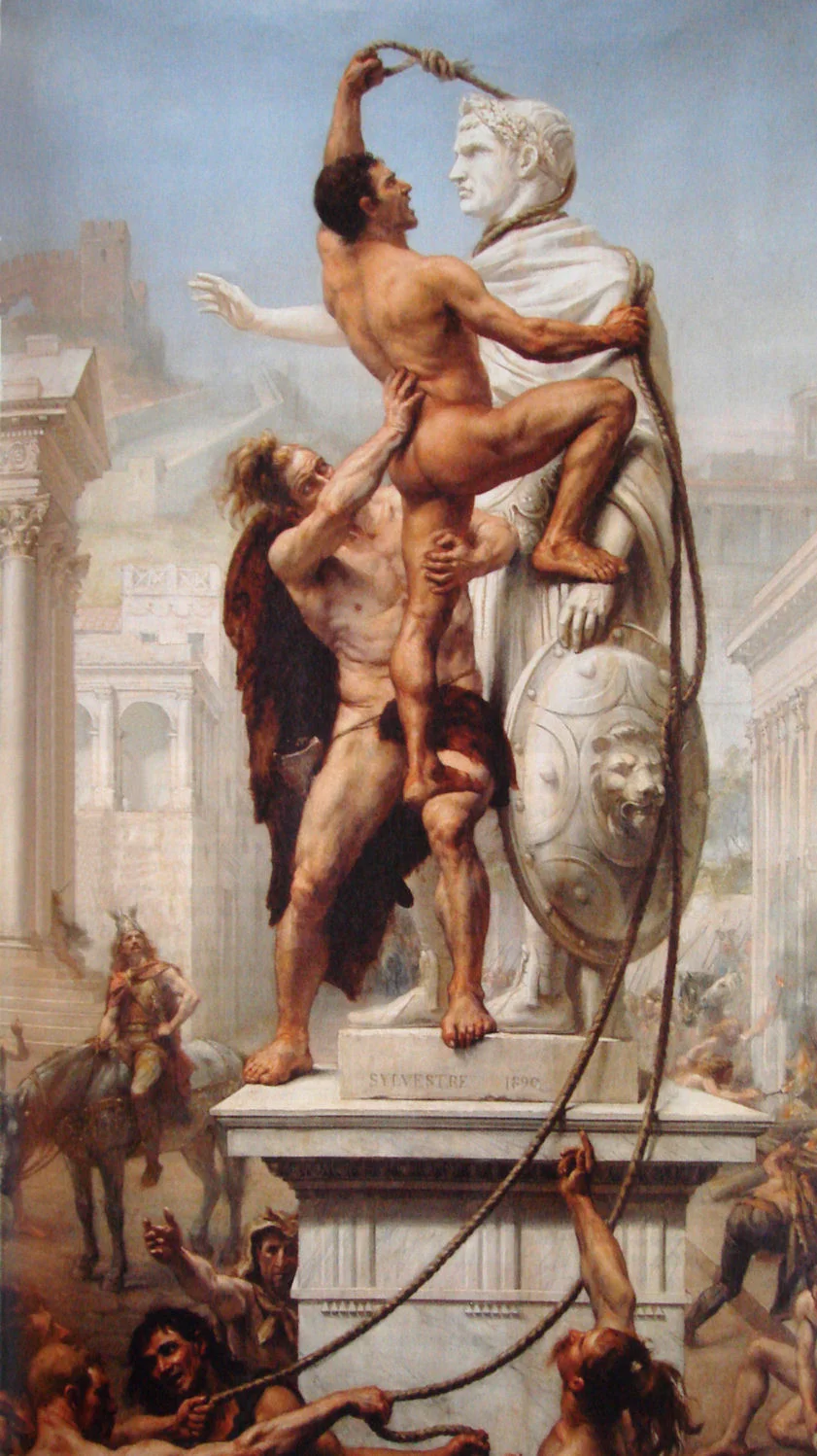
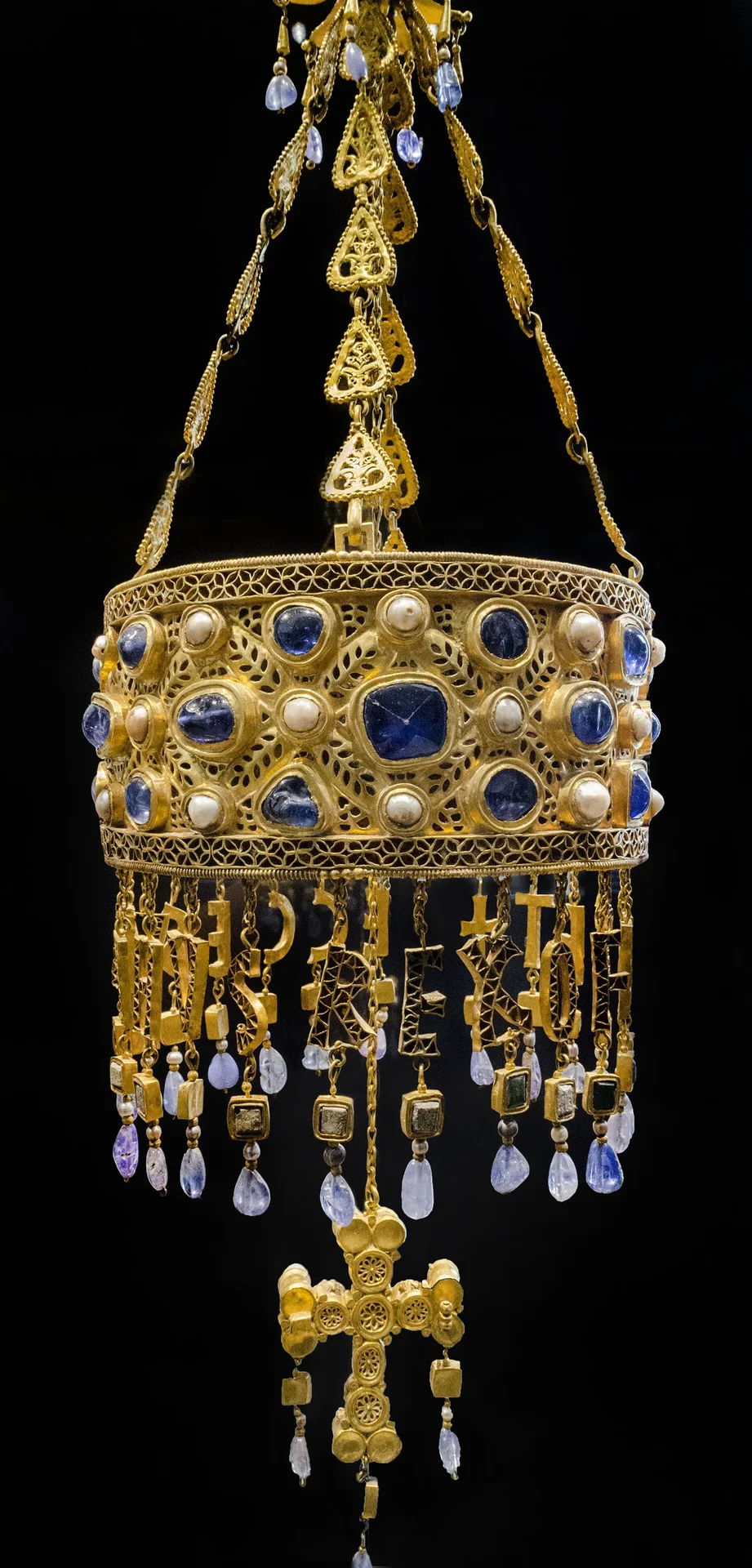
As the frontiers collapsed, Alaric I - After the death of Theodosius I, Alaric emerged as a leader of the Visigoths and was initially recognized by Rome as a federate commander. united the Visigoths - A Germanic kingdom that emerged from the Visigothic migrations, centered first in southern Gaul and later in Hispania with its capital at Toledo. and demanded land and status. When Rome repeatedly betrayed these promises, Alaric besieged and finally sacked Rome in 410 AD—the first time in 800 years the city had fallen to a foreign enemy. Meanwhile, the Vandals - A Germanic kingdom founded in North Africa with its capital at Carthage, dominating the western Mediterranean with a powerful fleet. crossed the Rhine, swept through Gaul and Spain, and conquered North Africa. In 455 AD, they launched a seaborne raid on Rome, looting the city even more thoroughly than the Visigoths had.
The chaos deepened with the invasion of Attila the Hun - Ruler of the Huns and one of the most feared enemies of the Roman Empire, known as the 'Scourge of God'., who ravaged Gaul and Italy until he was checked by a Roman-Visigothic alliance at the Battle of the Catalaunian Plains (451 AD). Finally, in 476 AD, the Western Roman Empire - The western half of the Roman Empire after its division in 395 AD. Plagued by internal instability and Germanic invasions, it fell in 476 AD, marking the start of the Middle Ages. fell. Odoacer - Odoacer led a revolt of barbarian mercenaries in Italy. Instead of appointing a puppet emperor, he declared himself King of Italy, marking the formal end of the Western Roman Empire., a Germanic leader, deposed the last emperor, Romulus Augustulus - The last Western Roman Emperor, whose deposition by Odoacer in 476 AD marks the traditional end of the Western Roman Empire.. Breaking with tradition, Odoacer sent the imperial regalia to Constantinople - Formerly the Greek city of Byzantium, it was rebuilt as 'New Rome' by Emperor Constantine I in 330 AD. Located on the Bosporus, it served as a bridge between Europe and Asia and was the wealthiest and largest city in Europe for centuries. Its strategic location and massive Theodosian Walls made it nearly impregnable until its fall to the Ottomans in 1453., declaring that the West no longer needed an emperor. This act formally ended the ancient Roman line in the West.
Odoacer ruled Italy as a client of Constantinople, but his independence worried Emperor Zeno. Zeno incited Theoderic the Great - King of the Ostrogoths who defeated Odoacer and established the Ostrogothic Kingdom in Italy, restoring stability and Roman culture., king of the Ostrogoths - After being subjugated by the Huns, the Ostrogoths regained independence and migrated to Italy. Under Theodoric, they replaced Odoacer's rule and established a kingdom that sought to preserve Roman administration and culture., to invade Italy. Theoderic defeated Odoacer in 493, killed him with his own hands, and established the Ostrogothic Kingdom - The Ostrogoths (Eastern Goths) were a branch of the Goths, a Germanic people from northern and central Europe. They lived north of the Black Sea and, in the late 4th century, were absorbed into the Hu..., maintaining Roman administration under Gothic military rule.