As new Germanic kingdoms formed across the West, the Western Roman Empire weakened step by step and finally collapsed in 476. The Visigoths formed a kingdom in 418 and later shifted their center to Spain, the Vandals seized North Africa and made Carthage their capital in 439, and the Ostrogoths under Theoderic established a kingdom in Italy from 493. For decades these states ruled much of the western Mediterranean while the Eastern Roman Empire watched and rebuilt its strength.
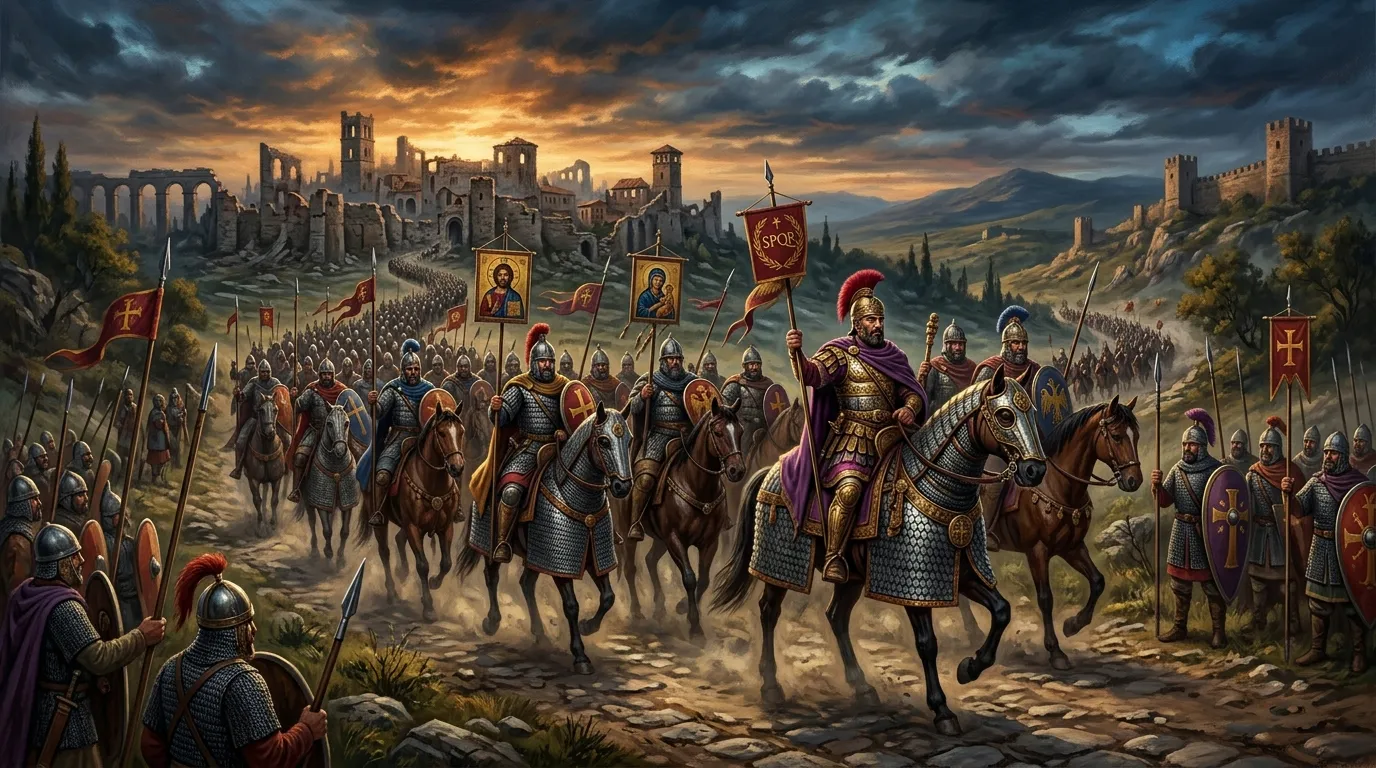
The reconquest began in 533 AD with the Vandalic War. Belisarius landed in North Africa with a small force and achieved a stunningly rapid victory. Within a year, he defeated King Gelimer at the Battles of Ad Decimum and Tricamarum, capturing Carthage and ending the Vandal Kingdom forever. This success encouraged Justinian to target Italy next.
The Gothic War (535–554 AD) proved far more difficult. Belisarius quickly took Sicily and Naples, then captured Rome in 536 AD. However, the Ostrogoths rallied under King Totila, who retook much of Italy and dragged the war into a brutal stalemate that devastated the peninsula. Belisarius was recalled, and it was the eunuch general Narses who finally defeated Totila at the Battle of Taginae in 552 AD.
While Italy was in flames, a civil war in Visigothic Spain allowed Justinian to send a small expedition in 552 AD, seizing the southern coast (Spania). By 554 AD, the Mediterranean was once again a 'Roman Lake', but the cost was immense. Italy was depopulated and ruined, and the empire's resources were exhausted, leaving it vulnerable to future threats.