After Great Khan - Khagan is a title of imperial rank in the Turkic and Mongolian languages, equivalent to the status of Emperor. It translates to 'Khan of Khans' (King of Kings). Under Genghis Khan, it was stabilized as the title for the supreme ruler of the Mongol Empire. According to Mongolian legends, the Khagan was chosen by Tengri, the supreme sky god, and ruled by the authority of the 'Eternal Blue Sky' (Mönkh Khukh Tengri) as his representative on Earth. Möngke died suddenly in 1259, the descendants of Genghis Khan fought one another for forty years. What began as a succession quarrel between the brothers Kublai - A grandson of Genghis Khan who won the succession war against his brother, became Great Khan, and founded the Yuan dynasty that ruled all of China. and Ariq Böke - Youngest son of Tolui and brother of Kublai, he held the capital Karakorum and contested the title of Great Khan. He stood for those who wanted to preserve the old ways of the steppe. spread to the Caucasus - The Caucasus Mountains are a grand mountain range stretching between the Black Sea and the Caspian Sea, serving as a natural boundary dividing Asia and Europe. With many peaks towering over 5,000 meters, its rugged terrain was historically considered an impassable natural barrier for large armies. According to ancient Greek mythology, this is the legendary place where the Titan Prometheus was chained to a cold cliff as a punishment for stealing fire from the gods to give to humanity. He suffered there daily as an eagle ate his liver. It is also nicknamed the 'Mountain of Tongues' because its deep valleys isolated many different tribes, allowing them to preserve their own unique languages. Historically, these mountains acted as a formidable natural fortress. However, in 1222, the Mongol forces led by Jebe and Subutai accomplished the miraculous feat of crossing the snowy, rugged Caucasus Mountains. Their sudden emergence from the southern slopes shocked the Alans and Cumans living in the northern steppes. and Central Asia, and the once-single Mongol Empire ended up divided into four realms: the Yuan - The Mongol-Chinese empire founded by Kublai Khan, the realm of the Great Khan that ruled all of China., the Chagatai Khanate - The khanate that grew from the share given to Chagatai, second son of Genghis Khan, ruling the steppes and oasis cities of Central Asia., the Ilkhanate - The Mongol khanate Hülegü founded in Persia and the Middle East; its very name means a khan who obeys the Great Khan., and the Golden Horde - The nomadic state Batu founded on the lower Volga, which collected tribute from the Rus principalities for some 250 years..
LocationMongolian steppe, Central Asia, and the Caucasus - The Caucasus Mountains are a grand mountain range stretching between the Black Sea and the Caspian Sea, serving as a natural boundary dividing Asia and Europe. With many peaks towering over 5,000 meters, its rugged terrain was historically considered an impassable natural barrier for large armies. According to ancient Greek mythology, this is the legendary place where the Titan Prometheus was chained to a cold cliff as a punishment for stealing fire from the gods to give to humanity. He suffered there daily as an eagle ate his liver. It is also nicknamed the 'Mountain of Tongues' because its deep valleys isolated many different tribes, allowing them to preserve their own unique languages. Historically, these mountains acted as a formidable natural fortress. However, in 1222, the Mongol forces led by Jebe and Subutai accomplished the miraculous feat of crossing the snowy, rugged Caucasus Mountains. Their sudden emergence from the southern slopes shocked the Alans and Cumans living in the northern steppes. (present-day Mongolia, Kazakhstan, southern Russia, Iran, Afghanistan)
BelligerentsKublai - A grandson of Genghis Khan who won the succession war against his brother, became Great Khan, and founded the Yuan dynasty that ruled all of China.'s faction (the future Yuan - The Mongol-Chinese empire founded by Kublai Khan, the realm of the Great Khan that ruled all of China.), Ariq Böke - Youngest son of Tolui and brother of Kublai, he held the capital Karakorum and contested the title of Great Khan. He stood for those who wanted to preserve the old ways of the steppe.'s faction (steppe traditionalists), Hülegü - A Mongol ruler and commander who founded the Ilkhanate in Persia and led the historic Siege of Baghdad in 1258. Grandson of Genghis Khan, he expanded the empire into much of Western Asia, destroying the Abbasid Caliphate and the Assassin sect before his advance was halted by the Mamluks.'s faction (the future Ilkhanate - The Mongol khanate Hülegü founded in Persia and the Middle East; its very name means a khan who obeys the Great Khan.), Berke - The first Mongol ruler to accept Islam, he went to war against his own cousin Hülegü over the destruction of Baghdad.'s faction (Golden Horde - The nomadic state Batu founded on the lower Volga, which collected tribute from the Rus principalities for some 250 years.), Kaidu - A grandson of Ögedei whose family had lost the throne, he fought Kublai and his successor in Central Asia for more than thirty years.'s faction (House of Ögedei and the Chagatai Khanate - The khanate that grew from the share given to Chagatai, second son of Genghis Khan, ruling the steppes and oasis cities of Central Asia.)
Context & Background
Mid-13th century
An empire that had grown too large
The empire stretched from the Pacific to the Black Sea. Even with a dense network of yam relay stations, where riders swapped horses, news took months to travel from Karakorum - Karakorum was the capital of the Mongol Empire, founded by Ögedei Khan on the Orkhon River in 1235, near present-day Kharkhorin in Mongolia. Standing in open grassland, it had to be fed by grain convoys from the farming lands to the south. That weakness decided a war: when Kublai cut the routes in 1261, Ariq Böke's hold on the capital collapsed without a decisive battle. It was also a city people reached from all over the world. Guillaume Boucher, a goldsmith taken captive in France, built a great silver tree in the palace whose pipes are said to have poured out wine and fermented mare's milk. Only ruins remain today, beside the Erdene Zuu Monastery built from its stones. to Persia. In a realm where even the death of a Great Khan - Khagan is a title of imperial rank in the Turkic and Mongolian languages, equivalent to the status of Emperor. It translates to 'Khan of Khans' (King of Kings). Under Genghis Khan, it was stabilized as the title for the supreme ruler of the Mongol Empire. According to Mongolian legends, the Khagan was chosen by Tengri, the supreme sky god, and ruled by the authority of the 'Eternal Blue Sky' (Mönkh Khukh Tengri) as his representative on Earth. arrived months late, rule by one man was reaching its limit.
13th century
Steppe or settled: two futures
The Mongol elite was splitting into two camps: those who wanted to keep the old steppe life and customs, and those who wanted to govern through the cities and tax systems of the farming lands they had conquered. Ariq Böke - Youngest son of Tolui and brother of Kublai, he held the capital Karakorum and contested the title of Great Khan. He stood for those who wanted to preserve the old ways of the steppe. stood for the first, Kublai - A grandson of Genghis Khan who won the succession war against his brother, became Great Khan, and founded the Yuan dynasty that ruled all of China. for the second. The succession fight was also a fight over what kind of state to build.
Later 13th century
Religion draws a new border
Berke - The first Mongol ruler to accept Islam, he went to war against his own cousin Hülegü over the destruction of Baghdad. of the Golden Horde - The nomadic state Batu founded on the lower Volga, which collected tribute from the Rus principalities for some 250 years. was the first Mongol ruler to accept Islam. So when Hülegü - A Mongol ruler and commander who founded the Ilkhanate in Persia and led the historic Siege of Baghdad in 1258. Grandson of Genghis Khan, he expanded the empire into much of Western Asia, destroying the Abbasid Caliphate and the Assassin sect before his advance was halted by the Mamluks. destroyed Baghdad in 1258 and killed the caliph, the leader of the whole Islamic world, Berke saw it not as family business but as an attack on his faith. A new line, drawn by religion, now cut across an empire that had been held together by blood.
The Narrative
The Mongol Empire kept growing for more than thirty years after Genghis Khan's death. But when Great Khan - Khagan is a title of imperial rank in the Turkic and Mongolian languages, equivalent to the status of Emperor. It translates to 'Khan of Khans' (King of Kings). Under Genghis Khan, it was stabilized as the title for the supreme ruler of the Mongol Empire. According to Mongolian legends, the Khagan was chosen by Tengri, the supreme sky god, and ruled by the authority of the 'Eternal Blue Sky' (Mönkh Khukh Tengri) as his representative on Earth. Möngke died on campaign in 1259, it began to come apart from the inside instead. The rule for choosing the next Great Khan was the kurultai - A kurultai was the assembly Mongol and Turkic nomads held to settle great questions. Princes, tribal chiefs and leading commanders gathered in one place to choose the next Great Khan or to decide on war. Its most important task was the election itself. The Mongols had no rule that the eldest son must inherit, so a man became Great Khan only once the assembly had recognised him. The system had a weakness: the outcome depended on who gathered, and where. In 1260 Kublai and Ariq Böke held separate kurultais in different places and both were proclaimed Great Khan, which is where the division of the Mongol Empire began., an assembly of princes and commanders. The problem was who would gather, and where.
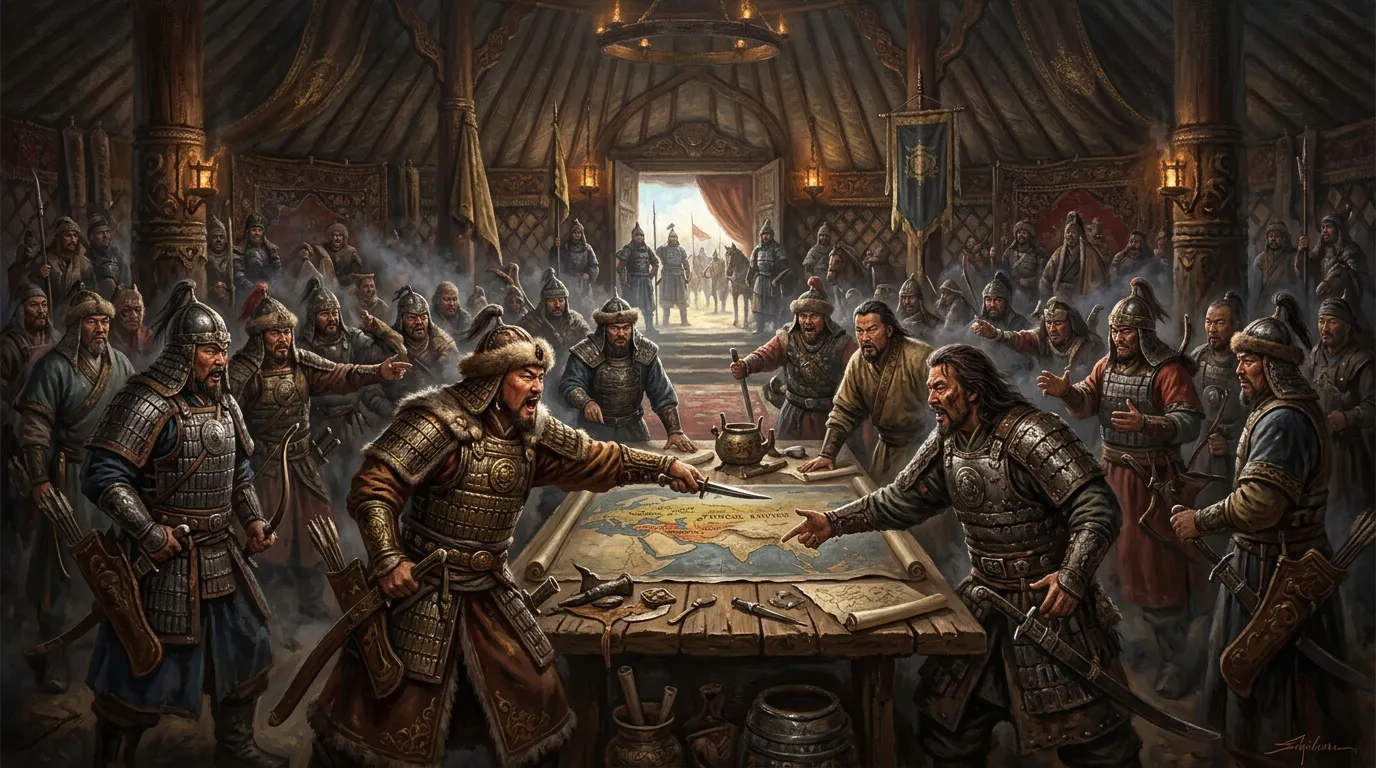
In the spring of 1260 Kublai - A grandson of Genghis Khan who won the succession war against his brother, became Great Khan, and founded the Yuan dynasty that ruled all of China. hurried back from the Southern Song front and held a kurultai at his own base of Kaiping, where he was proclaimed Great Khan. A month later his youngest brother Ariq Böke - Youngest son of Tolui and brother of Kublai, he held the capital Karakorum and contested the title of Great Khan. He stood for those who wanted to preserve the old ways of the steppe. held a separate kurultai in the capital, Karakorum - Karakorum was the capital of the Mongol Empire, founded by Ögedei Khan on the Orkhon River in 1235, near present-day Kharkhorin in Mongolia. Standing in open grassland, it had to be fed by grain convoys from the farming lands to the south. That weakness decided a war: when Kublai cut the routes in 1261, Ariq Böke's hold on the capital collapsed without a decisive battle. It was also a city people reached from all over the world. Guillaume Boucher, a goldsmith taken captive in France, built a great silver tree in the palace whose pipes are said to have poured out wine and fermented mare's milk. Only ruins remain today, beside the Erdene Zuu Monastery built from its stones., and was proclaimed Great Khan as well. For the first time in Mongol history there were two. They clashed fiercely in 1261 at the Battle of Shimultai, resulting in a stalemate. Consequently, Kublai chose to starve his brother rather than rely solely on combat. Karakorum sat in open grassland and had to be fed by convoys from the south, so Kublai seized every route. After a hungry winter, Ariq Böke surrendered in 1264.
Before that quarrel had even ended, another war broke out in the west. Hülegü - A Mongol ruler and commander who founded the Ilkhanate in Persia and led the historic Siege of Baghdad in 1258. Grandson of Genghis Khan, he expanded the empire into much of Western Asia, destroying the Abbasid Caliphate and the Assassin sect before his advance was halted by the Mamluks., who had taken Persia, and Berke - The first Mongol ruler to accept Islam, he went to war against his own cousin Hülegü over the destruction of Baghdad., who ruled the Kipchak steppe - The Kipchak Steppe, also known as Desht-i Qipchaq, is a massive expanse of grassland stretching from north of the Danube River in the west to near the Altai Mountains in the east. Covering parts of modern-day Ukraine, southern Russia, and Kazakhstan, it was the historic domain of nomadic peoples like the Cumans and Kipchaks. According to local legends, unseen spirit horses race across this vast sea of grass on the wind, and on quiet nights, one can hear the thundering hooves of tens of thousands of them shaking the earth. Later, after Batu Khan (Genghis Khan's grandson) completed his European campaigns, he settled here, making it the heartland of the Golden Horde (also known as the Kipchak Khanate). The endless plains and rich pastures were perfect for raising horses and moving camps, serving as the powerful core of nomadic empires for centuries., clashed over the pastures of the Caucasus - The Caucasus Mountains are a grand mountain range stretching between the Black Sea and the Caspian Sea, serving as a natural boundary dividing Asia and Europe. With many peaks towering over 5,000 meters, its rugged terrain was historically considered an impassable natural barrier for large armies. According to ancient Greek mythology, this is the legendary place where the Titan Prometheus was chained to a cold cliff as a punishment for stealing fire from the gods to give to humanity. He suffered there daily as an eagle ate his liver. It is also nicknamed the 'Mountain of Tongues' because its deep valleys isolated many different tribes, allowing them to preserve their own unique languages. Historically, these mountains acted as a formidable natural fortress. However, in 1222, the Mongol forces led by Jebe and Subutai accomplished the miraculous feat of crossing the snowy, rugged Caucasus Mountains. Their sudden emergence from the southern slopes shocked the Alans and Cumans living in the northern steppes.. The two were cousins, but Berke was a Muslim and never forgave the sack of Baghdad. In the winter of 1262 Hülegü pushed north through the Derbent pass - A narrow coastal strip between the Caspian Sea and the Caucasus Mountains, it has historically served as a crucial military and commercial passage connecting the north and south. Its highly defensible terrain made it a natural 'gate' for the region., and in January 1263 he was beaten badly at the Terek River - The Terek River originates in the deep valleys of the Caucasus Mountains and flows for about 620 kilometers before emptying into the Caspian Sea. Because of its fast currents and strategic location, it has historically served as an important geographical boundary and natural defense line for traveling peoples and armies. In the winter of 1262–1263, during the fragmentation of the Mongol Empire, the armies of Hülegü and Berke fought a major battle along this river. According to historical accounts, as Hülegü's forces retreated across the frozen river, the ice broke beneath them, and countless soldiers and horses tragically drowned in the freezing water. Later in 1395, the river became the stage for the climactic Battle of the Terek River between Timur (Tamerlane) and Khan Tokhtamysh. Timur's crushing victory here opened the way for his army to sack and raze Sarai and the Volga trade cities, delivering a fatal blow to the Golden Horde.. As his men fell back across the frozen river the ice broke under them and many drowned, the sources say. It was the first time a Mongol army had been shattered by another Mongol army.
Even after Ariq Böke surrendered, resistance from the steppe did not end. Kaidu - A grandson of Ögedei whose family had lost the throne, he fought Kublai and his successor in Central Asia for more than thirty years., the leader of the Ögedei Khanate founded by Genghis Khan's third son, took center stage. He rallied Central Asian nomads, and in 1269 held a kurultai at Talas - A river that flows through modern-day Kyrgyzstan and Kazakhstan. It was the site of the historic Battle of Talas in 751 AD, where the Abbasid Caliphate defeated the Tang dynasty, marking the end of Tang expansion to the west and the beginning of the spread of Islam in Central Asia. where the princes divided the empire's lands without the Great Khan's consent. The parties at Talas were Kaidu, Baraq - Ruler of the Chagatai Khanate who seized power and fought against both Kaidu and the Ilkhanate. and envoys of the Golden Horde - The nomadic state Batu founded on the lower Volga, which collected tribute from the Rus principalities for some 250 years.; the Ilkhanate - The Mongol khanate Hülegü founded in Persia and the Middle East; its very name means a khan who obeys the Great Khan. was not among them. The deal split the pastures and taxes of Transoxiana - The land of Central Asia between the Amu Darya and the Syr Darya rivers. Mawarannahr is Arabic for 'what lies beyond the river', and the Greek and Roman name Transoxiana means the same thing. It covers today's Uzbekistan and Tajikistan along with southern Kazakhstan. Water drawn from the two rivers let oasis cities such as Samarkand and Bukhara grow in the middle of the desert, and they thrived as staging posts on the Silk Road. Because the taxes of those cities and the profits of their merchants were so large, the khanates that emerged from the divided Mongol Empire fought hard to control the region. The Talas kurultai of 1269 was, in the end, a meeting about how to share out its pastures and its taxes. Samarkand carries an old legend of its own. It is said to have been founded by Afrasiab, the king of Turan in the Persian epics, and the mound of the old city is still called Afrasiab today. (present-day Uzbekistan and its neighbours) three ways and told Baraq to make up his share in Khorasan to the west. Rather than stopping the khanates from fighting, it pointed Baraq's spear at the one khanate that had not signed. In 1270 Baraq marched west and met the Ilkhan Abaqa - The second Mongol ruler of the Ilkhanate, who successfully defended Persia against invasions from the Golden Horde and Chagatai Khanate. near Herat, but the troops Kaidu had promised slipped away before the battle and Baraq was decisively beaten. When Baraq died the next year, Kaidu seized the opportunity to place the entire Chagatai Khanate - The khanate that grew from the share given to Chagatai, second son of Genghis Khan, ruling the steppes and oasis cities of Central Asia. under his control.
For over thirty years, Kaidu, allied with Duwa—whom he had installed as the new Chagatai Khan—fought a relentless war against Kublai's Yuan dynasty - The Mongol-Chinese empire founded by Kublai Khan, the realm of the Great Khan that ruled all of China.. In 1301, Kaidu and Duwa led a massive army to seize the old capital of Karakorum, clashing with Yuan forces at the Battle of the Zavkhan River - A river in western Mongolia. It rises in the Khangai Mountains and runs northwest into Khyargas Lake. It never reaches the sea but ends in a salt lake inland, as many rivers in Central Asia do. Grass and watering places follow the river, which made it a precious road for nomads who had to feed their animals as they travelled. Anyone moving from the Altai in the west toward the Orkhon valley, where the old capital Karakorum stood, found it easiest to keep to this water, so armies used it as a corridor during the Mongol civil war. The clash between the Yuan army and the combined forces of Kaidu and Duwa in 1301, as they marched on Karakorum, is placed along this river. The name survives today in Mongolia's Zavkhan Province. The Khangai Mountains where the river begins have long been called the bountiful mountains and treated as sacred, a place where offerings were made to the spirits that own the mountains and the rivers.. The brutal fight ended in a stalemate with heavy losses, leaving Duwa wounded. Kaidu was also injured and died soon after. Upon Kaidu's death, the situation flipped. Duwa made a secret pact with the Yuan dynasty, launched a surprise attack on Kaidu's heirs, and absorbed almost all the territories of the Ögedei Khanate. With the Ögedei Khanate wiped from history, the remaining four realms—Yuan, Chagatai, Ilkhanate, and Golden Horde—signed a peace treaty in 1304, nominally recognizing the Yuan emperor as the supreme Great Khan. Though the empire never truly reunited as one, this treaty ended over forty years of civil war and ushered in an era of east-west exchange known as the Pax Mongolica.
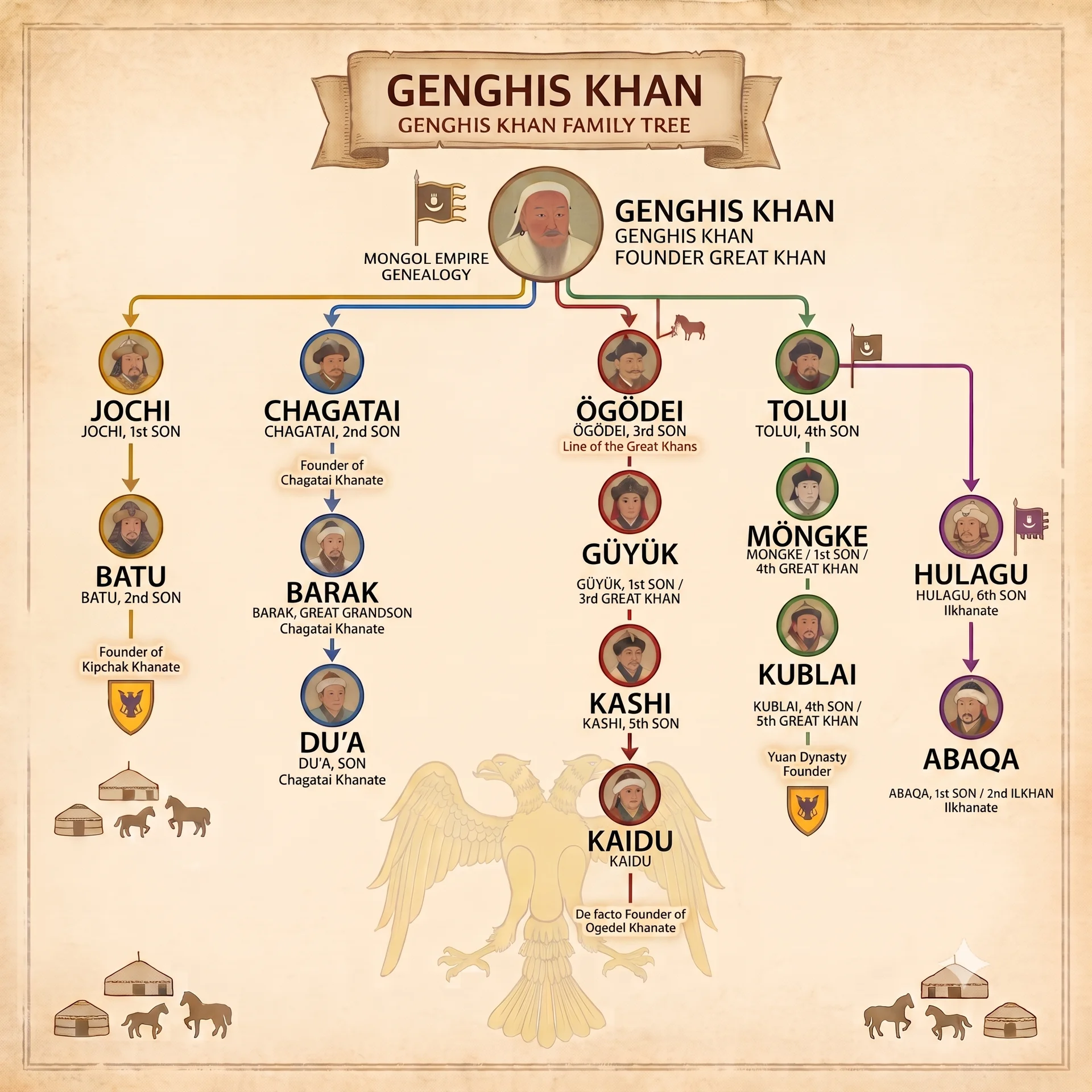
Family tree from Genghis Khan to the founders of the four Khanates.
Chronology
1259 AD
Death of Great Khan - Khagan is a title of imperial rank in the Turkic and Mongolian languages, equivalent to the status of Emperor. It translates to 'Khan of Khans' (King of Kings). Under Genghis Khan, it was stabilized as the title for the supreme ruler of the Mongol Empire. According to Mongolian legends, the Khagan was chosen by Tengri, the supreme sky god, and ruled by the authority of the 'Eternal Blue Sky' (Mönkh Khukh Tengri) as his representative on Earth. Möngke
Möngke spent months besieging the Song fortress of Diaoyucheng. Built on a hilltop with its own water and grain, it held out, and sickness spread through the Mongol camp in the summer heat. When Möngke died there in August 1259 the siege was lifted, and princes on every front abandoned their campaigns for the succession.
1260 AD
Two rival kurultai - A kurultai was the assembly Mongol and Turkic nomads held to settle great questions. Princes, tribal chiefs and leading commanders gathered in one place to choose the next Great Khan or to decide on war. Its most important task was the election itself. The Mongols had no rule that the eldest son must inherit, so a man became Great Khan only once the assembly had recognised him. The system had a weakness: the outcome depended on who gathered, and where. In 1260 Kublai and Ariq Böke held separate kurultais in different places and both were proclaimed Great Khan, which is where the division of the Mongol Empire began.s
In spring 1260 Kublai - A grandson of Genghis Khan who won the succession war against his brother, became Great Khan, and founded the Yuan dynasty that ruled all of China. returned from the Song front and held a kurultai - A kurultai was the assembly Mongol and Turkic nomads held to settle great questions. Princes, tribal chiefs and leading commanders gathered in one place to choose the next Great Khan or to decide on war. Its most important task was the election itself. The Mongols had no rule that the eldest son must inherit, so a man became Great Khan only once the assembly had recognised him. The system had a weakness: the outcome depended on who gathered, and where. In 1260 Kublai and Ariq Böke held separate kurultais in different places and both were proclaimed Great Khan, which is where the division of the Mongol Empire began. at his base of Kaiping, the first time a Great Khan was proclaimed outside the Mongol homeland. A month later Ariq Böke - Youngest son of Tolui and brother of Kublai, he held the capital Karakorum and contested the title of Great Khan. He stood for those who wanted to preserve the old ways of the steppe. held his own kurultai in the capital, Karakorum - Karakorum was the capital of the Mongol Empire, founded by Ögedei Khan on the Orkhon River in 1235, near present-day Kharkhorin in Mongolia. Standing in open grassland, it had to be fed by grain convoys from the farming lands to the south. That weakness decided a war: when Kublai cut the routes in 1261, Ariq Böke's hold on the capital collapsed without a decisive battle. It was also a city people reached from all over the world. Guillaume Boucher, a goldsmith taken captive in France, built a great silver tree in the palace whose pipes are said to have poured out wine and fermented mare's milk. Only ruins remain today, beside the Erdene Zuu Monastery built from its stones.. With two Great Khans, the empire split into two camps.
1261 AD
Battle of Shimultai and the Khingan clash
📍Shimultai and the Greater Khingan range (eastern Mongolia)
When Ariq Böke moved south in 1261 the two forces of cavalry met head-on at Shimultai. Kublai's army, stronger in men and supply, pushed him back into the deeper steppe. Ten days later they fought again near the Khingan mountains with no clear winner, showing that neither side could settle the matter in open combat.
Instead of seeking a decisive battle, Kublai chose to starve his brother out. Karakorum lay in open grassland and depended on grain convoys from the farming south, and Kublai now held every route. Through the winter, commanders and princes began deserting Ariq Böke.
1262 AD – 1263 AD
Battle of the Terek River
📍Terek River (present-day North Caucasus, Russia) (Map)
Hülegü - A Mongol ruler and commander who founded the Ilkhanate in Persia and led the historic Siege of Baghdad in 1258. Grandson of Genghis Khan, he expanded the empire into much of Western Asia, destroying the Abbasid Caliphate and the Assassin sect before his advance was halted by the Mamluks. forced the narrow pass at Derbent - A narrow coastal strip between the Caspian Sea and the Caucasus Mountains, it has historically served as a crucial military and commercial passage connecting the north and south. Its highly defensible terrain made it a natural 'gate' for the region. and pushed north, but in January 1263 Berke - The first Mongol ruler to accept Islam, he went to war against his own cousin Hülegü over the destruction of Baghdad.'s reinforcements trapped him at the Terek - The Terek River originates in the deep valleys of the Caucasus Mountains and flows for about 620 kilometers before emptying into the Caspian Sea. Because of its fast currents and strategic location, it has historically served as an important geographical boundary and natural defense line for traveling peoples and armies. In the winter of 1262–1263, during the fragmentation of the Mongol Empire, the armies of Hülegü and Berke fought a major battle along this river. According to historical accounts, as Hülegü's forces retreated across the frozen river, the ice broke beneath them, and countless soldiers and horses tragically drowned in the freezing water. Later in 1395, the river became the stage for the climactic Battle of the Terek River between Timur (Tamerlane) and Khan Tokhtamysh. Timur's crushing victory here opened the way for his army to sack and raze Sarai and the Volga trade cities, delivering a fatal blow to the Golden Horde.. As his men retreated across the frozen river the ice gave way and many drowned. Hülegü fell back to Azerbaijan, and the Caucasus - The Caucasus Mountains are a grand mountain range stretching between the Black Sea and the Caspian Sea, serving as a natural boundary dividing Asia and Europe. With many peaks towering over 5,000 meters, its rugged terrain was historically considered an impassable natural barrier for large armies. According to ancient Greek mythology, this is the legendary place where the Titan Prometheus was chained to a cold cliff as a punishment for stealing fire from the gods to give to humanity. He suffered there daily as an eagle ate his liver. It is also nicknamed the 'Mountain of Tongues' because its deep valleys isolated many different tribes, allowing them to preserve their own unique languages. Historically, these mountains acted as a formidable natural fortress. However, in 1222, the Mongol forces led by Jebe and Subutai accomplished the miraculous feat of crossing the snowy, rugged Caucasus Mountains. Their sudden emergence from the southern slopes shocked the Alans and Cumans living in the northern steppes. hardened into a border between two khanates.
With his supplies cut and his supporters gone, Ariq Böke came to Shangdu in 1264 and submitted to his brother. Kublai spared him but executed the men who had backed him. Ariq Böke died of illness two years later, ending the brothers' war over the title of Great Khan.
Truce / Interlude (5 years)
1269 AD
The Talas - A river that flows through modern-day Kyrgyzstan and Kazakhstan. It was the site of the historic Battle of Talas in 751 AD, where the Abbasid Caliphate defeated the Tang dynasty, marking the end of Tang expansion to the west and the beginning of the spread of Islam in Central Asia. kurultai
Kaidu - A grandson of Ögedei whose family had lost the throne, he fought Kublai and his successor in Central Asia for more than thirty years., Baraq - Ruler of the Chagatai Khanate who seized power and fought against both Kaidu and the Ilkhanate. of the Chagatai Khanate - The khanate that grew from the share given to Chagatai, second son of Genghis Khan, ruling the steppes and oasis cities of Central Asia. and envoys of the Golden Horde - The nomadic state Batu founded on the lower Volga, which collected tribute from the Rus principalities for some 250 years. met at Talas - A river that flows through modern-day Kyrgyzstan and Kazakhstan. It was the site of the historic Battle of Talas in 751 AD, where the Abbasid Caliphate defeated the Tang dynasty, marking the end of Tang expansion to the west and the beginning of the spread of Islam in Central Asia. and agreed how the pastures and cities of Central Asia would be shared. No representative of Great Khan Kublai attended. Baraq was told to make up his short share in Khorasan to the west, which soon set him against the Ilkhanate - The Mongol khanate Hülegü founded in Persia and the Middle East; its very name means a khan who obeys the Great Khan.. Dividing imperial land without the Great Khan's consent showed the empire had already broken into separate states.
Backed by the Talas agreement, Baraq of the Chagatai Khanate marched west and met Abaqa - The second Mongol ruler of the Ilkhanate, who successfully defended Persia against invasions from the Golden Horde and Chagatai Khanate., the second Ilkhan and son of Hülegü, near Herat in 1270. Abaqa used the classic Mongol trick of a feigned retreat, drawing the enemy in before wheeling around, and won a decisive victory. Devastated by the defeat, Baraq died the next year, leaving his realm leaderless. Kaidu seized this opportunity to install his own puppet khans, bringing the entire Chagatai Khanate firmly under his control.
Kaidu, together with Duwa—the son of Baraq whom Kaidu had installed as the new khan of the Chagatai Khanate—gathered a large force to seize the old capital of Karakorum. The Yuan - The Mongol-Chinese empire founded by Kublai Khan, the realm of the Great Khan that ruled all of China. army barred the approach, and the fighting swayed back and forth without either side breaking the other's line, at heavy cost to both. Duwa was wounded in the battle. Kaidu was also hurt around the same time and died soon after, and the long Central Asian resistance lost its driving force.
ResultNo decision
1304 AD – 1306 AD
Fall of the Ögedei Khanate and the 1304 Peace Treaty
After Kaidu's death, Duwa of the Chagatai Khanate allied with the Yuan dynasty and launched a surprise attack on his former overlords, absorbing most of the Ögedei Khanate's territory. In 1304, envoys from the four surviving realms—Yuan, Chagatai, Ilkhanate, and Golden Horde—met to sign a peace treaty, nominally acknowledging the Yuan emperor as the supreme Great Khan. Although it did not fully reunite the empire, the treaty brought an end to over four decades of civil war and established the Pax Mongolica, an era of unprecedented Eurasian exchange.
Art & Heritage
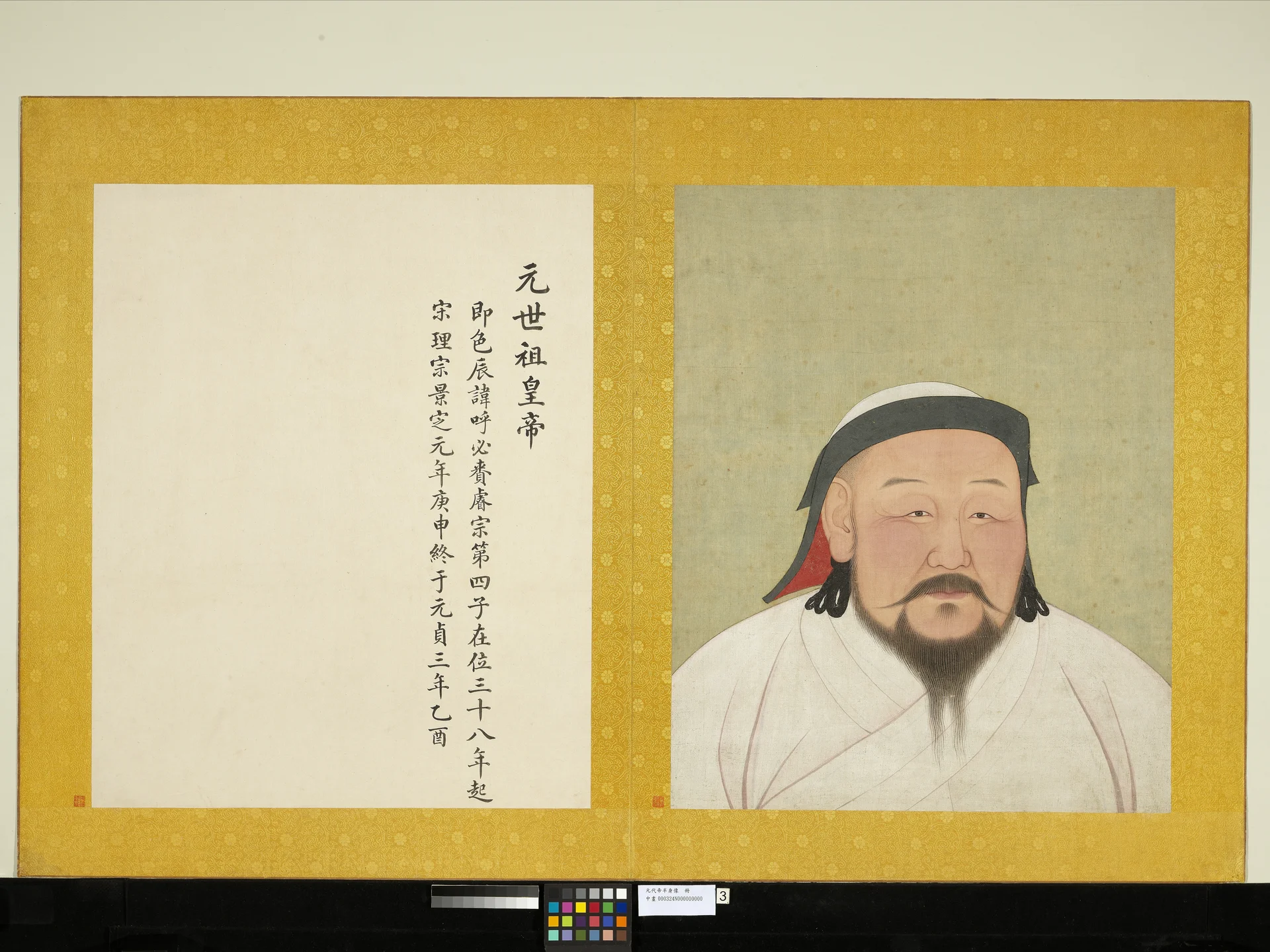
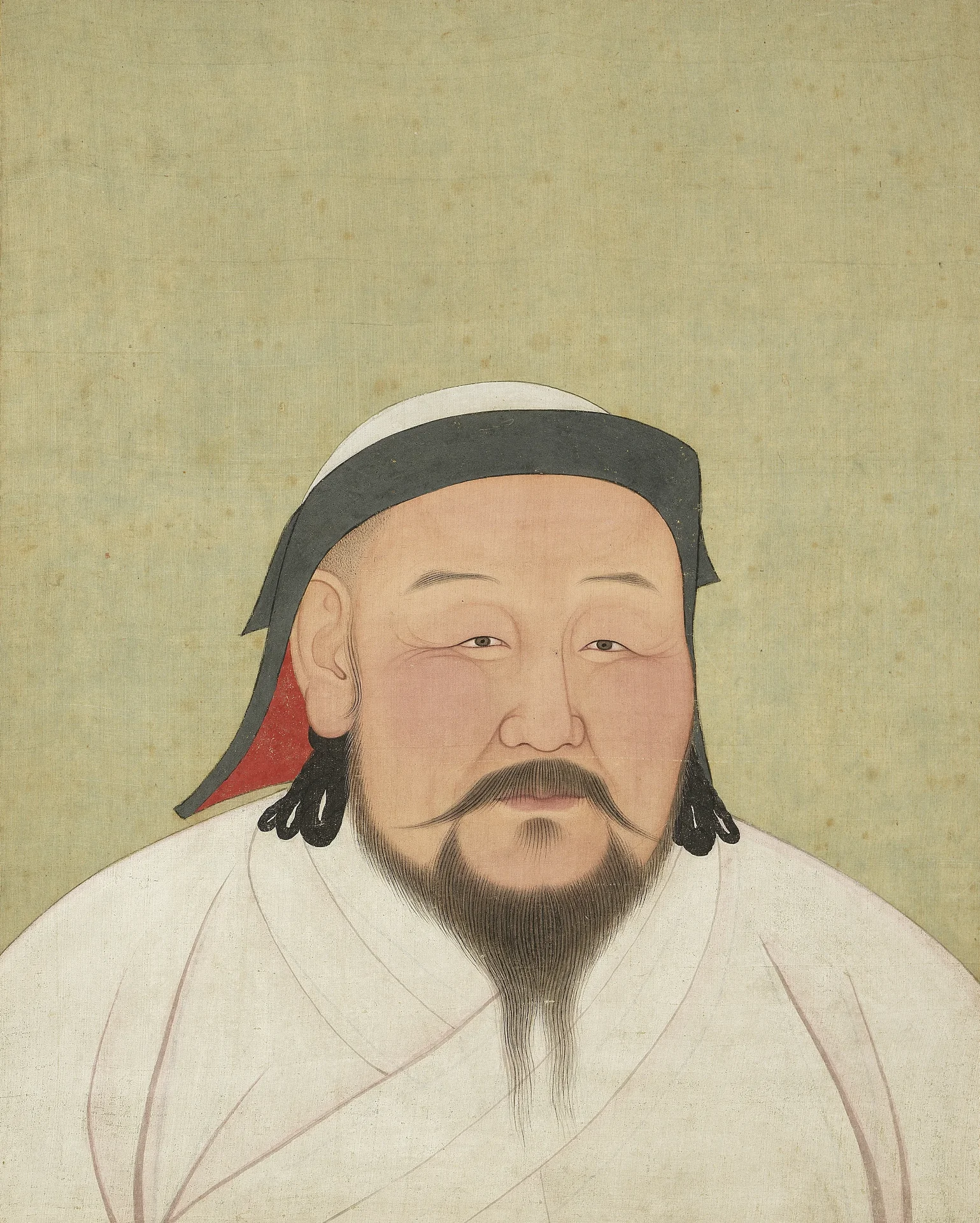
Portrait of Kublai Khan
Araniko (attributed), 13th century
🏛️ National Palace Museum, Taipei
An album portrait of the Great Khan who won the succession war and founded the Yuan. He is shown in the white robe of a Mongol ruler, in a painting made for a Chinese-style imperial gallery — the two halves of his rule in one picture.
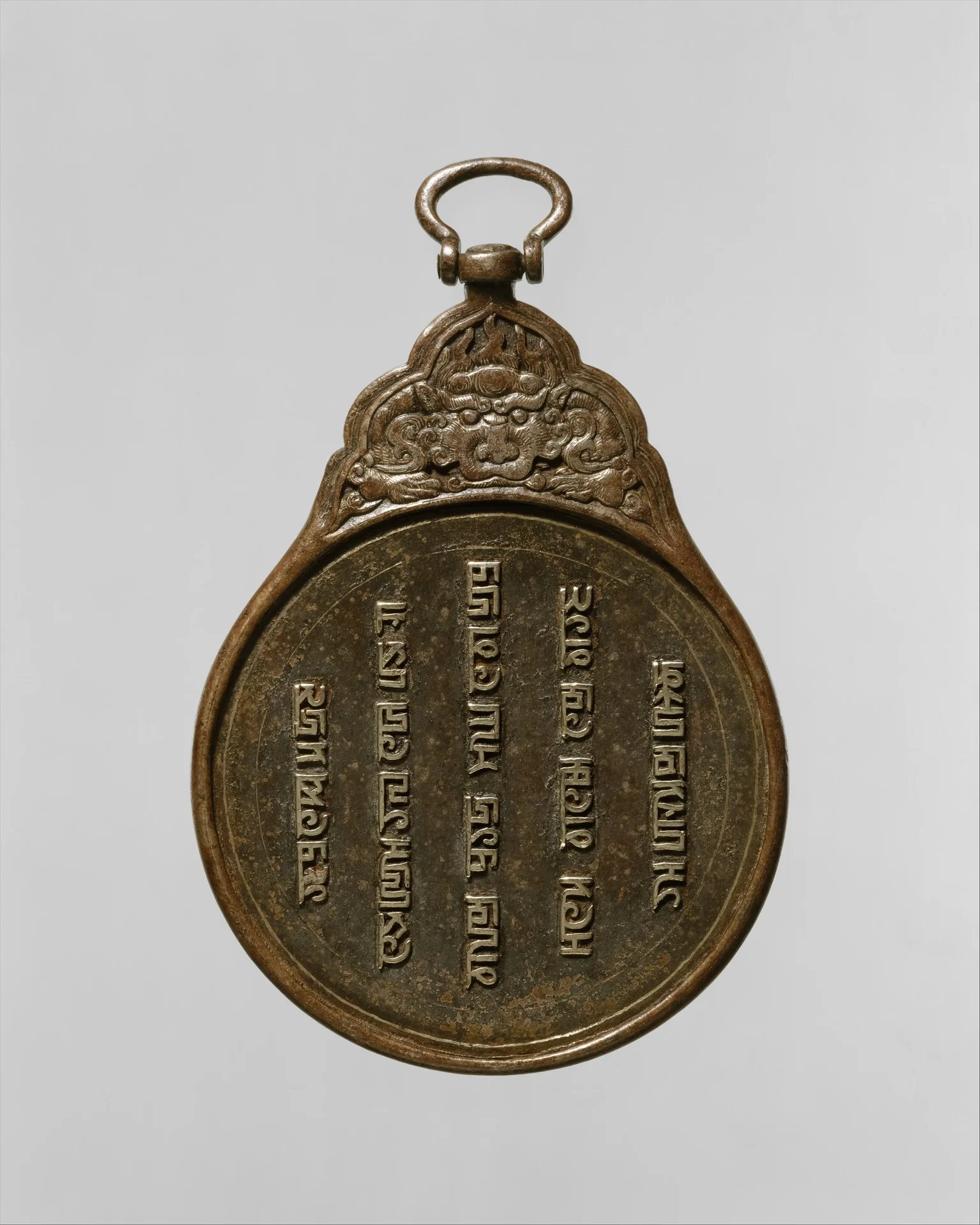
Paiza (Mongol passport tablet)
Mongol Empire artisans, 13th–14th century
🏛️ Metropolitan Museum of Art, New York
A metal tablet that let its bearer demand horses and food at relay stations across the empire. It is the physical form of the network that held the Mongol world together — and that the civil wars cut apart.
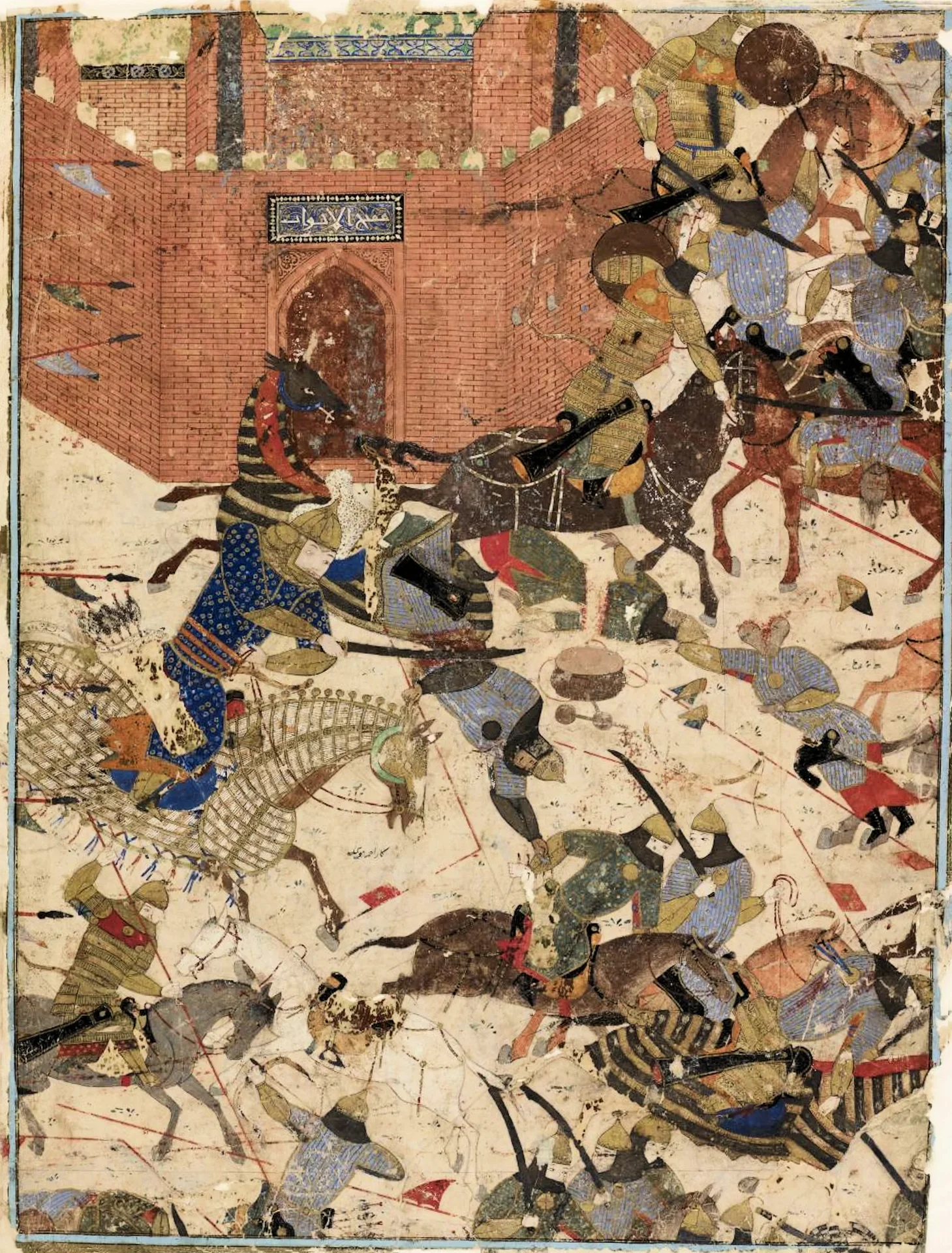
Horsemen tangle in front of a city gate, bows drawn at close range while the defenders watch from the wall. Both sides wear the same armour and ride the same kind of horse, which is exactly what a war between Mongol armies looked like.
Related Videos
How the Mongol Empire Fell - Medieval History DOCUMENTARY