Breakup of the Chagatai Khanate and the Rise of Timur
The Chagatai Khanate - The khanate that grew from the share given to Chagatai, second son of Genghis Khan, ruling the steppes and oasis cities of Central Asia. tore in two as its western half moved toward settled city life while its eastern half held to the steppe. In the west, tribal chiefs took real power from the khans, and out of their infighting rose Timur - Formidable Central Asian conqueror who unified the fragmented steppes and forged a colossal empire from Delhi to Anatolia, sparking the architectural and cultural glory of the Timurid Renaissance., who seized Samarkand - One of the oldest continuously inhabited cities in Central Asia and a vital hub on the Silk Road. It was captured by Qutayba ibn Muslim in 712 and became a major center for Islamic learning and commerce. in 1370 and opened the way to a new empire.
LocationCentral Asia (present-day Uzbekistan, southern Kazakhstan, Kyrgyzstan, Xinjiang in China)
BelligerentsTransoxiana - The land of Central Asia between the Amu Darya and the Syr Darya rivers. Mawarannahr is Arabic for 'what lies beyond the river', and the Greek and Roman name Transoxiana means the same thing. It covers today's Uzbekistan and Tajikistan along with southern Kazakhstan. Water drawn from the two rivers let oasis cities such as Samarkand and Bukhara grow in the middle of the desert, and they thrived as staging posts on the Silk Road. Because the taxes of those cities and the profits of their merchants were so large, the khanates that emerged from the divided Mongol Empire fought hard to control the region. The Talas kurultai of 1269 was, in the end, a meeting about how to share out its pastures and its taxes. Samarkand carries an old legend of its own. It is said to have been founded by Afrasiab, the king of Turan in the Persian epics, and the mound of the old city is still called Afrasiab today. (western Chagatai - The khanate that grew from the share given to Chagatai, second son of Genghis Khan, ruling the steppes and oasis cities of Central Asia.), Moghulistan - The nomadic realm formed across the northern and eastern steppes of the Tian Shan when the Chagatai Khanate split in the 14th century, also known as the Eastern Chagatai Khanate. In Persian, Moghulistan means 'Land of the Mongols.' While the western region of Transoxiana embraced settled urban life and Islamic administrative traditions around cities like Samarkand and Bukhara, the eastern tribes of Moghulistan tenaciously preserved the nomadic code (Yassa) and tent life of Genghis Khan. They looked down on the settled westerners as degenerate or soft, while western townspeople disparaged the Moghuls as savage raiders (Jete). Under Khan Tughlugh Timur, the realm adopted Islam and launched campaigns southward to briefly reunite the Chagatai lands. Although the west ultimately became the heart of the Timurid Empire, Moghulistan maintained its nomadic domain around the Tian Shan and the Tarim Basin for centuries. Babur, who later founded the Mughal Empire in India, was a descendant of the Moghulistan khans on his mother's side. (eastern Chagatai - The khanate that grew from the share given to Chagatai, second son of Genghis Khan, ruling the steppes and oasis cities of Central Asia.), Qazaghan - A powerful tribal chief who killed Qazan Khan in 1346 and ruled Transoxiana, establishing the system of puppet Genghisid khans controlled by military amirs. and the tribal amirs - Derived from the Arabic word meaning 'commander' or 'one who gives orders,' amir (or emir) is a high-ranking title in the Islamic world used for military commanders, governors, tribal chieftains, and regional princes. In the Mongol successor states such as the Chagatai Khanate, the title took on a distinctive political significance. According to steppe tradition, only direct patrilineal descendants of Genghis Khan (the Golden Family) were eligible to claim the supreme title of 'Khan.' Consequently, powerful tribal chieftains and warlords who held immense military and administrative power but lacked Genghisid lineage ruled using the title of 'Amir' while placing puppet Genghisid khans on the throne. Notable examples include Amir Qazaghan and Timur (Tamerlane). Although Timur built a vast empire spanning Central Asia and the Middle East and wielded absolute authority, he never claimed the title of Khan. Instead, he ruled as Amir and strengthened his legitimacy by marrying a Genghisid princess, adopting the honorific title of 'Gurgan' (son-in-law)., Timur - Formidable Central Asian conqueror who unified the fragmented steppes and forged a colossal empire from Delhi to Anatolia, sparking the architectural and cultural glory of the Timurid Renaissance.'s faction
💡 Historical Significance
The breakup of the Chagatai Khanate - The khanate that grew from the share given to Chagatai, second son of Genghis Khan, ruling the steppes and oasis cities of Central Asia. was a seismic geopolitical divergence driven by irreconcilable tensions between nomadic steppe traditionalists and settled, Islamic urban elites in Central Asia. While eastern Moghulistan - The nomadic realm formed across the northern and eastern steppes of the Tian Shan when the Chagatai Khanate split in the 14th century, also known as the Eastern Chagatai Khanate. In Persian, Moghulistan means 'Land of the Mongols.' While the western region of Transoxiana embraced settled urban life and Islamic administrative traditions around cities like Samarkand and Bukhara, the eastern tribes of Moghulistan tenaciously preserved the nomadic code (Yassa) and tent life of Genghis Khan. They looked down on the settled westerners as degenerate or soft, while western townspeople disparaged the Moghuls as savage raiders (Jete). Under Khan Tughlugh Timur, the realm adopted Islam and launched campaigns southward to briefly reunite the Chagatai lands. Although the west ultimately became the heart of the Timurid Empire, Moghulistan maintained its nomadic domain around the Tian Shan and the Tarim Basin for centuries. Babur, who later founded the Mughal Empire in India, was a descendant of the Moghulistan khans on his mother's side. tenaciously clung to nomadic pastoralism and the ancestral Yassa code of Genghis Khan, western Transoxiana - The land of Central Asia between the Amu Darya and the Syr Darya rivers. Mawarannahr is Arabic for 'what lies beyond the river', and the Greek and Roman name Transoxiana means the same thing. It covers today's Uzbekistan and Tajikistan along with southern Kazakhstan. Water drawn from the two rivers let oasis cities such as Samarkand and Bukhara grow in the middle of the desert, and they thrived as staging posts on the Silk Road. Because the taxes of those cities and the profits of their merchants were so large, the khanates that emerged from the divided Mongol Empire fought hard to control the region. The Talas kurultai of 1269 was, in the end, a meeting about how to share out its pastures and its taxes. Samarkand carries an old legend of its own. It is said to have been founded by Afrasiab, the king of Turan in the Persian epics, and the mound of the old city is still called Afrasiab today. developed an oligarchy of Turkic-Mongol emirs - Derived from the Arabic word meaning 'commander' or 'one who gives orders,' amir (or emir) is a high-ranking title in the Islamic world used for military commanders, governors, tribal chieftains, and regional princes. In the Mongol successor states such as the Chagatai Khanate, the title took on a distinctive political significance. According to steppe tradition, only direct patrilineal descendants of Genghis Khan (the Golden Family) were eligible to claim the supreme title of 'Khan.' Consequently, powerful tribal chieftains and warlords who held immense military and administrative power but lacked Genghisid lineage ruled using the title of 'Amir' while placing puppet Genghisid khans on the throne. Notable examples include Amir Qazaghan and Timur (Tamerlane). Although Timur built a vast empire spanning Central Asia and the Middle East and wielded absolute authority, he never claimed the title of Khan. Instead, he ruled as Amir and strengthened his legitimacy by marrying a Genghisid princess, adopting the honorific title of 'Gurgan' (son-in-law). centered in urban hubs like Samarkand - One of the oldest continuously inhabited cities in Central Asia and a vital hub on the Silk Road. It was captured by Qutayba ibn Muslim in 712 and became a major center for Islamic learning and commerce. and Bukhara - A historic city in modern-day Uzbekistan that long served as a center of trade, scholarship, and culture on the Silk Road. It was added to the Umayyad Caliphate in 709 during the conquests of Qutayba ibn Muslim., ruling behind figurehead Chinggisid puppet khans. Decades of violent civil war and border raids eroded central authority, creating a fertile power vacuum. Out of this tumultuous fragmentation emerged Timur - Formidable Central Asian conqueror who unified the fragmented steppes and forged a colossal empire from Delhi to Anatolia, sparking the architectural and cultural glory of the Timurid Renaissance. (Tamerlane), a Barlas tribal chieftain who unified Transoxiana, dismantled rival emirates, and established the Timurid Renaissance across Eurasia.
Context & Background
14th century
City or steppe
This split was not merely a fight over power but a choice about how to live. The west wanted to run the state on urban taxes and trade; the east kept to herds and pasture. Easterners mocked the westerners as no longer proper Mongols, and westerners thought the easterners crude.
14th century
The bloodline as a qualification
Holding power did not make one khan. So Qazaghan - A powerful tribal chief who killed Qazan Khan in 1346 and ruled Transoxiana, establishing the system of puppet Genghisid khans controlled by military amirs. and Timur - Formidable Central Asian conqueror who unified the fragmented steppes and forged a colossal empire from Delhi to Anatolia, sparking the architectural and cultural glory of the Timurid Renaissance. alike seated a Genghisid on the throne and used the title amir - Derived from the Arabic word meaning 'commander' or 'one who gives orders,' amir (or emir) is a high-ranking title in the Islamic world used for military commanders, governors, tribal chieftains, and regional princes. In the Mongol successor states such as the Chagatai Khanate, the title took on a distinctive political significance. According to steppe tradition, only direct patrilineal descendants of Genghis Khan (the Golden Family) were eligible to claim the supreme title of 'Khan.' Consequently, powerful tribal chieftains and warlords who held immense military and administrative power but lacked Genghisid lineage ruled using the title of 'Amir' while placing puppet Genghisid khans on the throne. Notable examples include Amir Qazaghan and Timur (Tamerlane). Although Timur built a vast empire spanning Central Asia and the Middle East and wielded absolute authority, he never claimed the title of Khan. Instead, he ruled as Amir and strengthened his legitimacy by marrying a Genghisid princess, adopting the honorific title of 'Gurgan' (son-in-law). for themselves. Timur went further, marrying a princess of Genghis Khan's house so he could add gurgan, 'son-in-law', to his name.
Later 14th century
Everything turns on Samarkand
The wars of this period in Central Asia came down to who held Samarkand - One of the oldest continuously inhabited cities in Central Asia and a vital hub on the Silk Road. It was captured by Qutayba ibn Muslim in 712 and became a major center for Islamic learning and commerce. and Bukhara - A historic city in modern-day Uzbekistan that long served as a center of trade, scholarship, and culture on the Silk Road. It was added to the Umayyad Caliphate in 709 during the conquests of Qutayba ibn Muslim.. Those cities concentrated taxes, artisans and merchants, and even a steppe army could not last long without them. That is why Timur made Samarkand his capital.
The Narrative
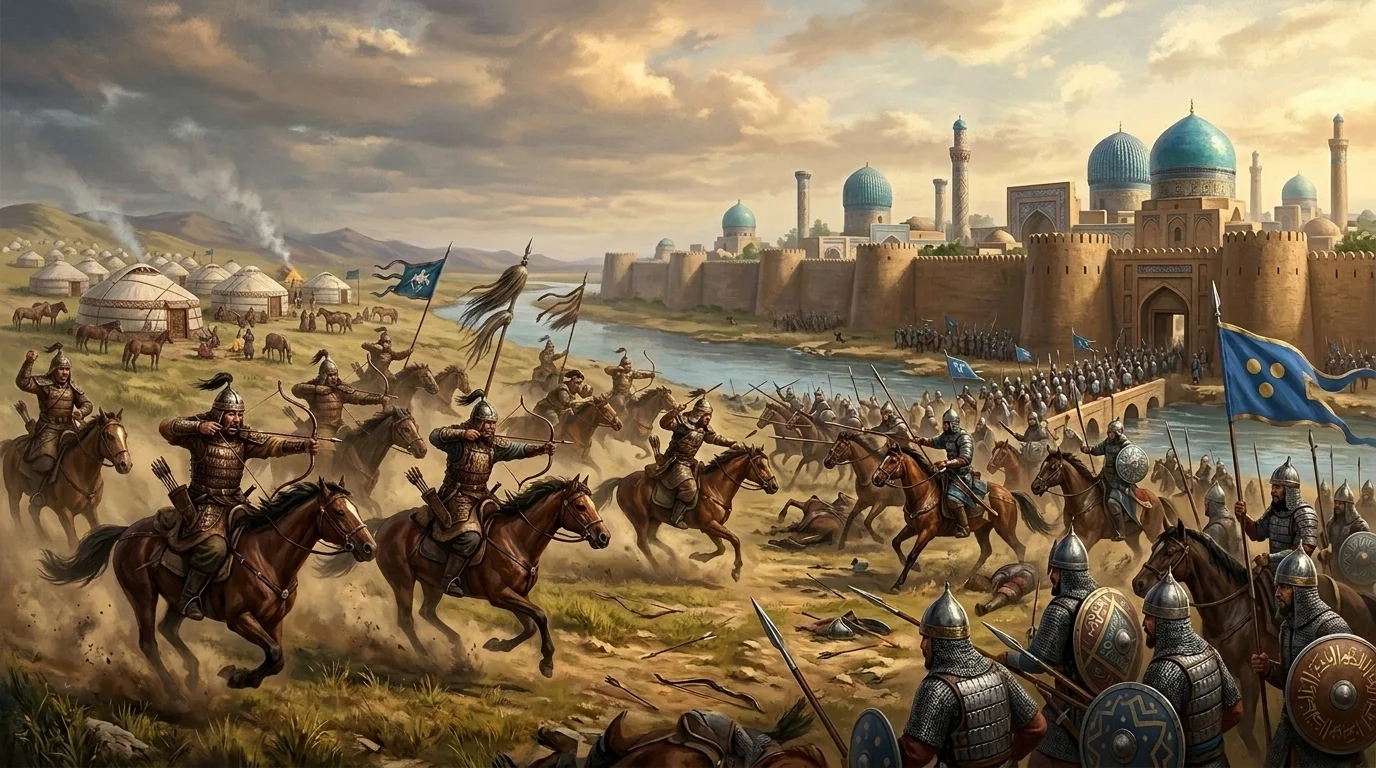
The Chagatai Khanate - The khanate that grew from the share given to Chagatai, second son of Genghis Khan, ruling the steppes and oasis cities of Central Asia. straddled the middle of the Silk Road - The Silk Road was a very long network of trade routes that connected the East and the West in ancient times. It got its name, which means 'route of silk,' because expensive and beautiful Chinese silk was traded along these paths starting from the Han Dynasty. Merchants traveled on camels across deserts and mountains, exchanging not only goods like spices and jewels, but also sharing different religions, new technologies, and interesting stories. Later, massive empires like the Tang Dynasty and the Mongol Empire gained incredible wealth and power by protecting and managing these important routes.. In the west, Transoxiana - The land of Central Asia between the Amu Darya and the Syr Darya rivers. Mawarannahr is Arabic for 'what lies beyond the river', and the Greek and Roman name Transoxiana means the same thing. It covers today's Uzbekistan and Tajikistan along with southern Kazakhstan. Water drawn from the two rivers let oasis cities such as Samarkand and Bukhara grow in the middle of the desert, and they thrived as staging posts on the Silk Road. Because the taxes of those cities and the profits of their merchants were so large, the khanates that emerged from the divided Mongol Empire fought hard to control the region. The Talas kurultai of 1269 was, in the end, a meeting about how to share out its pastures and its taxes. Samarkand carries an old legend of its own. It is said to have been founded by Afrasiab, the king of Turan in the Persian epics, and the mound of the old city is still called Afrasiab today. held wealthy cities like Samarkand - One of the oldest continuously inhabited cities in Central Asia and a vital hub on the Silk Road. It was captured by Qutayba ibn Muslim in 712 and became a major center for Islamic learning and commerce. and Bukhara - A historic city in modern-day Uzbekistan that long served as a center of trade, scholarship, and culture on the Silk Road. It was added to the Umayyad Caliphate in 709 during the conquests of Qutayba ibn Muslim.; in the east lay wide pasture along the Tian Shan - A massive mountain range stretching over 2,500 kilometers across Central Asia and Xinjiang. Towering peaks crowned with glaciers—including Jengish Chokusu (7,439 m) and Khan Tengri (7,010 m)—form a colossal natural wall dividing the northern Eurasian steppes from the arid Tarim Basin and Taklamakan Desert to the south. The name Tian Shan translates to the 'Heavenly Mountains.' Ancient Turkic and Mongol nomads revered these imposing heights as the sacred dwelling of Tengri, the sky god, calling them 'Tengri Tagh.' In ancient Chinese mythology, including lore from the Shan Hai Jing, the jade pool (Yaochi) of the Queen Mother of the West (Xi Wangmu), keeper of the peaches of immortality, was believed to lie high in these mountains at Lake Tianchi. Historically, the fertile river valleys along the northern slopes, particularly the Ili River basin around Almaliq, provided lush seasonal pastures for nomadic confederations and formed vital conduits along the northern Silk Road. When the Chagatai Khanate split in the 14th century, the eastern nomads who rejected settled urban life retreated into the Tian Shan region to establish Moghulistan.. Containing two such different worlds was what defined the khanate, and in the 14th century the two stopped tolerating each other.
The break came when khans began living in cities. Kebek built a palace and settled; Tarmashirin accepted Islam. The eastern tribes saw this as abandoning the Mongol way and drove Tarmashirin out in 1334. Over the next decade, a succession of short-lived khans followed in rapid turmoil. Qazan Khan then took the throne and attempted to rein in the tribal chieftains, but in 1346 the amir Qazaghan - A powerful tribal chief who killed Qazan Khan in 1346 and ruled Transoxiana, establishing the system of puppet Genghisid khans controlled by military amirs. rose in revolt and defeated him. From that point on, the khans in the west became mere figureheads, while the tribal amirs - Derived from the Arabic word meaning 'commander' or 'one who gives orders,' amir (or emir) is a high-ranking title in the Islamic world used for military commanders, governors, tribal chieftains, and regional princes. In the Mongol successor states such as the Chagatai Khanate, the title took on a distinctive political significance. According to steppe tradition, only direct patrilineal descendants of Genghis Khan (the Golden Family) were eligible to claim the supreme title of 'Khan.' Consequently, powerful tribal chieftains and warlords who held immense military and administrative power but lacked Genghisid lineage ruled using the title of 'Amir' while placing puppet Genghisid khans on the throne. Notable examples include Amir Qazaghan and Timur (Tamerlane). Although Timur built a vast empire spanning Central Asia and the Middle East and wielded absolute authority, he never claimed the title of Khan. Instead, he ruled as Amir and strengthened his legitimacy by marrying a Genghisid princess, adopting the honorific title of 'Gurgan' (son-in-law). held true power. Through the 1340s the khanate separated completely into western Transoxiana and eastern Moghulistan - The nomadic realm formed across the northern and eastern steppes of the Tian Shan when the Chagatai Khanate split in the 14th century, also known as the Eastern Chagatai Khanate. In Persian, Moghulistan means 'Land of the Mongols.' While the western region of Transoxiana embraced settled urban life and Islamic administrative traditions around cities like Samarkand and Bukhara, the eastern tribes of Moghulistan tenaciously preserved the nomadic code (Yassa) and tent life of Genghis Khan. They looked down on the settled westerners as degenerate or soft, while western townspeople disparaged the Moghuls as savage raiders (Jete). Under Khan Tughlugh Timur, the realm adopted Islam and launched campaigns southward to briefly reunite the Chagatai lands. Although the west ultimately became the heart of the Timurid Empire, Moghulistan maintained its nomadic domain around the Tian Shan and the Tarim Basin for centuries. Babur, who later founded the Mughal Empire in India, was a descendant of the Moghulistan khans on his mother's side..
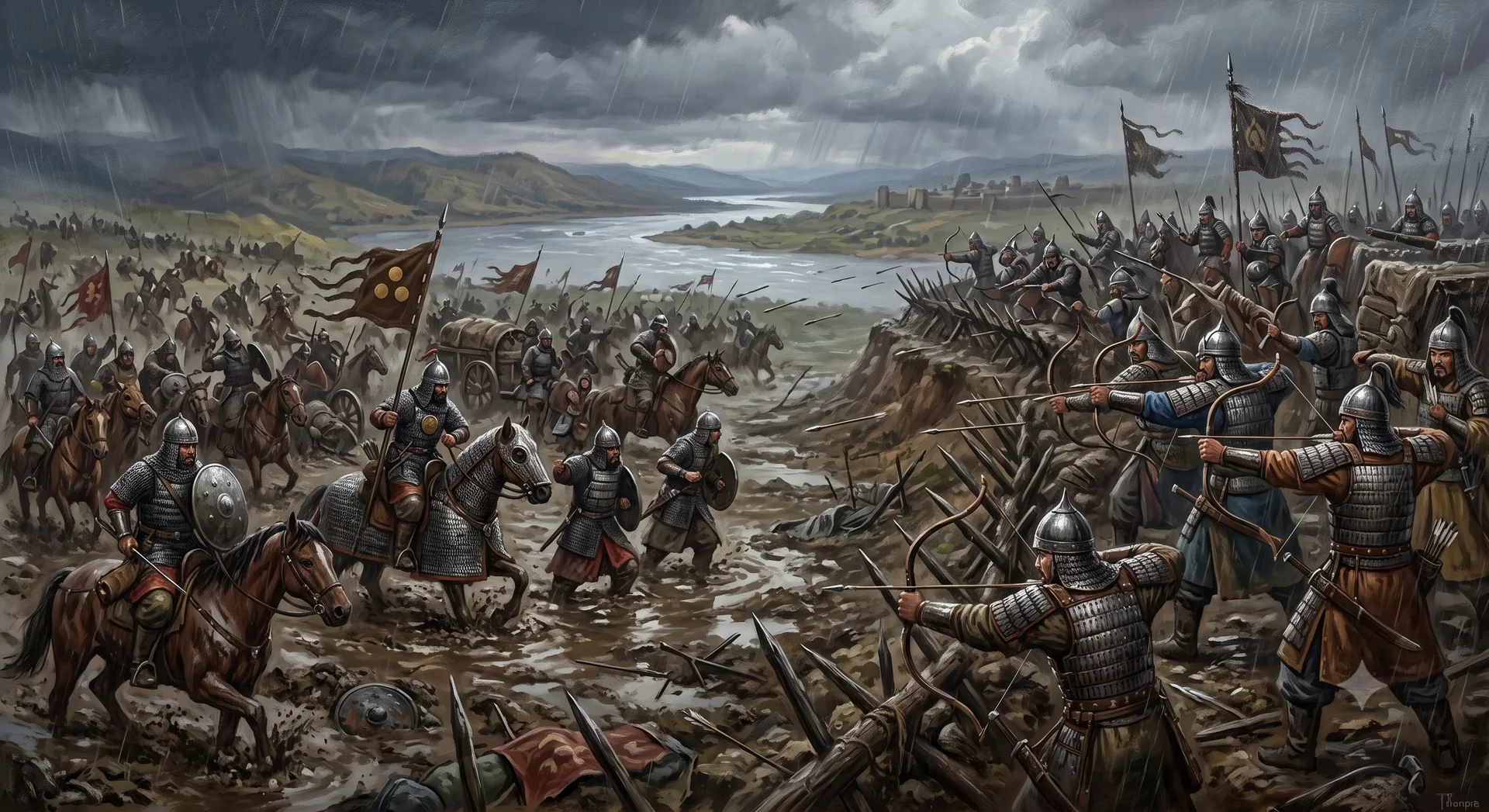
In 1360 Tughlugh Timur - Khan of eastern Moghulistan and a convert to Islam, he invaded the west twice with the stated aim of reuniting the divided khanate. of Moghulistan crossed the Syr Darya - Originating in the glacial meltwaters of the Tian Shan Mountains, the Syr Darya is a major river of Central Asia flowing some 2,200 kilometers through the fertile Fergana Valley and into the Aral Sea basin. Together with the Amu Darya to the south, it defines the historic region of Transoxiana (Mawarannahr), the heartland of Central Asian civilization. In classical antiquity, the Greeks and Romans knew this river as the Jaxartes. When Alexander the Great reached its banks in the 4th century BC, he fought off northern Scythian nomads and founded Alexandria Eschate ('Alexandria the Furthest', present-day Khujand) as the northernmost frontier garrison of his vast empire. Throughout history, the waters of the Syr Darya sustained vital agricultural oases and thriving trade hubs amidst the surrounding deserts. Control over its strategic crossings and fortress cities was bitterly contested during the era of the Chagatai Khanate and the rise of the Timurid Empire., declaring he would reunite the khanate. A young chieftain named Timur - Formidable Central Asian conqueror who unified the fragmented steppes and forged a colossal empire from Delhi to Anatolia, sparking the architectural and cultural glory of the Timurid Renaissance. initially cooperated with the invaders and was confirmed in the governorship of his homeland, Kesh. Tughlugh Timur installed his son Ilyas Khoja as ruler of the west and returned to the steppe, but Ilyas Khoja's harsh rule provoked widespread resentment. Timur soon broke with him, joining his brother-in-law Amir Husayn - Grandson of the strongman Qazaghan and once Timur's ally and brother-in-law, he was defeated and killed by Timur at Balkh in 1370. to wage a protracted guerrilla resistance from the hills and deserts. When Tughlugh Timur died in 1363, Timur and Husayn drove Ilyas Khoja out of Transoxiana. After returning to Moghulistan and taking the throne as khan, Ilyas Khoja launched a massive invasion in 1365 to reconquer the west. Timur and Husayn met him at the Battle of the Mire but suffered a catastrophic defeat. The Moghuls had anticipated the downpour, protecting their bows and bodies with greased leather and thick felt - A dense, non-woven textile produced by matting, condensing, and pressing animal fibers—especially wool—together using moisture, heat, and mechanical pressure. For Central Asian nomadic peoples, felt was an indispensable material for both daily survival and warfare. It was used to cover portable tents (yurts or gers) against harsh steppe winds and freezing cold, as well as to make warm heavy cloaks, boots, hats, and protective saddle blankets. Thick, naturally greasy or oiled wool felt provided exceptional insulation and water resistance. During the Battle of the Mire in 1365, Moghulistan warriors preserved their combat readiness by wrapping themselves and their delicate composite bows in thick felt and greased leather, preventing their bows' water-soluble animal glue from dissolving in the torrential rain., whereas the unprepared coalition troops saw the animal glue in their composite bows dissolve in the rain and were weighed down by soaked armor. Compounding the disaster, Husayn refused to reinforce Timur's advancing right wing, resulting in the coalition being defeated in detail with over 10,000 casualties.
The Battle of the Mire (1365): The allied forces of Timur and Husayn suffering defeat against the Moghul army amidst torrential rain and mud.
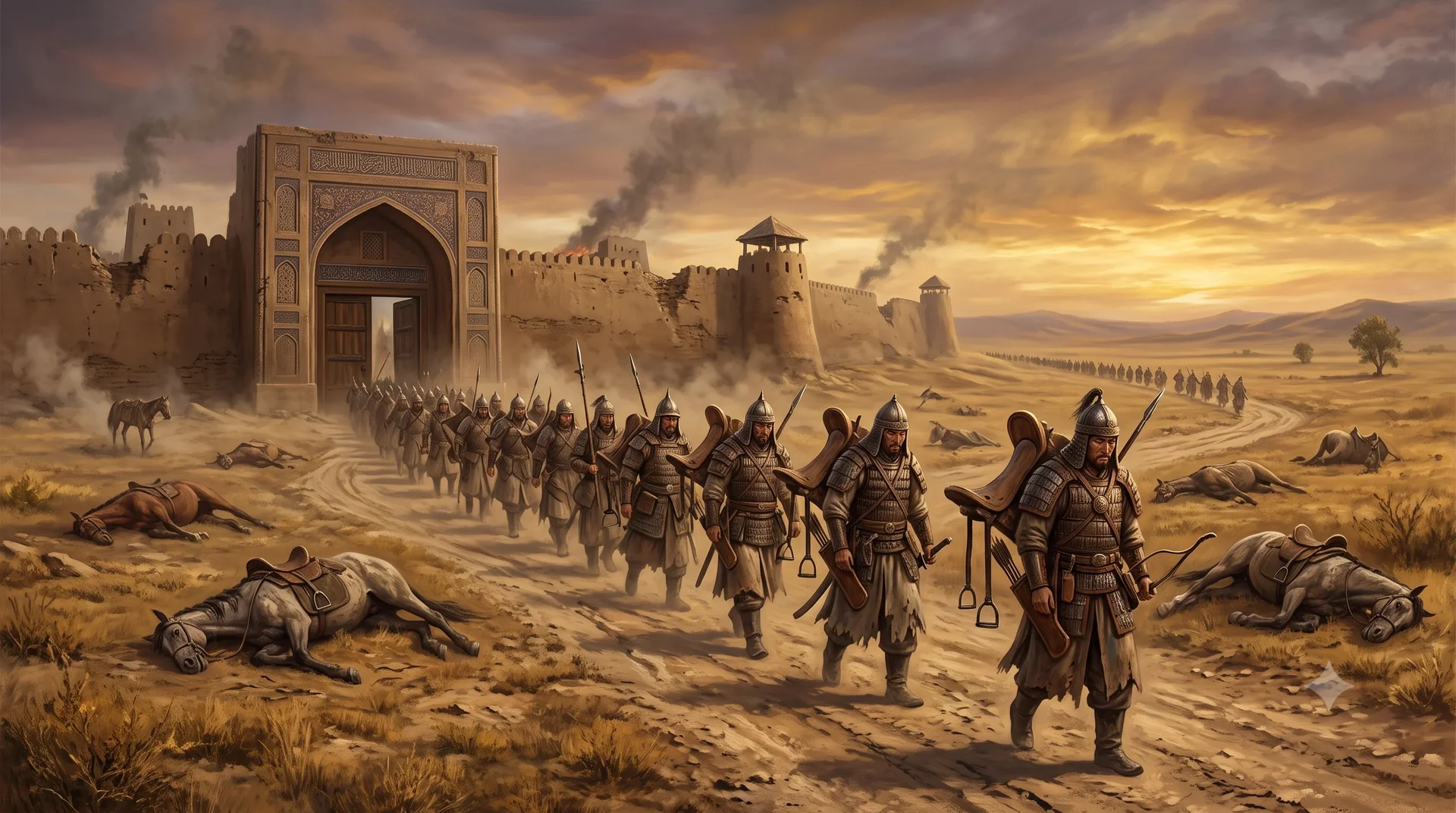
Yet when Ilyas Khoja's victorious army laid siege to Samarkand, townspeople known as sarbadars took up arms, barricaded the narrow lanes and held the walls. When a devastating equine epidemic - A collective term for lethal contagious diseases affecting horses and other equines, most notably glanders—a severe bacterial infection caused by *Burkholderia mallei*. Infected horses suffer from high fever, severe ulcers and discharge in the respiratory tract, and rapid asphyxiation, often dying within days. Highly contagious, it spread like wildfire through dense military encampments, horse lines, and supply trains, decimating entire herds of warhorses in a matter of weeks. For medieval cavalry and nomadic steppe armies whose supreme advantage lay in equestrian mobility, equine epidemics were far deadlier than enemy weapons. Losing their mounts stripped horsemen of their combat effectiveness and left them stranded. A famous instance occurred during the 1365 siege of Samarkand, where an outbreak of glanders killed over three-quarters of the Moghul cavalry horses, forcing the besieging army to pack their saddles on their own backs and march on foot back to the steppe. (glanders / horse plague) swept through the Moghul camp and killed three-quarters of their horses, the stranded khan was forced to lift the siege and retreat permanently to the eastern steppe.
The Siege of Samarkand (1365): The Sarbadar citizens defending the city behind street barricades against the invading Moghul army.
With the Moghuls gone, Transoxiana fell to the two allies, but they soon divided the realm into separate spheres of power. Husayn established his base south of the Amu Darya - The Amu Darya River (ancient Oxus) is one of Central Asia's major rivers. Flowing west and northwest toward the Aral basin, it has long marked strategic corridors and frontier zones for steppe and settled powers. at Balkh - An ancient city in northern Afghanistan, known in antiquity as Bactra. Located at a vital crossroads of the Silk Road, it was historically known as the 'Mother of Cities' (Umm al-Bilaad). It served as the capital of ancient Bactria and flourished as a major center for Zoroastrianism, Buddhism, and Islamic scholarship. According to legend, Zoroaster first preached here. In 1370, Balkh was the site of the pivotal siege where Timur defeated his rival Amir Husayn to consolidate supreme power. and Kunduz, setting up a puppet khan and levying crushing taxes on cities to finance grand stone fortifications. Timur, operating from his native Kesh and Samarkand, cultivated the loyalty of merchants, scholars, and local chieftains by relieving their tax burdens. The rivalry between the two amirs erupted into years of maneuvering and skirmishes across the realm. Finally in 1370, backed by tribal chiefs alienated by Husayn's harsh rule, Timur led a massive army across the Amu Darya to besiege Husayn's stronghold at Balkh. When Husayn's own commanders opened the gates and defected, Husayn was captured and put to death. Lacking Genghisid blood, Timur took the title of amir rather than khan, but supreme power was undisputed. From his capital at Samarkand he founded a vast new empire, while eastern Moghulistan endured on the steppe for generations.
The eastern tribes turned against Tarmashirin for accepting Islam and staying among the cities. They raised an army on the steppe and rode south, and the city-based khan could not gather troops in time to face nomad cavalry. Tarmashirin was caught in flight and killed.
Qazan Khan set out to break the power of the tribal chiefs, and the amir Qazaghan - A powerful tribal chief who killed Qazan Khan in 1346 and ruled Transoxiana, establishing the system of puppet Genghisid khans controlled by military amirs. took up arms against him. Beaten in the first encounter, Qazaghan withdrew, rebuilt his forces and attacked again, killing the khan. From then on the west was ruled by amirs - Derived from the Arabic word meaning 'commander' or 'one who gives orders,' amir (or emir) is a high-ranking title in the Islamic world used for military commanders, governors, tribal chieftains, and regional princes. In the Mongol successor states such as the Chagatai Khanate, the title took on a distinctive political significance. According to steppe tradition, only direct patrilineal descendants of Genghis Khan (the Golden Family) were eligible to claim the supreme title of 'Khan.' Consequently, powerful tribal chieftains and warlords who held immense military and administrative power but lacked Genghisid lineage ruled using the title of 'Amir' while placing puppet Genghisid khans on the throne. Notable examples include Amir Qazaghan and Timur (Tamerlane). Although Timur built a vast empire spanning Central Asia and the Middle East and wielded absolute authority, he never claimed the title of Khan. Instead, he ruled as Amir and strengthened his legitimacy by marrying a Genghisid princess, adopting the honorific title of 'Gurgan' (son-in-law). behind puppet khans.
As the khan's authority collapsed the realm separated into two worlds. Western Transoxiana - The land of Central Asia between the Amu Darya and the Syr Darya rivers. Mawarannahr is Arabic for 'what lies beyond the river', and the Greek and Roman name Transoxiana means the same thing. It covers today's Uzbekistan and Tajikistan along with southern Kazakhstan. Water drawn from the two rivers let oasis cities such as Samarkand and Bukhara grow in the middle of the desert, and they thrived as staging posts on the Silk Road. Because the taxes of those cities and the profits of their merchants were so large, the khanates that emerged from the divided Mongol Empire fought hard to control the region. The Talas kurultai of 1269 was, in the end, a meeting about how to share out its pastures and its taxes. Samarkand carries an old legend of its own. It is said to have been founded by Afrasiab, the king of Turan in the Persian epics, and the mound of the old city is still called Afrasiab today. lived by its cities and trade, while the eastern Tian Shan - A massive mountain range stretching over 2,500 kilometers across Central Asia and Xinjiang. Towering peaks crowned with glaciers—including Jengish Chokusu (7,439 m) and Khan Tengri (7,010 m)—form a colossal natural wall dividing the northern Eurasian steppes from the arid Tarim Basin and Taklamakan Desert to the south. The name Tian Shan translates to the 'Heavenly Mountains.' Ancient Turkic and Mongol nomads revered these imposing heights as the sacred dwelling of Tengri, the sky god, calling them 'Tengri Tagh.' In ancient Chinese mythology, including lore from the Shan Hai Jing, the jade pool (Yaochi) of the Queen Mother of the West (Xi Wangmu), keeper of the peaches of immortality, was believed to lie high in these mountains at Lake Tianchi. Historically, the fertile river valleys along the northern slopes, particularly the Ili River basin around Almaliq, provided lush seasonal pastures for nomadic confederations and formed vital conduits along the northern Silk Road. When the Chagatai Khanate split in the 14th century, the eastern nomads who rejected settled urban life retreated into the Tian Shan region to establish Moghulistan. country, called Moghulistan - The nomadic realm formed across the northern and eastern steppes of the Tian Shan when the Chagatai Khanate split in the 14th century, also known as the Eastern Chagatai Khanate. In Persian, Moghulistan means 'Land of the Mongols.' While the western region of Transoxiana embraced settled urban life and Islamic administrative traditions around cities like Samarkand and Bukhara, the eastern tribes of Moghulistan tenaciously preserved the nomadic code (Yassa) and tent life of Genghis Khan. They looked down on the settled westerners as degenerate or soft, while western townspeople disparaged the Moghuls as savage raiders (Jete). Under Khan Tughlugh Timur, the realm adopted Islam and launched campaigns southward to briefly reunite the Chagatai lands. Although the west ultimately became the heart of the Timurid Empire, Moghulistan maintained its nomadic domain around the Tian Shan and the Tarim Basin for centuries. Babur, who later founded the Mughal Empire in India, was a descendant of the Moghulistan khans on his mother's side., kept to herding. From this point each treated the other as a foreign state.
Truce / Interlude (10 years)
1360 AD – 1363 AD
Tughlugh Timur's Western Campaigns and the Expulsion of Ilyas Khoja
Tughlugh Timur - Khan of eastern Moghulistan and a convert to Islam, he invaded the west twice with the stated aim of reuniting the divided khanate. of Moghulistan came south twice, took Transoxiana and left his son Ilyas Khoja to govern it. Oppressive rule sparked widespread guerrilla resistance led by Timur - Formidable Central Asian conqueror who unified the fragmented steppes and forged a colossal empire from Delhi to Anatolia, sparking the architectural and cultural glory of the Timurid Renaissance. and Husayn - Grandson of the strongman Qazaghan and once Timur's ally and brother-in-law, he was defeated and killed by Timur at Balkh in 1370., who successfully expelled Ilyas Khoja upon Tughlugh Timur's death in 1363.
ResultMoghul occupation followed by expulsion by Timur and Husayn
1365 AD
Battle of the Mire
📍Near the Chirchiq River (present-day Tashkent region, Uzbekistan) (Map)
Timur and Husayn moved to block Ilyas Khoja's army. The Moghuls had prepared for the rain, protecting their bows and body warmth with greased leather and felt - A dense, non-woven textile produced by matting, condensing, and pressing animal fibers—especially wool—together using moisture, heat, and mechanical pressure. For Central Asian nomadic peoples, felt was an indispensable material for both daily survival and warfare. It was used to cover portable tents (yurts or gers) against harsh steppe winds and freezing cold, as well as to make warm heavy cloaks, boots, hats, and protective saddle blankets. Thick, naturally greasy or oiled wool felt provided exceptional insulation and water resistance. During the Battle of the Mire in 1365, Moghulistan warriors preserved their combat readiness by wrapping themselves and their delicate composite bows in thick felt and greased leather, preventing their bows' water-soluble animal glue from dissolving in the torrential rain., whereas the unprepared coalition troops were incapacitated as rain dissolved the glue in their composite bows. Compounding this, Husayn refused to support Timur's wing, resulting in over 10,000 casualties and a catastrophic defeat.
With no garrison and no ruler, students and artisans of Samarkand - One of the oldest continuously inhabited cities in Central Asia and a vital hub on the Silk Road. It was captured by Qutayba ibn Muslim in 712 and became a major center for Islamic learning and commerce. armed themselves. They barricaded the mouths of the narrow lanes and shot from the rooftops, denying the cavalry any charge. When a lethal equine epidemic - A collective term for lethal contagious diseases affecting horses and other equines, most notably glanders—a severe bacterial infection caused by *Burkholderia mallei*. Infected horses suffer from high fever, severe ulcers and discharge in the respiratory tract, and rapid asphyxiation, often dying within days. Highly contagious, it spread like wildfire through dense military encampments, horse lines, and supply trains, decimating entire herds of warhorses in a matter of weeks. For medieval cavalry and nomadic steppe armies whose supreme advantage lay in equestrian mobility, equine epidemics were far deadlier than enemy weapons. Losing their mounts stripped horsemen of their combat effectiveness and left them stranded. A famous instance occurred during the 1365 siege of Samarkand, where an outbreak of glanders killed over three-quarters of the Moghul cavalry horses, forcing the besieging army to pack their saddles on their own backs and march on foot back to the steppe. (glanders / horse plague) then swept through the Moghul mounts, decimating their cavalry, the besiegers lifted the siege and left.
Husayn, who had lost support through heavy taxation, fell back on the walls of Balkh - An ancient city in northern Afghanistan, known in antiquity as Bactra. Located at a vital crossroads of the Silk Road, it was historically known as the 'Mother of Cities' (Umm al-Bilaad). It served as the capital of ancient Bactria and flourished as a major center for Zoroastrianism, Buddhism, and Islamic scholarship. According to legend, Zoroaster first preached here. In 1370, Balkh was the site of the pivotal siege where Timur defeated his rival Amir Husayn to consolidate supreme power., but his own commanders went over to Timur one after another and the defence collapsed. Husayn was captured and killed. Timur, still calling himself amir rather than khan, made Samarkand his capital and began building a new empire.
ResultTimur victorious
Art & Heritage
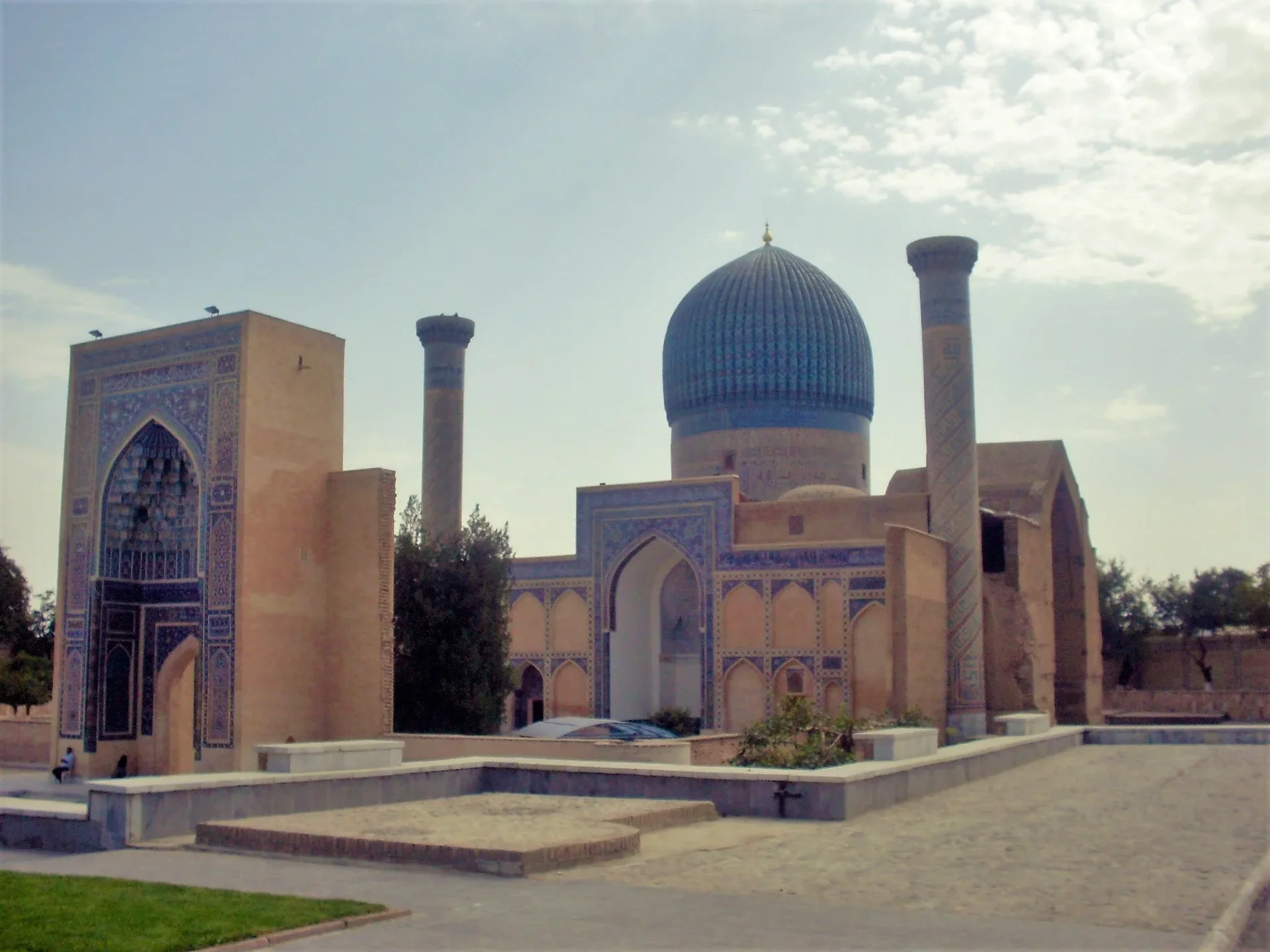
Gur-e-Amir, the tomb of Timur
Timurid builders, early 15th century
🏛️ Samarkand, Uzbekistan (in situ)
The ribbed turquoise dome over Timur's grave. Craftsmen brought from conquered cities built it, so a single monument carries techniques gathered from Persia, India and beyond — a conqueror's biography written in tile.
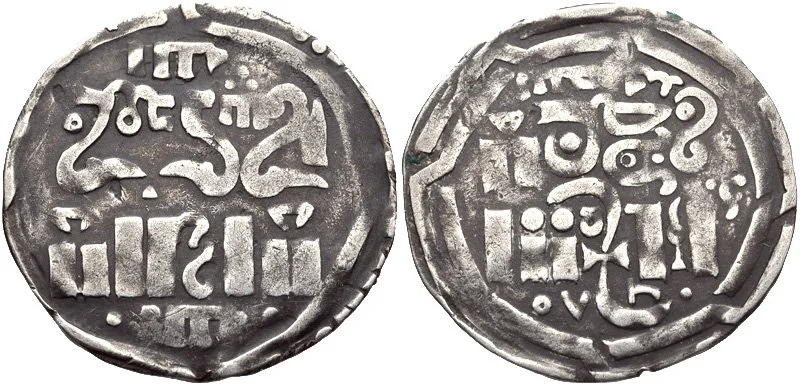
Chagatai Khanate coinage
Chagatai mints, 14th century
🏛️ Various numismatic collections
Coins struck at Bukhara, Samarkand and Almaliq. Whose name appears on them, and in which script, tracks the khanate's split better than any chronicle: puppet khans, amirs and rival capitals all leave their mark in metal.
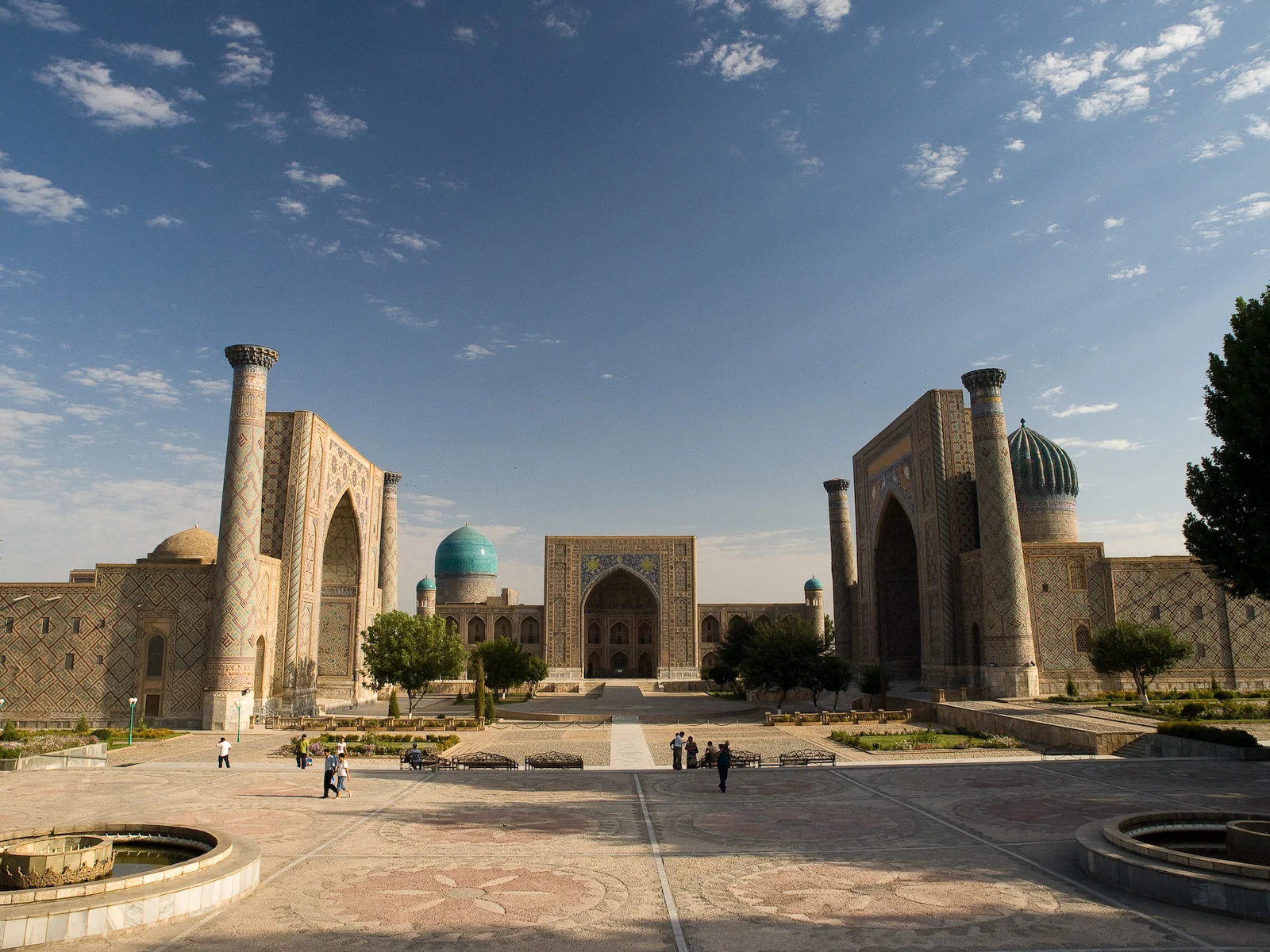
The Registan of Samarkand
Timurid builders, 15th century onward
🏛️ Samarkand, Uzbekistan (in situ)
The square of madrasahs at the heart of the city Timur made his capital. One of them carries tigers and human-faced suns in tile, unusual in Islamic architecture, and a reminder of how many traditions met in this place.
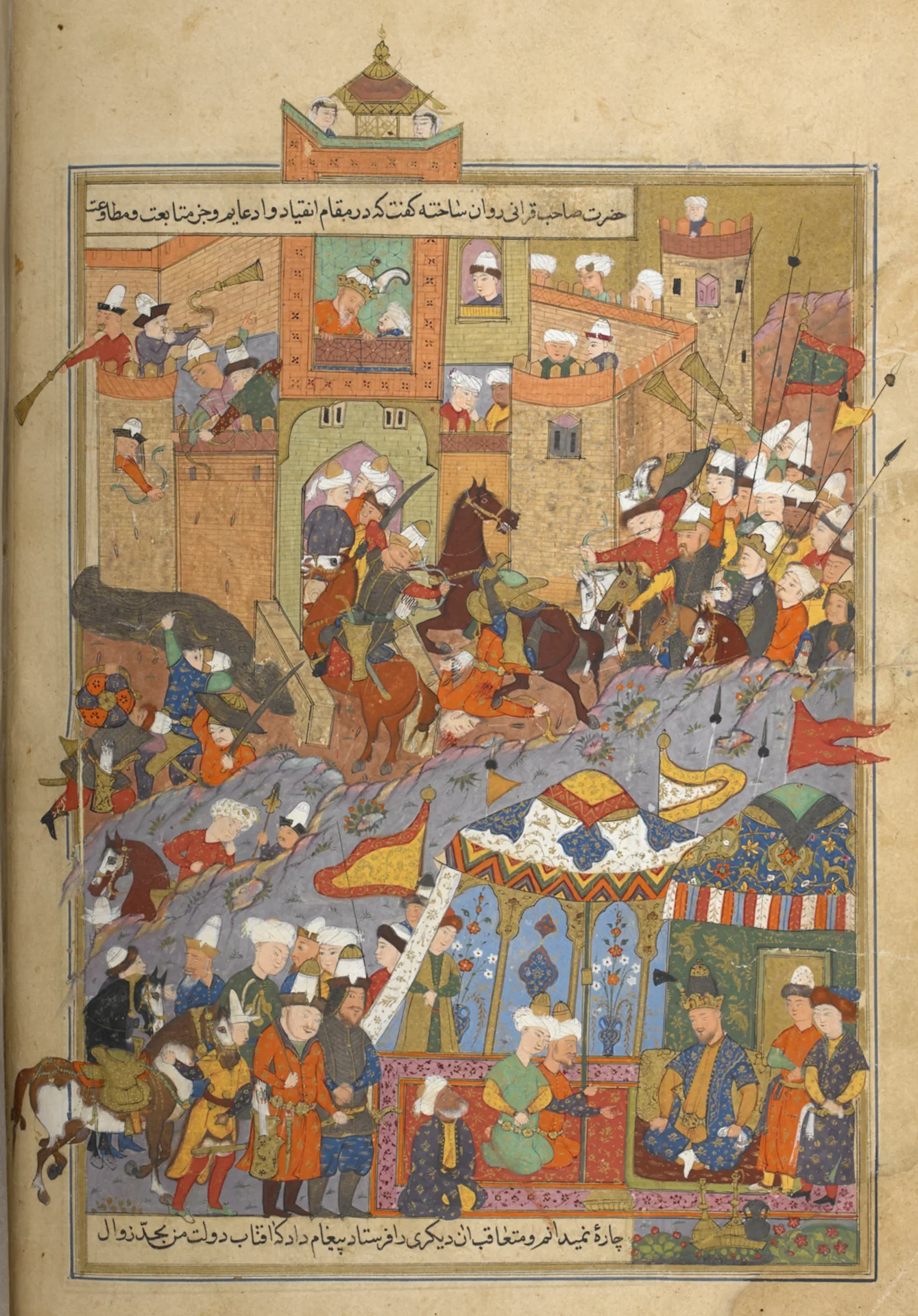
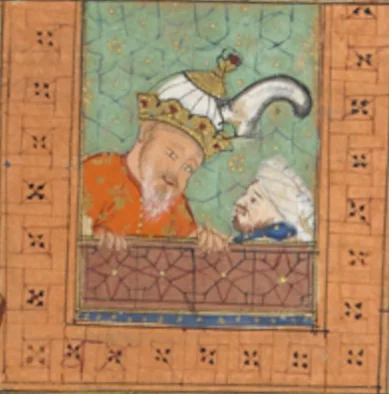
Timur Receiving Envoys during the Siege of Balkh
Miniaturist of Mirkhvand's Rawdat al-Safa, c. 1599 (16th century)
🏛️ Manuscript collection (Turkey/Netherlands)
A 16th-century manuscript miniature from Mirkhvand's Rawdat al-Safa (1599) depicting Timur receiving the envoys sent by Amir Husayn during the decisive 1370 siege of Balkh, capturing the momentous turning point that established Timur's supremacy over Transoxiana.
Related Videos
The Rise and Fall of Timur's Empire (AI Reconstruction)