A series of major military campaigns from 1370 to 1405 led by Timur - Formidable Central Asian conqueror who unified the fragmented steppes and forged a colossal empire from Delhi to Anatolia, sparking the architectural and cultural glory of the Timurid Renaissance. from Samarkand - One of the oldest continuously inhabited cities in Central Asia and a vital hub on the Silk Road. It was captured by Qutayba ibn Muslim in 712 and became a major center for Islamic learning and commerce., establishing a vast Eurasian empire across Central, West, and South Asia by defeating rivals including the Golden Horde - The nomadic state Batu founded on the lower Volga, which collected tribute from the Rus principalities for some 250 years., the Muzaffarids - A Persian dynasty that ruled southern Iran from Shiraz (1314–1393), known for its cultural patronage., the Delhi Sultanate - A succession of five Muslim dynasties that ruled large parts of the Indian subcontinent from Delhi between 1206 and 1526, defending India from Mongol invasions and fostering a unique Indo-Islamic culture., the Mamluks - The Mamluk Sultanate was a powerful medieval state that ruled Egypt, Syria, and the western Arabian Peninsula (the Hejaz) from 1250 to 1517. The word Mamluk literally translates to owned, referring to military slaves of Turkic and Kipchak origin who were purchased to serve as elite palace guards and cavalry forces. Renowned for their superb martial skills and strong solidarity, these military slaves eventually revolted against their Ayyubid masters, seized power, and founded their own dynasty in Cairo. Under their rule, Cairo became one of the wealthiest and most populous cities in the world, serving as a vibrant center for Islamic scholarship, trade, and culture. The sultanate played a pivotal role in world history, most notably during the Mongol invasions. In 1260, after sacking Baghdad, the unstoppable Mongol war machine marched toward Egypt. At the Battle of Ain Jalut, the legendary Mamluk general Baibars and Sultan Qutuz employed a feigned retreat tactic to lure the Mongol vanguard into an ambush, scoring a decisive victory. This battle marked the first time a Mongol advance had ever been permanently halted in close combat, saving Cairo from destruction and securing the Islamic holy sites of Mecca and Medina. Baibars, who later became sultan, was celebrated as a hero of Islam. He adopted the lion as his royal crest, stamping it onto coins and bridges. His daring campaigns and combat exploits against both the Mongols and the Crusaders became the source of grand heroic legends and oral folk epics, passed down through generations in the Arab world. Although the sultanate was eventually conquered by the Ottoman Empire in 1517, its long military dominance remains a remarkable chapter in Middle Eastern history., and the Ottoman Empire - The Ottoman Empire was a powerful Islamic state that began as a small Turkish tribe in Anatolia (present-day Turkey). Over six centuries, it grew into a massive superpower that stretched across three continents: Southeast Europe, Western Asia, and Northern Africa. It stood at the crossroads of the East and West, controlling vital trade routes.Osman's Dream and the FoundationLegend says the empire's founder, Osman I, had a miraculous dream in the late 13th century. He dreamed that a moon emerged from a holy man's chest and entered his own. Then, a massive tree grew from his navel, its branches covering the entire world. This dream was seen as a divine prophecy that Osman and his descendants were destined to rule a mighty empire.The Fall of ConstantinopleThe backbone of the Ottoman army was the Janissaries, elite infantry soldiers trained with intense discipline. Using these forces and massive gunpowder cannons, Sultan Mehmed II accomplished the impossible in 1453: he conquered Constantinople (present-day Istanbul). This historic victory ended the thousand-year-old Byzantine Empire, and the city became the glorious new capital of the Ottomans.The Golden AgeThe empire reached its absolute peak in the 16th century under the rule of Suleiman the Magnificent. He was not only a brilliant military commander who expanded the empire deep into Europe—even laying siege to Vienna—but also a great lawmaker and patron of the arts. During his reign, the empire was incredibly wealthy, and its culture, architecture, and science flourished.Decline and FallHowever, no empire lasts forever. Starting in the 17th century, the Ottoman Empire slowly began to weaken. It faced internal corruption, technological stagnation, and increasing pressure from rising European powers like the Russian and Habsburg Empires. By the 19th century, it was often called the 'Sick Man of Europe.' The final blow came during World War I (1914–1918), where the empire fought on the losing side. After the war, the vast empire was divided, leading to its official collapse in 1922 and the birth of the modern Republic of Turkey under the leadership of Mustafa Kemal Atatürk..
LocationCentral Asia, West Asia, and South Asia (present-day Uzbekistan, Iran, Iraq, Azerbaijan, Syria - Syria was a vital and wealthy region in the Near East. During the Roman and Byzantine periods, it was a crucial province known for its major trade routes, rich agriculture, and important cities like Antioch., Turkey, Southern Russia, and India)
BelligerentsTimurid Empire - A great empire founded in the late 14th century by the conqueror Timur, centered on Samarkand and uniting Central Asia and Persia in a brilliant cultural renaissance., Chagatai Khanate - The khanate that grew from the share given to Chagatai, second son of Genghis Khan, ruling the steppes and oasis cities of Central Asia. (Moghulistan - The nomadic realm formed across the northern and eastern steppes of the Tian Shan when the Chagatai Khanate split in the 14th century, also known as the Eastern Chagatai Khanate. In Persian, Moghulistan means 'Land of the Mongols.' While the western region of Transoxiana embraced settled urban life and Islamic administrative traditions around cities like Samarkand and Bukhara, the eastern tribes of Moghulistan tenaciously preserved the nomadic code (Yassa) and tent life of Genghis Khan. They looked down on the settled westerners as degenerate or soft, while western townspeople disparaged the Moghuls as savage raiders (Jete). Under Khan Tughlugh Timur, the realm adopted Islam and launched campaigns southward to briefly reunite the Chagatai lands. Although the west ultimately became the heart of the Timurid Empire, Moghulistan maintained its nomadic domain around the Tian Shan and the Tarim Basin for centuries. Babur, who later founded the Mughal Empire in India, was a descendant of the Moghulistan khans on his mother's side.), Golden Horde (Kipchak Khanate) - The nomadic state Batu founded on the lower Volga, which collected tribute from the Rus principalities for some 250 years., Ottoman Empire - The Ottoman Empire was a powerful Islamic state that began as a small Turkish tribe in Anatolia (present-day Turkey). Over six centuries, it grew into a massive superpower that stretched across three continents: Southeast Europe, Western Asia, and Northern Africa. It stood at the crossroads of the East and West, controlling vital trade routes.Osman's Dream and the FoundationLegend says the empire's founder, Osman I, had a miraculous dream in the late 13th century. He dreamed that a moon emerged from a holy man's chest and entered his own. Then, a massive tree grew from his navel, its branches covering the entire world. This dream was seen as a divine prophecy that Osman and his descendants were destined to rule a mighty empire.The Fall of ConstantinopleThe backbone of the Ottoman army was the Janissaries, elite infantry soldiers trained with intense discipline. Using these forces and massive gunpowder cannons, Sultan Mehmed II accomplished the impossible in 1453: he conquered Constantinople (present-day Istanbul). This historic victory ended the thousand-year-old Byzantine Empire, and the city became the glorious new capital of the Ottomans.The Golden AgeThe empire reached its absolute peak in the 16th century under the rule of Suleiman the Magnificent. He was not only a brilliant military commander who expanded the empire deep into Europe—even laying siege to Vienna—but also a great lawmaker and patron of the arts. During his reign, the empire was incredibly wealthy, and its culture, architecture, and science flourished.Decline and FallHowever, no empire lasts forever. Starting in the 17th century, the Ottoman Empire slowly began to weaken. It faced internal corruption, technological stagnation, and increasing pressure from rising European powers like the Russian and Habsburg Empires. By the 19th century, it was often called the 'Sick Man of Europe.' The final blow came during World War I (1914–1918), where the empire fought on the losing side. After the war, the vast empire was divided, leading to its official collapse in 1922 and the birth of the modern Republic of Turkey under the leadership of Mustafa Kemal Atatürk., Mamluk Sultanate - The Mamluk Sultanate was a powerful medieval state that ruled Egypt, Syria, and the western Arabian Peninsula (the Hejaz) from 1250 to 1517. The word Mamluk literally translates to owned, referring to military slaves of Turkic and Kipchak origin who were purchased to serve as elite palace guards and cavalry forces. Renowned for their superb martial skills and strong solidarity, these military slaves eventually revolted against their Ayyubid masters, seized power, and founded their own dynasty in Cairo. Under their rule, Cairo became one of the wealthiest and most populous cities in the world, serving as a vibrant center for Islamic scholarship, trade, and culture. The sultanate played a pivotal role in world history, most notably during the Mongol invasions. In 1260, after sacking Baghdad, the unstoppable Mongol war machine marched toward Egypt. At the Battle of Ain Jalut, the legendary Mamluk general Baibars and Sultan Qutuz employed a feigned retreat tactic to lure the Mongol vanguard into an ambush, scoring a decisive victory. This battle marked the first time a Mongol advance had ever been permanently halted in close combat, saving Cairo from destruction and securing the Islamic holy sites of Mecca and Medina. Baibars, who later became sultan, was celebrated as a hero of Islam. He adopted the lion as his royal crest, stamping it onto coins and bridges. His daring campaigns and combat exploits against both the Mongols and the Crusaders became the source of grand heroic legends and oral folk epics, passed down through generations in the Arab world. Although the sultanate was eventually conquered by the Ottoman Empire in 1517, its long military dominance remains a remarkable chapter in Middle Eastern history., Delhi Sultanate - A succession of five Muslim dynasties that ruled large parts of the Indian subcontinent from Delhi between 1206 and 1526, defending India from Mongol invasions and fostering a unique Indo-Islamic culture., Persia - A historic region and great civilization centered on the Iranian Plateau in Western Asia, roughly corresponding to modern-day Iran and its surrounding territories. Great empires arose from this land across millennia, from the ancient Achaemenids and Sasanians to the Ilkhanate and Safavids. Set amid the Zagros Mountains, sweeping deserts, and fertile oases, Persian civilization flourished with distinctive architecture, walled gardens (the linguistic root of 'paradise'), intricate carpets, and delicate miniature paintings. The Feather of the Mythical SimurghIn the Persian epic 'Shahnameh' (The Book of Kings), tales are told of the Simurgh, an ancient, benevolent creature of immense size and wisdom living atop the Alborz mountains. When baby Zal (Rostam's father) was abandoned on the mountain because he was born with white hair, the Simurgh adopted him and raised him with care and knowledge. When Zal returned to human society, the bird gave him a magical feather, promising to fly in like a dark cloud whenever it was burned in times of dire need. Years later, when Zal's wife struggled in mortal danger giving birth to the giant baby Rostam, Zal burned the feather, and the Simurgh flew down to guide a miraculous surgical birth. The Seven Labors of RostamGrowing into an invincible warrior of supernatural strength, Rostam became the legendary protector of Persia alongside his faithful, fearless warhorse Rakhsh. To rescue the Persian king and army captured in the demon realm of Mazandaran, Rostam braved the Seven Labors (Haft Khan). Through perilous trials, he slew a fierce lion, endured scorching desert thirst, conquered a fire-breathing dragon, outwitted an enchantress, and defeated monstrous demons. In his final battle deep inside a dark cave, he vanquished the terrifying White Div and restored freedom to Persia.n Dynasties (Muzaffarids - A Persian dynasty that ruled southern Iran from Shiraz (1314–1393), known for its cultural patronage., Kartids - A Tajik dynasty that ruled Khorasan from Herat (1244–1381) after the decline of the Ilkhanate., Jalayirids - A Mongol-descended dynasty that ruled Iraq and western Iran (1335–1432) following the Ilkhanate's fall.)
💡 Historical Significance
The conquests of Timur - Formidable Central Asian conqueror who unified the fragmented steppes and forged a colossal empire from Delhi to Anatolia, sparking the architectural and cultural glory of the Timurid Renaissance. represented the final monumental explosion of nomadic military expansion across Eurasia, attempting to resurrect the Mongol imperial mantle through Islamic ghazi authority. Claiming legitimacy as an imperial son-in-law (Guregen), Timur disrupted the geopolitical equilibrium across three continents: shattering the trade arteries of the Golden Horde - The nomadic state Batu founded on the lower Volga, which collected tribute from the Rus principalities for some 250 years., debilitating the Delhi Sultanate - A succession of five Muslim dynasties that ruled large parts of the Indian subcontinent from Delhi between 1206 and 1526, defending India from Mongol invasions and fostering a unique Indo-Islamic culture. and the Mamluk Sultanate - The Mamluk Sultanate was a powerful medieval state that ruled Egypt, Syria, and the western Arabian Peninsula (the Hejaz) from 1250 to 1517. The word Mamluk literally translates to owned, referring to military slaves of Turkic and Kipchak origin who were purchased to serve as elite palace guards and cavalry forces. Renowned for their superb martial skills and strong solidarity, these military slaves eventually revolted against their Ayyubid masters, seized power, and founded their own dynasty in Cairo. Under their rule, Cairo became one of the wealthiest and most populous cities in the world, serving as a vibrant center for Islamic scholarship, trade, and culture. The sultanate played a pivotal role in world history, most notably during the Mongol invasions. In 1260, after sacking Baghdad, the unstoppable Mongol war machine marched toward Egypt. At the Battle of Ain Jalut, the legendary Mamluk general Baibars and Sultan Qutuz employed a feigned retreat tactic to lure the Mongol vanguard into an ambush, scoring a decisive victory. This battle marked the first time a Mongol advance had ever been permanently halted in close combat, saving Cairo from destruction and securing the Islamic holy sites of Mecca and Medina. Baibars, who later became sultan, was celebrated as a hero of Islam. He adopted the lion as his royal crest, stamping it onto coins and bridges. His daring campaigns and combat exploits against both the Mongols and the Crusaders became the source of grand heroic legends and oral folk epics, passed down through generations in the Arab world. Although the sultanate was eventually conquered by the Ottoman Empire in 1517, its long military dominance remains a remarkable chapter in Middle Eastern history., and plunging the rising Ottoman Empire - The Ottoman Empire was a powerful Islamic state that began as a small Turkish tribe in Anatolia (present-day Turkey). Over six centuries, it grew into a massive superpower that stretched across three continents: Southeast Europe, Western Asia, and Northern Africa. It stood at the crossroads of the East and West, controlling vital trade routes.Osman's Dream and the FoundationLegend says the empire's founder, Osman I, had a miraculous dream in the late 13th century. He dreamed that a moon emerged from a holy man's chest and entered his own. Then, a massive tree grew from his navel, its branches covering the entire world. This dream was seen as a divine prophecy that Osman and his descendants were destined to rule a mighty empire.The Fall of ConstantinopleThe backbone of the Ottoman army was the Janissaries, elite infantry soldiers trained with intense discipline. Using these forces and massive gunpowder cannons, Sultan Mehmed II accomplished the impossible in 1453: he conquered Constantinople (present-day Istanbul). This historic victory ended the thousand-year-old Byzantine Empire, and the city became the glorious new capital of the Ottomans.The Golden AgeThe empire reached its absolute peak in the 16th century under the rule of Suleiman the Magnificent. He was not only a brilliant military commander who expanded the empire deep into Europe—even laying siege to Vienna—but also a great lawmaker and patron of the arts. During his reign, the empire was incredibly wealthy, and its culture, architecture, and science flourished.Decline and FallHowever, no empire lasts forever. Starting in the 17th century, the Ottoman Empire slowly began to weaken. It faced internal corruption, technological stagnation, and increasing pressure from rising European powers like the Russian and Habsburg Empires. By the 19th century, it was often called the 'Sick Man of Europe.' The final blow came during World War I (1914–1918), where the empire fought on the losing side. After the war, the vast empire was divided, leading to its official collapse in 1922 and the birth of the modern Republic of Turkey under the leadership of Mustafa Kemal Atatürk. into a decadelong dynastic interregnum. Crucially, by concentrating master artisans, scholars, and architects from across the conquered lands in his capital at Samarkand - One of the oldest continuously inhabited cities in Central Asia and a vital hub on the Silk Road. It was captured by Qutayba ibn Muslim in 712 and became a major center for Islamic learning and commerce., he fostered the brilliant cultural efflorescence known as the Timurid Renaissance, which later provided the direct cultural and architectural heritage for the Mughal Empire in India.
Context & Background
Late 14th Century
Heir to Genghis Khan and Sword of Islam
Lacking direct Chinggisid descent, Timur - Formidable Central Asian conqueror who unified the fragmented steppes and forged a colossal empire from Delhi to Anatolia, sparking the architectural and cultural glory of the Timurid Renaissance. adopted the title of Amir - Derived from the Arabic word meaning 'commander' or 'one who gives orders,' amir (or emir) is a high-ranking title in the Islamic world used for military commanders, governors, tribal chieftains, and regional princes. In the Mongol successor states such as the Chagatai Khanate, the title took on a distinctive political significance. According to steppe tradition, only direct patrilineal descendants of Genghis Khan (the Golden Family) were eligible to claim the supreme title of 'Khan.' Consequently, powerful tribal chieftains and warlords who held immense military and administrative power but lacked Genghisid lineage ruled using the title of 'Amir' while placing puppet Genghisid khans on the throne. Notable examples include Amir Qazaghan and Timur (Tamerlane). Although Timur built a vast empire spanning Central Asia and the Middle East and wielded absolute authority, he never claimed the title of Khan. Instead, he ruled as Amir and strengthened his legitimacy by marrying a Genghisid princess, adopting the honorific title of 'Gurgan' (son-in-law). rather than Khan, claiming legitimacy through marriage to a Genghisid princess as a Gurgan (son-in-law) while projecting himself as the champion of Islam.
Late 14th Century
Hybrid Army of Nomadic Mobility and Siege Engineering
Timur's military combined the rapid maneuvers and strict discipline of steppe horse archers with advanced Persia - A historic region and great civilization centered on the Iranian Plateau in Western Asia, roughly corresponding to modern-day Iran and its surrounding territories. Great empires arose from this land across millennia, from the ancient Achaemenids and Sasanians to the Ilkhanate and Safavids. Set amid the Zagros Mountains, sweeping deserts, and fertile oases, Persian civilization flourished with distinctive architecture, walled gardens (the linguistic root of 'paradise'), intricate carpets, and delicate miniature paintings. The Feather of the Mythical SimurghIn the Persian epic 'Shahnameh' (The Book of Kings), tales are told of the Simurgh, an ancient, benevolent creature of immense size and wisdom living atop the Alborz mountains. When baby Zal (Rostam's father) was abandoned on the mountain because he was born with white hair, the Simurgh adopted him and raised him with care and knowledge. When Zal returned to human society, the bird gave him a magical feather, promising to fly in like a dark cloud whenever it was burned in times of dire need. Years later, when Zal's wife struggled in mortal danger giving birth to the giant baby Rostam, Zal burned the feather, and the Simurgh flew down to guide a miraculous surgical birth. The Seven Labors of RostamGrowing into an invincible warrior of supernatural strength, Rostam became the legendary protector of Persia alongside his faithful, fearless warhorse Rakhsh. To rescue the Persian king and army captured in the demon realm of Mazandaran, Rostam braved the Seven Labors (Haft Khan). Through perilous trials, he slew a fierce lion, endured scorching desert thirst, conquered a fire-breathing dragon, outwitted an enchantress, and defeated monstrous demons. In his final battle deep inside a dark cave, he vanquished the terrifying White Div and restored freedom to Persia.n and Chinese siegecraft, producing a formidable military force in both open field battles and sieges.
Late 14th - Early 15th Century
Reshaping the Silk Road and the Timurid Renaissance
By neutralizing competing northern trade hubs of the Golden Horde - The nomadic state Batu founded on the lower Volga, which collected tribute from the Rus principalities for some 250 years., Timur redirected Silk Road - The Silk Road was a very long network of trade routes that connected the East and the West in ancient times. It got its name, which means 'route of silk,' because expensive and beautiful Chinese silk was traded along these paths starting from the Han Dynasty. Merchants traveled on camels across deserts and mountains, exchanging not only goods like spices and jewels, but also sharing different religions, new technologies, and interesting stories. Later, massive empires like the Tang Dynasty and the Mongol Empire gained incredible wealth and power by protecting and managing these important routes. commerce to Samarkand - One of the oldest continuously inhabited cities in Central Asia and a vital hub on the Silk Road. It was captured by Qutayba ibn Muslim in 712 and became a major center for Islamic learning and commerce., forcibly relocating master artisans to transform his capital into a glittering architectural wonderland.
The Narrative
In the mid-14th century, the Chagatai Khanate - The khanate that grew from the share given to Chagatai, second son of Genghis Khan, ruling the steppes and oasis cities of Central Asia. fractured into the nomadic Moghulistan - The nomadic realm formed across the northern and eastern steppes of the Tian Shan when the Chagatai Khanate split in the 14th century, also known as the Eastern Chagatai Khanate. In Persian, Moghulistan means 'Land of the Mongols.' While the western region of Transoxiana embraced settled urban life and Islamic administrative traditions around cities like Samarkand and Bukhara, the eastern tribes of Moghulistan tenaciously preserved the nomadic code (Yassa) and tent life of Genghis Khan. They looked down on the settled westerners as degenerate or soft, while western townspeople disparaged the Moghuls as savage raiders (Jete). Under Khan Tughlugh Timur, the realm adopted Islam and launched campaigns southward to briefly reunite the Chagatai lands. Although the west ultimately became the heart of the Timurid Empire, Moghulistan maintained its nomadic domain around the Tian Shan and the Tarim Basin for centuries. Babur, who later founded the Mughal Empire in India, was a descendant of the Moghulistan khans on his mother's side. in the east and the urbanized Transoxiana - The land of Central Asia between the Amu Darya and the Syr Darya rivers. Mawarannahr is Arabic for 'what lies beyond the river', and the Greek and Roman name Transoxiana means the same thing. It covers today's Uzbekistan and Tajikistan along with southern Kazakhstan. Water drawn from the two rivers let oasis cities such as Samarkand and Bukhara grow in the middle of the desert, and they thrived as staging posts on the Silk Road. Because the taxes of those cities and the profits of their merchants were so large, the khanates that emerged from the divided Mongol Empire fought hard to control the region. The Talas kurultai of 1269 was, in the end, a meeting about how to share out its pastures and its taxes. Samarkand carries an old legend of its own. It is said to have been founded by Afrasiab, the king of Turan in the Persian epics, and the mound of the old city is still called Afrasiab today. in the west. Emerging as the leader of the Barlas tribe amidst this chaos, Timur - Formidable Central Asian conqueror who unified the fragmented steppes and forged a colossal empire from Delhi to Anatolia, sparking the architectural and cultural glory of the Timurid Renaissance. vied for supremacy against his rival Amir - Derived from the Arabic word meaning 'commander' or 'one who gives orders,' amir (or emir) is a high-ranking title in the Islamic world used for military commanders, governors, tribal chieftains, and regional princes. In the Mongol successor states such as the Chagatai Khanate, the title took on a distinctive political significance. According to steppe tradition, only direct patrilineal descendants of Genghis Khan (the Golden Family) were eligible to claim the supreme title of 'Khan.' Consequently, powerful tribal chieftains and warlords who held immense military and administrative power but lacked Genghisid lineage ruled using the title of 'Amir' while placing puppet Genghisid khans on the throne. Notable examples include Amir Qazaghan and Timur (Tamerlane). Although Timur built a vast empire spanning Central Asia and the Middle East and wielded absolute authority, he never claimed the title of Khan. Instead, he ruled as Amir and strengthened his legitimacy by marrying a Genghisid princess, adopting the honorific title of 'Gurgan' (son-in-law). Husayn, ultimately crushing him at Balkh - An ancient city in northern Afghanistan, known in antiquity as Bactra. Located at a vital crossroads of the Silk Road, it was historically known as the 'Mother of Cities' (Umm al-Bilaad). It served as the capital of ancient Bactria and flourished as a major center for Zoroastrianism, Buddhism, and Islamic scholarship. According to legend, Zoroaster first preached here. In 1370, Balkh was the site of the pivotal siege where Timur defeated his rival Amir Husayn to consolidate supreme power. in 1370 to establish himself as supreme ruler in Samarkand - One of the oldest continuously inhabited cities in Central Asia and a vital hub on the Silk Road. It was captured by Qutayba ibn Muslim in 712 and became a major center for Islamic learning and commerce.. Setting out to restore the prestige and vast domains of the Mongol Empire, Timur ruled under the titles of Amir and Gurgan (son-in-law) while placing a puppet Chinggisid on the nominal throne. Launching his massive sequential campaigns—the 'Three-Year Campaign' (1386–1388) to subdue western Persia - A historic region and great civilization centered on the Iranian Plateau in Western Asia, roughly corresponding to modern-day Iran and its surrounding territories. Great empires arose from this land across millennia, from the ancient Achaemenids and Sasanians to the Ilkhanate and Safavids. Set amid the Zagros Mountains, sweeping deserts, and fertile oases, Persian civilization flourished with distinctive architecture, walled gardens (the linguistic root of 'paradise'), intricate carpets, and delicate miniature paintings. The Feather of the Mythical SimurghIn the Persian epic 'Shahnameh' (The Book of Kings), tales are told of the Simurgh, an ancient, benevolent creature of immense size and wisdom living atop the Alborz mountains. When baby Zal (Rostam's father) was abandoned on the mountain because he was born with white hair, the Simurgh adopted him and raised him with care and knowledge. When Zal returned to human society, the bird gave him a magical feather, promising to fly in like a dark cloud whenever it was burned in times of dire need. Years later, when Zal's wife struggled in mortal danger giving birth to the giant baby Rostam, Zal burned the feather, and the Simurgh flew down to guide a miraculous surgical birth. The Seven Labors of RostamGrowing into an invincible warrior of supernatural strength, Rostam became the legendary protector of Persia alongside his faithful, fearless warhorse Rakhsh. To rescue the Persian king and army captured in the demon realm of Mazandaran, Rostam braved the Seven Labors (Haft Khan). Through perilous trials, he slew a fierce lion, endured scorching desert thirst, conquered a fire-breathing dragon, outwitted an enchantress, and defeated monstrous demons. In his final battle deep inside a dark cave, he vanquished the terrifying White Div and restored freedom to Persia. and the Caucasus, followed by the 'Five-Year Campaign' (1392–1396) to completely annex the Iranian plateau and Baghdad - Founded in 762 CE as the capital of the Abbasid Caliphate, Baghdad became a global center of learning, culture, and trade. Known as the 'City of Peace,' it was home to the House of Wisdom and was one of the largest and most sophisticated cities in the world during the Islamic Golden Age. Its capture and destruction by the Mongols in 1258 marked a profound turning point in Islamic history.—Timur systematically crushed the successor states of the collapsed Ilkhanate, including the Kart dynasty - A Tajik dynasty that ruled Khorasan from Herat (1244–1381) after the decline of the Ilkhanate. of Herat, the Muzaffarids - A Persian dynasty that ruled southern Iran from Shiraz (1314–1393), known for its cultural patronage. of Fars, and the Jalayirids - A Mongol-descended dynasty that ruled Iraq and western Iran (1335–1432) following the Ilkhanate's fall. of Baghdad, bringing all of Persia and Iraq under his absolute sway.
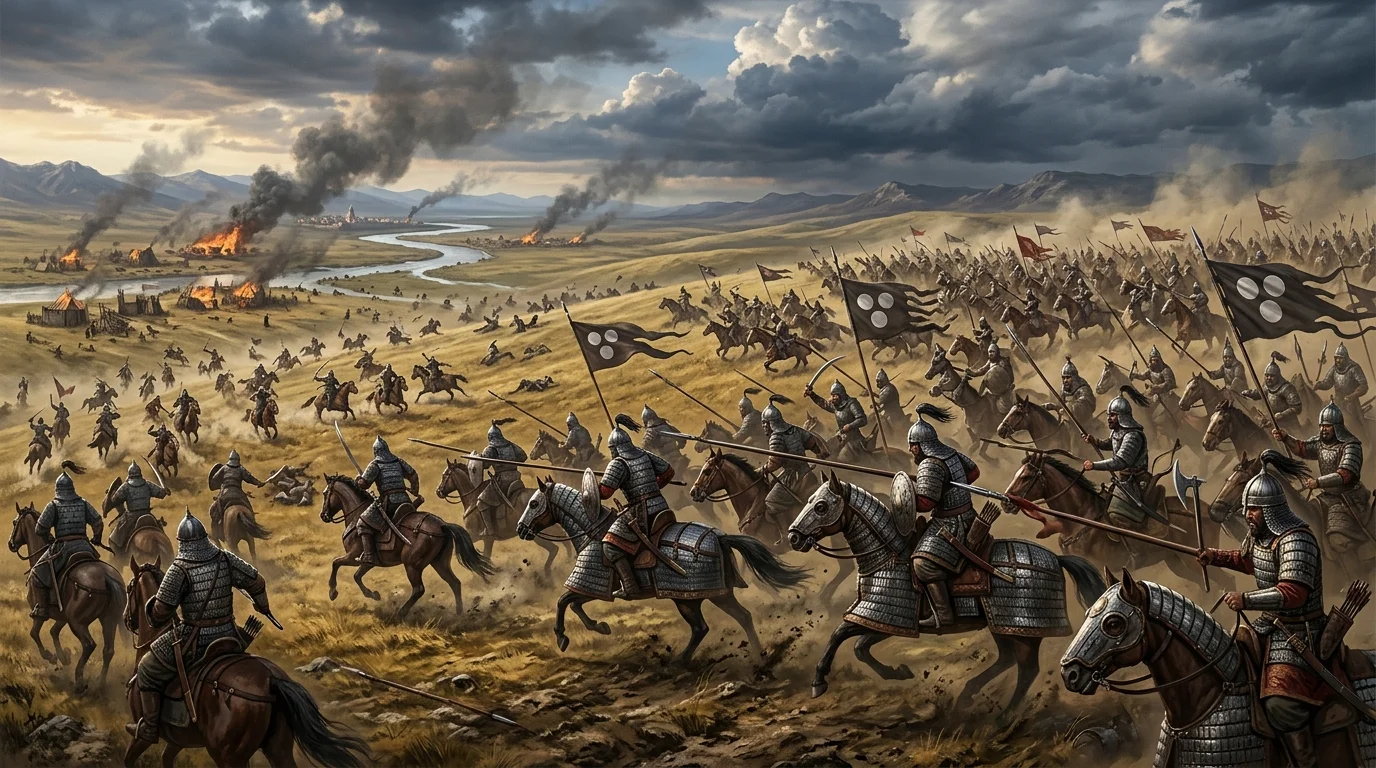
The armored cavalry host of the Timurid army surging across the Eurasian steppes. Timur decisively defeated Tokhtamysh's Golden Horde forces at the Kondurcha and Terek Rivers, dismantling northern caravan routes.
When Tokhtamysh - He reunited the shattered Horde with Timur's help, then turned on his patron, lost two crushing battles and brought his own state down., whom Timur had earlier helped install as Khan of the Golden Horde - The nomadic state Batu founded on the lower Volga, which collected tribute from the Rus principalities for some 250 years., turned against him and invaded Transoxiana and Azerbaijan, Timur led massive punitive expeditions into the northern steppes. In the titanic clashes at the Kondurcha River - The Kondurcha River is a 294-kilometer river flowing through Samara Oblast and Tatarstan in western Russia, emptying into the Sok River, a tributary of the Volga. Flowing through the transition zone between open steppe and forest, it is renowned as the battleground of the epic Battle of the Kondurcha River in 1391 between Timur (Tamerlane) and Khan Tokhtamysh of the Golden Horde. To punish Tokhtamysh for his betrayal, Timur executed a gruelling 2,000-kilometer march across the barren Kazakh steppes lasting several months. Meeting on the banks of the Kondurcha, Timur deployed his army into seven highly disciplined battle lines, neutralizing the Horde's flanking cavalry and shattering Tokhtamysh's host. The battle dealt a catastrophic military blow to the Golden Horde from which it never fully recovered. in 1391 and the Terek River - The Terek River originates in the deep valleys of the Caucasus Mountains and flows for about 620 kilometers before emptying into the Caspian Sea. Because of its fast currents and strategic location, it has historically served as an important geographical boundary and natural defense line for traveling peoples and armies. In the winter of 1262–1263, during the fragmentation of the Mongol Empire, the armies of Hülegü and Berke fought a major battle along this river. According to historical accounts, as Hülegü's forces retreated across the frozen river, the ice broke beneath them, and countless soldiers and horses tragically drowned in the freezing water. Later in 1395, the river became the stage for the climactic Battle of the Terek River between Timur (Tamerlane) and Khan Tokhtamysh. Timur's crushing victory here opened the way for his army to sack and raze Sarai and the Volga trade cities, delivering a fatal blow to the Golden Horde. in 1395, Timur's brilliant tactical formations routed the Kipchak forces. He then sacked Sarai - Sarai was the grand capital city of the Golden Horde (Kipchak Khanate), founded by Batu Khan in the mid-13th century near the lower Volga River. It grew into a major, wealthy trading hub connecting Europe and Asia, featuring beautiful mosques, palaces, and public baths. According to a famous local legend, two life-sized golden horses made of solid gold stood at the gates of Sarai to show off the Khan's power, but they mysteriously disappeared and are believed to be buried somewhere in the Volga steppes. and devastated the northern caravan centers, permanently crippling the Volga trade network. This catastrophic destruction shattered the Golden Horde's grip over the Russian principalities—the 'Tatar Yoke - The 'Tatar Yoke' (or Mongol-Tatar Yoke) refers to the roughly 240-year period from the Mongol destruction of Kievan Rus' (1237–1240) until the Great Stand on the Ugra River (1480), during which the Rus' principalities were subjugated as tributary vassals to the Golden Horde. The metaphor of a 'yoke'—a heavy wooden beam placed across draft animals—symbolizes the profound political subordination and economic burden endured by the Rus' lands. The khans did not govern the forests directly; instead, they granted patents of authority (yarlyks) to favored princes to collect crushing taxes and levies. Defiance or withheld tribute was met with ruthless punitive raids, pillaging, and enslavement. While this era isolated Russia from Western European developments such as the Renaissance, it paradoxically allowed the Grand Duchy of Moscow to accumulate unprecedented wealth as the chief tax collector, ultimately enabling Ivan III to cast off the yoke in 1480 and establish a unified Russian state.'—creating the crucial geopolitical vacuum that allowed the Grand Duchy of Moscow (later the Russian Empire) to rapidly rise to power.
In 1398, Timur crossed the Hindu Kush - A Colossal Natural Barrier between Central Asia and the Indian Subcontinent The Hindu Kush is an 800-kilometer-long mountain range stretching through central and northeastern Afghanistan into northern Pakistan. Crowned by glaciated peaks exceeding 7,000 meters—including its highest summit, Tirich Mir (7,708 m)—the range has historically served as a formidable natural divide between the Eurasian steppes and the Indian subcontinent. The name is traditionally believed to derive from Persian, often interpreted as 'Mountains of India' or 'Slayer of the Hindu,' evoking the perilous winter blizzards and extreme cold that claimed the lives of countless travelers. In antiquity, Alexander the Great's Greeks likened the range to the legendary Caucasus Mountains and named it 'Caucasus Indicus' (the Indian Caucasus).Salang Pass — High-Altitude Mountain Corridor Salang Pass (elevation 3,878 m) is a crucial mountain pass connecting northern Afghanistan and the steppes with the Kabul Basin and southern regions.The rugged, arid mountain pass in summer (1977) While dry, rugged canyons characterize the pass during summer months, winter transforms the corridor into a treacherous landscape of heavy snowstorms, avalanches, and sub-zero temperatures.Snow-covered landscape around the Salang Pass in winterKhyber Pass — The Gateway of Conquerors Khyber Pass (elevation 1,070 m), situated on the southeastern periphery of the Hindu Kush, is one of the most historically significant strategic passes in world history, connecting Afghanistan to Pakistan and the Indian plains.The strategic Khyber Pass traversed by historical conquerors and trade caravans From Alexander the Great's vanguard to Timur's 1398 invasion of the Delhi Sultanate and Babur's founding of the Mughal Empire, generations of conquerors and Silk Road trade caravans navigated through the Khyber Pass to enter the Indian subcontinent. into northern India, advancing upon the Delhi Sultanate - A succession of five Muslim dynasties that ruled large parts of the Indian subcontinent from Delhi between 1206 and 1526, defending India from Mongol invasions and fostering a unique Indo-Islamic culture.. Faced with 120 armored war elephants deployed by the Sultan of Delhi, Timur countered by loading pack camels with burning straw and driving them forward, causing the panicked beasts to trample their own ranks. After sacking Delhi, Timur chose not to annex India permanently, instead carrying vast wealth and skilled stonemasons back to Samarkand. Although the ruling Tughlaq dynasty was severely crippled and splintered by the onslaught, the Delhi Sultanate survived and continued under the subsequent Sayyid and Lodi dynasties. Turning westward, Timur invaded Mamluk Syria - Syria was a vital and wealthy region in the Near East. During the Roman and Byzantine periods, it was a crucial province known for its major trade routes, rich agriculture, and important cities like Antioch., capturing Aleppo - A historic metropolis in northern Syria, celebrated as one of the oldest continuously inhabited cities in the world, with human settlement stretching back millennia. Situated strategically between the Mediterranean Sea and the Euphrates River, it flourished as a premier commercial terminus of the Silk Road where Asian caravans met Mediterranean maritime merchants. Local tradition associates its Arabic name, Halab, with the patriarch Abraham (Ibrahim), who is said to have grazed his flocks on the citadel hill and milked his cattle to distribute fresh milk to the poor, from which the Arabic root for 'to milk' gave the city its name. At the heart of the city rises the colossal Citadel of Aleppo atop a massive natural hill, forming one of the most formidable medieval fortified complexes in the world. It served as a pivotal Islamic stronghold during the Crusades and was besieged and taken by Timur's forces in 1400 during his Syrian campaigns. and Damascus - The capital of Syria and one of the oldest continuously inhabited cities in the world, nestled in the fertile Ghouta oasis watered by the Barada River. Thanks to its lush orchards and flowing waters amidst arid surrounding plains, it was historically celebrated across the Orient as the 'Pearl of the Desert' and an earthly paradise. According to a famous Islamic legend, the Prophet Muhammad gazed down upon the verdant city from Mount Qasiyun and refused to enter, declaring that man should enter paradise only once, and choosing the celestial paradise over an earthly one. During the 7th and 8th centuries, Damascus served as the imperial capital of the Umayyad Caliphate, during which the magnificent Umayyad Mosque was erected as a masterpiece of early Islamic architecture. The city was also world-renowned for its legendary Damascus steel, famed for distinctive watered patterns and razor-sharp resilience. When Timur captured Damascus in 1400–1401, he held extensive intellectual dialogues with the historian Ibn Khaldun and deported its finest swordsmiths and artisans to Samarkand.. Sending renowned artisans to Samarkand, he chose not to march into Egypt and withdrew, allowing the Mamluks - The Mamluk Sultanate was a powerful medieval state that ruled Egypt, Syria, and the western Arabian Peninsula (the Hejaz) from 1250 to 1517. The word Mamluk literally translates to owned, referring to military slaves of Turkic and Kipchak origin who were purchased to serve as elite palace guards and cavalry forces. Renowned for their superb martial skills and strong solidarity, these military slaves eventually revolted against their Ayyubid masters, seized power, and founded their own dynasty in Cairo. Under their rule, Cairo became one of the wealthiest and most populous cities in the world, serving as a vibrant center for Islamic scholarship, trade, and culture. The sultanate played a pivotal role in world history, most notably during the Mongol invasions. In 1260, after sacking Baghdad, the unstoppable Mongol war machine marched toward Egypt. At the Battle of Ain Jalut, the legendary Mamluk general Baibars and Sultan Qutuz employed a feigned retreat tactic to lure the Mongol vanguard into an ambush, scoring a decisive victory. This battle marked the first time a Mongol advance had ever been permanently halted in close combat, saving Cairo from destruction and securing the Islamic holy sites of Mecca and Medina. Baibars, who later became sultan, was celebrated as a hero of Islam. He adopted the lion as his royal crest, stamping it onto coins and bridges. His daring campaigns and combat exploits against both the Mongols and the Crusaders became the source of grand heroic legends and oral folk epics, passed down through generations in the Arab world. Although the sultanate was eventually conquered by the Ottoman Empire in 1517, its long military dominance remains a remarkable chapter in Middle Eastern history. to quickly recover Syria. In 1401, he recaptured and devastated Baghdad—where the Jalayirid remnants had rebelled—cementing his absolute hegemony across West Asia.
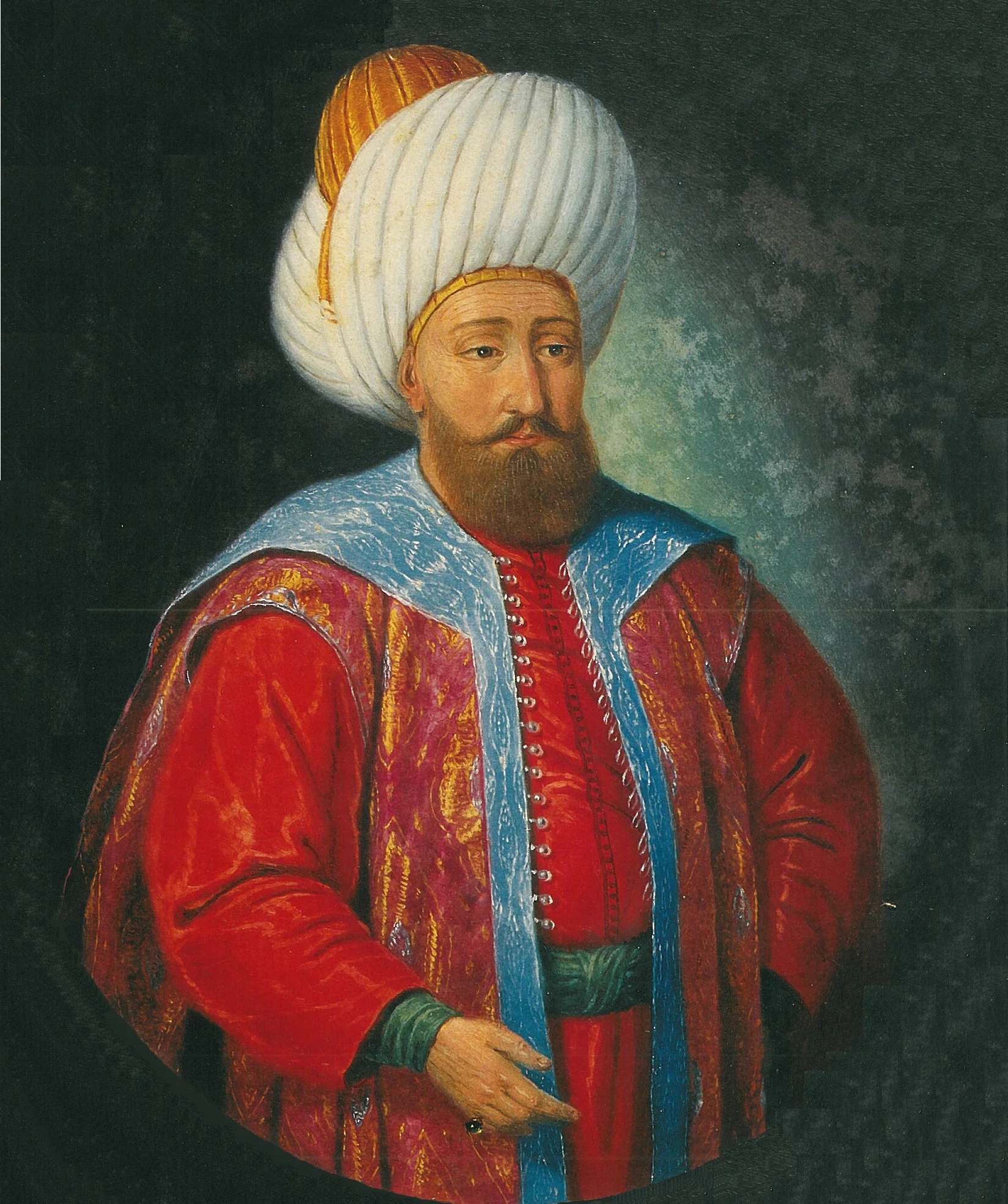
In 1402, Timur confronted Sultan Bayezid I - Nicknamed 'the Thunderbolt' for his speed, he crushed a European crusade but was captured by Timur at the Battle of Ankara. of the Ottoman Empire - The Ottoman Empire was a powerful Islamic state that began as a small Turkish tribe in Anatolia (present-day Turkey). Over six centuries, it grew into a massive superpower that stretched across three continents: Southeast Europe, Western Asia, and Northern Africa. It stood at the crossroads of the East and West, controlling vital trade routes.Osman's Dream and the FoundationLegend says the empire's founder, Osman I, had a miraculous dream in the late 13th century. He dreamed that a moon emerged from a holy man's chest and entered his own. Then, a massive tree grew from his navel, its branches covering the entire world. This dream was seen as a divine prophecy that Osman and his descendants were destined to rule a mighty empire.The Fall of ConstantinopleThe backbone of the Ottoman army was the Janissaries, elite infantry soldiers trained with intense discipline. Using these forces and massive gunpowder cannons, Sultan Mehmed II accomplished the impossible in 1453: he conquered Constantinople (present-day Istanbul). This historic victory ended the thousand-year-old Byzantine Empire, and the city became the glorious new capital of the Ottomans.The Golden AgeThe empire reached its absolute peak in the 16th century under the rule of Suleiman the Magnificent. He was not only a brilliant military commander who expanded the empire deep into Europe—even laying siege to Vienna—but also a great lawmaker and patron of the arts. During his reign, the empire was incredibly wealthy, and its culture, architecture, and science flourished.Decline and FallHowever, no empire lasts forever. Starting in the 17th century, the Ottoman Empire slowly began to weaken. It faced internal corruption, technological stagnation, and increasing pressure from rising European powers like the Russian and Habsburg Empires. By the 19th century, it was often called the 'Sick Man of Europe.' The final blow came during World War I (1914–1918), where the empire fought on the losing side. After the war, the vast empire was divided, leading to its official collapse in 1922 and the birth of the modern Republic of Turkey under the leadership of Mustafa Kemal Atatürk. on the plains of Ankara. By seizing the water supply and turning the Ottoman Tatars to his side, Timur crushed the Ottoman forces and captured Bayezid, plunging the Ottoman realm into a decade-long interregnum. This crushing victory postponed the Ottoman conquest of Constantinople by roughly half a century, granting the Byzantine Empire a vital reprieve during which Byzantine scholars, classical manuscripts, and ideas flowed into Western Europe, fueling the Italian Renaissance. Spanning from Delhi to Anatolia - Also known as Asia Minor, this large peninsula in West Asia corresponds to modern-day Turkey. Historically, it has been a cradle of civilization and a bridge between East and West, hosting the Hittites, Lydians, Greeks, Romans, Byzantines, and Turks. During the Crusades, it was a treacherous but necessary overland route for European armies marching toward the Holy Land., Timur stood as the 'last great nomadic conqueror' to reshape the Old World through the sheer military might of the Eurasian steppes - An Endless Sea of Grass from Eastern Europe to Manchuria The Eurasian Steppe (also known as the Great Steppe or Central Eurasian Steppe) is the vast ecoregion of temperate grasslands stretching approximately 8,000 kilometers from the Hungarian plains and the northern shores of the Black Sea across Central Asia to the Mongolian plateau and Manchuria.Cradle of Nomadic Empires and Military Powerhouse The boundless grasslands provided the ideal environment for breeding and grazing large herds of horses. From the Scythians, Xiongnu, Huns, and Turks to the monumental rise of the Mongol Empire in the 13th century, the steppe served as the crucible for formidable horse-mounted empires whose mobility, composite bows, and cavalry tactics repeatedly reshaped world history.The Steppe Route and the Last Nomadic Conqueror Beyond warfare, the Eurasian Steppe functioned as the northern highway of the Silk Road—the 'Steppe Route'—enabling the swift transmission of trade goods, metallurgy, horses, and cultural ideas across Eurasia. In the late 14th century, Timur mobilized the formidable steppe cavalry forces of Central Eurasia to forge a sprawling empire, closing the era of the world's 'last great nomadic conqueror.'. He transformed Samarkand into a glittering gem of Islamic arts and architecture before succumbing to a sudden illness at Otrar - A Prosperous Silk Road Oasis City Otrar (ancient Farab) was a major ancient and medieval city located at the junction of the Syr Darya and Arys rivers in present-day southern Kazakhstan. Situated at a crucial crossroads of Silk Road trade routes connecting China, Persia, and the Eurasian steppes, it flourished as a center of commerce, craft production, and Islamic scholarship. It is renowned as the birthplace of the eminent 9th-century polymath and philosopher Al-Farabi.The 1219 Otrar Catastrophe and the Mongol Invasions In 1218, Genghis Khan dispatched a 450-man caravan to establish trade relations with the Khwarazmian Empire. However, the Khwarazmian governor of Otrar, Inalchuq, accused the merchants of espionage, slaughtered them, and seized their wealth. When Genghis Khan's diplomatic envoy sent to demand justice was also executed by Shah Muhammad II, Genghis Khan launched the devastating 1219 invasion of Khwarazm. After a five-month siege, Otrar fell to the Mongol forces, setting off the conquest of Central Asia.The Final Resting Place of Timur's Ambition In late 1404, the Central Asian conqueror Timur (Tamerlane) mobilized a massive 200,000-man army for an ambitious campaign to conquer Ming Dynasty China. However, amidst severe winter blizzards while encamped at Otrar along the frozen Syr Darya in February 1405, Timur fell ill with a fatal fever and died at the age of 69, bringing an immediate end to the eastern invasion. in 1405 while embarking on a grand campaign against Ming China.
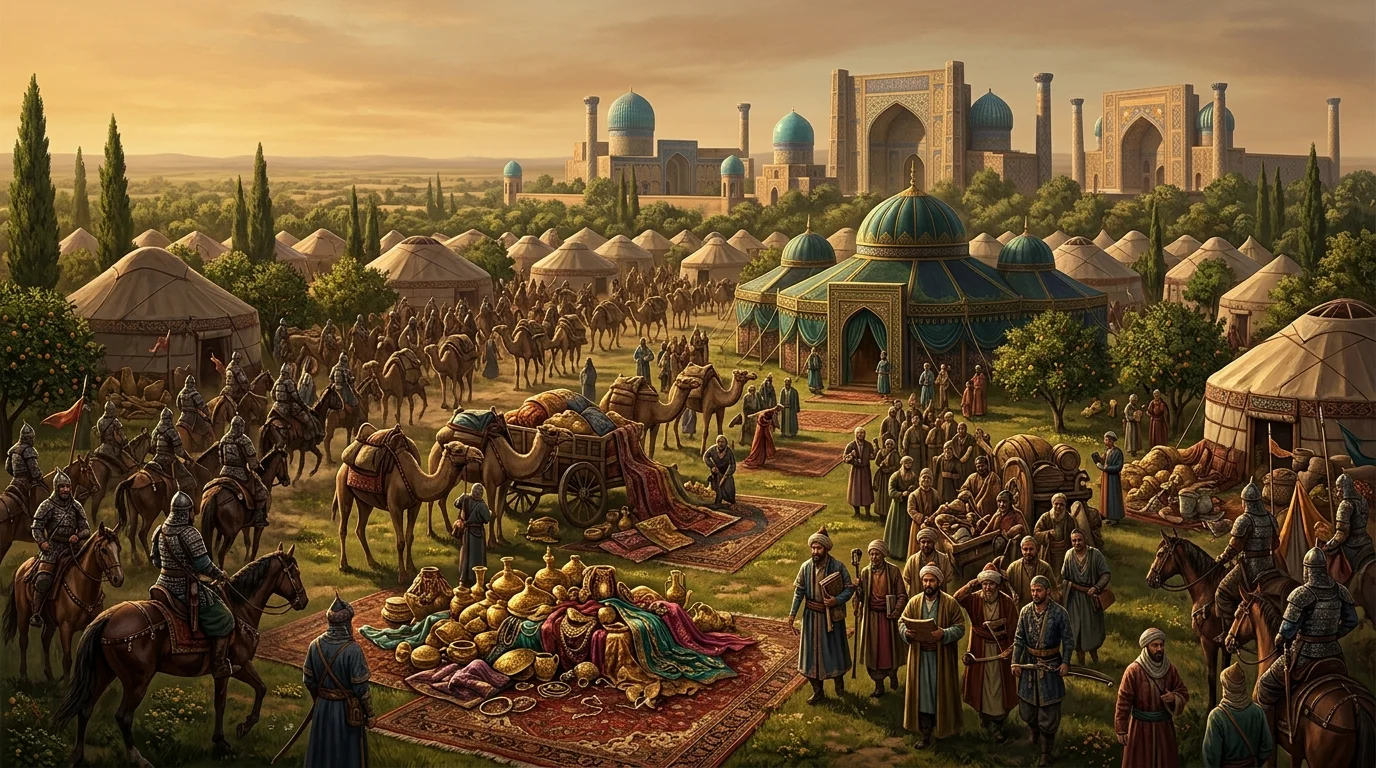
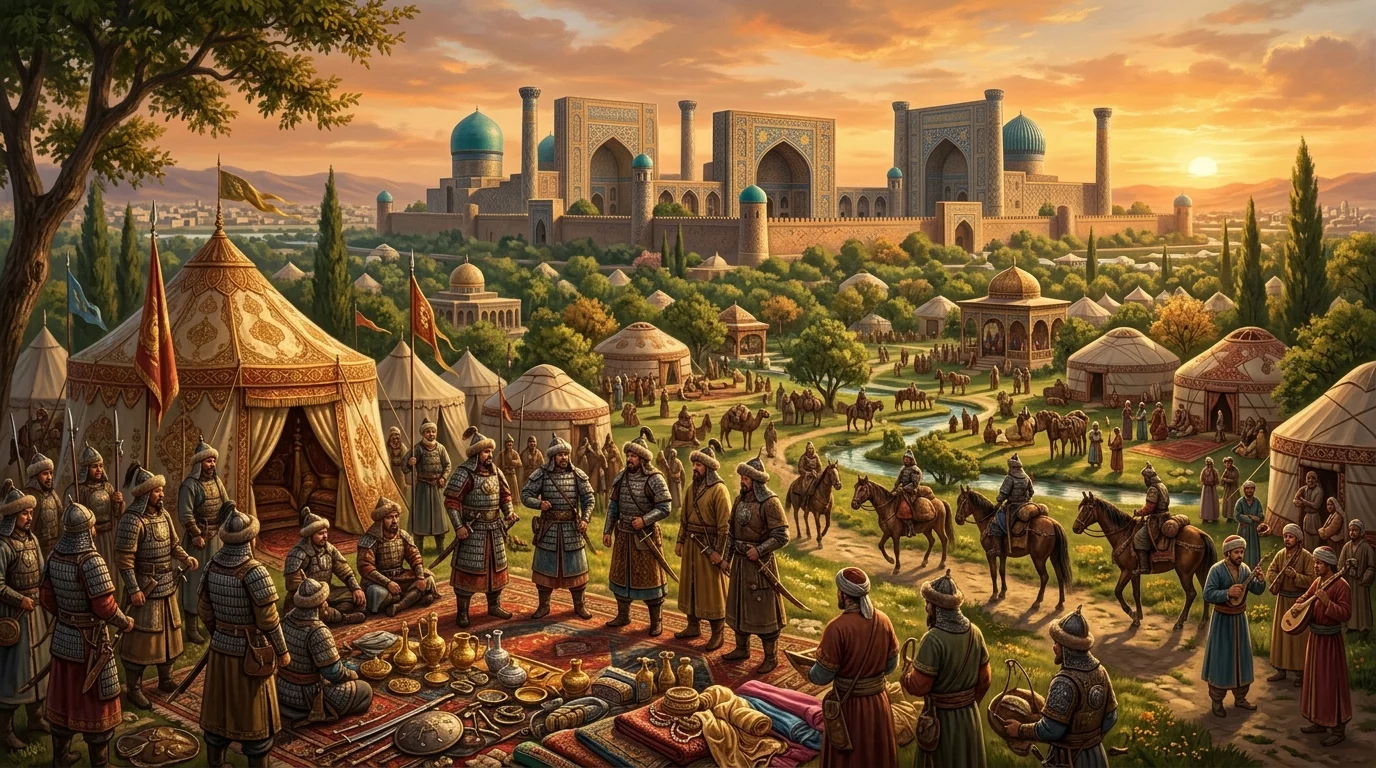
The reason Timur's campaigns focused on sweeping devastation and plunder rather than permanent administrative annexation lay in his distinct power base and semi-nomadic lifestyle. Lacking Genghisid blood, Timur relied almost entirely on continuous military victories and the redistribution of vast spoils to secure the loyalty of his fiercely independent nomadic warlords and steppe cavalry, locking him into a perpetual cycle of warfare. Moreover, the ruling elite maintained pastoral traditions, preferring luxurious silk tents in the gardens outside Samarkand and seasonal migrations over residing in stone palaces or managing complex imperial bureaucracies. By crippling rival commercial hubs, Timur systematically funneled the wealth, trade, and master artisans of the Silk Road - The Silk Road was a very long network of trade routes that connected the East and the West in ancient times. It got its name, which means 'route of silk,' because expensive and beautiful Chinese silk was traded along these paths starting from the Han Dynasty. Merchants traveled on camels across deserts and mountains, exchanging not only goods like spices and jewels, but also sharing different religions, new technologies, and interesting stories. Later, massive empires like the Tang Dynasty and the Mongol Empire gained incredible wealth and power by protecting and managing these important routes. into Samarkand, sparking the glorious 'Timurid Renaissance.' Yet, because his conquests were held together by personal terror and tributary extortion rather than institutional integration, the vast periphery of the empire rapidly disintegrated following his death.
A lavish royal garden camp outside Samarkand. Timur and his nomadic commanders resided in silk pavilions and ornate tents rather than stone palaces, redistributing campaign spoils to maintain military loyalty while transforming Samarkand into a dazzling imperial capital.
When Ghiyath al-Din of the Kart dynasty - A Tajik dynasty that ruled Khorasan from Herat (1244–1381) after the decline of the Ilkhanate. refused to submit, Timur - Formidable Central Asian conqueror who unified the fragmented steppes and forged a colossal empire from Delhi to Anatolia, sparking the architectural and cultural glory of the Timurid Renaissance. surrounded the strategic fortress of Herat. Timur constructed massive earthen mounds around the walls to mount siege engines and heavily bombarded the defenders. Overwhelmed by ceaseless barrages of arrows and stones, the city surrendered. Timur dismantled the city walls and deported its vast treasures and master artisans to Samarkand - One of the oldest continuously inhabited cities in Central Asia and a vital hub on the Silk Road. It was captured by Qutayba ibn Muslim in 712 and became a major center for Islamic learning and commerce..
ResultTimurid Victory
Truce / Interlude (6 years)
1387 AD
Three-Year Campaign and Fall of Isfahan
📍Isfahan and the Caucasus (present-day Iran and Georgia) (Map)
Launching his 'Three-Year Campaign' in 1386, Timur subdued Tabriz - Tabriz, in north-western Iran, was the capital of the Ilkhanate. It sat where the roads from the Caucasus, Anatolia and Persia met, so merchants and envoys were always passing through. Under Ghazan Khan it was rebuilt into a centre of learning with hospitals, libraries and an observatory, and it was here that painting techniques arriving from China passed through Persian hands and grew into a new style of miniature. After the Ilkhanate broke apart, whoever held this city held Azerbaijan, so rival powers fought over it in turn. Its covered bazaar, still standing, is counted among the oldest markets in the world. and the Caucasus before subjugating the major southern Persia - A historic region and great civilization centered on the Iranian Plateau in Western Asia, roughly corresponding to modern-day Iran and its surrounding territories. Great empires arose from this land across millennia, from the ancient Achaemenids and Sasanians to the Ilkhanate and Safavids. Set amid the Zagros Mountains, sweeping deserts, and fertile oases, Persian civilization flourished with distinctive architecture, walled gardens (the linguistic root of 'paradise'), intricate carpets, and delicate miniature paintings. The Feather of the Mythical SimurghIn the Persian epic 'Shahnameh' (The Book of Kings), tales are told of the Simurgh, an ancient, benevolent creature of immense size and wisdom living atop the Alborz mountains. When baby Zal (Rostam's father) was abandoned on the mountain because he was born with white hair, the Simurgh adopted him and raised him with care and knowledge. When Zal returned to human society, the bird gave him a magical feather, promising to fly in like a dark cloud whenever it was burned in times of dire need. Years later, when Zal's wife struggled in mortal danger giving birth to the giant baby Rostam, Zal burned the feather, and the Simurgh flew down to guide a miraculous surgical birth. The Seven Labors of RostamGrowing into an invincible warrior of supernatural strength, Rostam became the legendary protector of Persia alongside his faithful, fearless warhorse Rakhsh. To rescue the Persian king and army captured in the demon realm of Mazandaran, Rostam braved the Seven Labors (Haft Khan). Through perilous trials, he slew a fierce lion, endured scorching desert thirst, conquered a fire-breathing dragon, outwitted an enchantress, and defeated monstrous demons. In his final battle deep inside a dark cave, he vanquished the terrifying White Div and restored freedom to Persia.n city of Isfahan in 1387. When the citizens of Isfahan rebelled and killed his tax collectors, Timur unleashed merciless retribution, razing the city and erecting towers from tens of thousands of severed heads. Having established absolute dominance over western Persia, Timur rushed back to Transoxiana - The land of Central Asia between the Amu Darya and the Syr Darya rivers. Mawarannahr is Arabic for 'what lies beyond the river', and the Greek and Roman name Transoxiana means the same thing. It covers today's Uzbekistan and Tajikistan along with southern Kazakhstan. Water drawn from the two rivers let oasis cities such as Samarkand and Bukhara grow in the middle of the desert, and they thrived as staging posts on the Silk Road. Because the taxes of those cities and the profits of their merchants were so large, the khanates that emerged from the divided Mongol Empire fought hard to control the region. The Talas kurultai of 1269 was, in the end, a meeting about how to share out its pastures and its taxes. Samarkand carries an old legend of its own. It is said to have been founded by Afrasiab, the king of Turan in the Persian epics, and the mound of the old city is still called Afrasiab today. in 1388 to repel an invasion by Tokhtamysh - He reunited the shattered Horde with Timur's help, then turned on his patron, lost two crushing battles and brought his own state down..
Truce / Interlude (4 years)
1391 AD
Battle of the Kondurcha River
📍Kondurcha River (near modern Samara, Russia) (Map)
After Tokhtamysh turned against his benefactor, Timur led a massive force deep into the Russian steppes. Deploying his army into seven flexible tactical divisions to prevent envelopment, Timur outmaneuvered the Kipchak forces. Timur's elite guard broke the enemy lines, and when Tokhtamysh's standard fell, the Golden Horde - The nomadic state Batu founded on the lower Volga, which collected tribute from the Rus principalities for some 250 years. army dissolved in panic, severely weakening its military might.
ResultDecisive Timurid Victory
1393 AD
Five-Year Campaign and Fall of Baghdad - Founded in 762 CE as the capital of the Abbasid Caliphate, Baghdad became a global center of learning, culture, and trade. Known as the 'City of Peace,' it was home to the House of Wisdom and was one of the largest and most sophisticated cities in the world during the Islamic Golden Age. Its capture and destruction by the Mongols in 1258 marked a profound turning point in Islamic history.
📍Baghdad and Persia (present-day Iraq and Iran) (Map)
In 1392, Timur launched his ambitious 'Five-Year Campaign' to fully annex the Iranian plateau and assert supremacy across West Asia. In 1393, he extinguished the rebellious Muzaffarid dynasty - A Persian dynasty that ruled southern Iran from Shiraz (1314–1393), known for its cultural patronage. to consolidate control over Persia before marching into Mesopotamia. As Sultan Ahmad of the Jalayirid dynasty fled, Timur entered historic Baghdad - Founded in 762 CE as the capital of the Abbasid Caliphate, Baghdad became a global center of learning, culture, and trade. Known as the 'City of Peace,' it was home to the House of Wisdom and was one of the largest and most sophisticated cities in the world during the Islamic Golden Age. Its capture and destruction by the Mongols in 1258 marked a profound turning point in Islamic history. virtually unopposed. Securing Iraq, he then turned his army northward to strike at the Golden Horde in the climactic phase of the campaign.
When Tokhtamysh regrouped and invaded the Caucasus, Timur engaged him in a fierce showdown along the Terek River - The Terek River originates in the deep valleys of the Caucasus Mountains and flows for about 620 kilometers before emptying into the Caspian Sea. Because of its fast currents and strategic location, it has historically served as an important geographical boundary and natural defense line for traveling peoples and armies. In the winter of 1262–1263, during the fragmentation of the Mongol Empire, the armies of Hülegü and Berke fought a major battle along this river. According to historical accounts, as Hülegü's forces retreated across the frozen river, the ice broke beneath them, and countless soldiers and horses tragically drowned in the freezing water. Later in 1395, the river became the stage for the climactic Battle of the Terek River between Timur (Tamerlane) and Khan Tokhtamysh. Timur's crushing victory here opened the way for his army to sack and raze Sarai and the Volga trade cities, delivering a fatal blow to the Golden Horde.. After Timur's left flank nearly collapsed under a sudden charge, Timur personally rallied his elite cavalry to stabilize the front. A powerful flank attack then shattered the Kipchak lines. Timur pursued the defeated army, devastating Sarai - Sarai was the grand capital city of the Golden Horde (Kipchak Khanate), founded by Batu Khan in the mid-13th century near the lower Volga River. It grew into a major, wealthy trading hub connecting Europe and Asia, featuring beautiful mosques, palaces, and public baths. According to a famous local legend, two life-sized golden horses made of solid gold stood at the gates of Sarai to show off the Khan's power, but they mysteriously disappeared and are believed to be buried somewhere in the Volga steppes. and destroying northern trade routes.
Confronted by the Delhi Sultanate - A succession of five Muslim dynasties that ruled large parts of the Indian subcontinent from Delhi between 1206 and 1526, defending India from Mongol invasions and fostering a unique Indo-Islamic culture.'s terrifying vanguard of 120 armored war elephants, Timur devised an ingenious countermeasure. He loaded pack camels with burning straw and drove them directly toward the enemy line. Terrified by the flames, the elephants turned and trampled the Indian ranks. Timur's cavalry exploited the chaos to secure a crushing victory and capture Delhi.
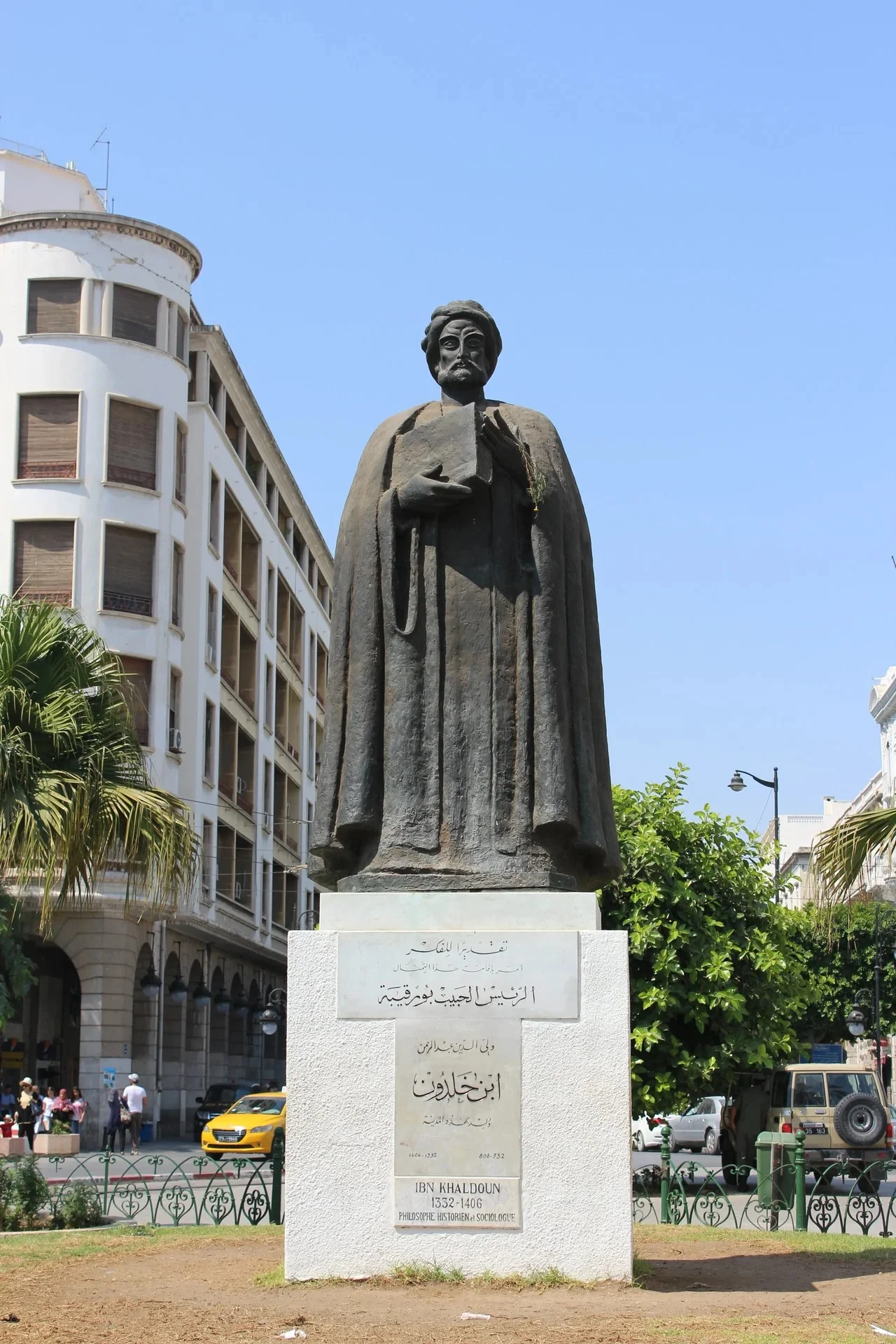
Following the fall of Aleppo - A historic metropolis in northern Syria, celebrated as one of the oldest continuously inhabited cities in the world, with human settlement stretching back millennia. Situated strategically between the Mediterranean Sea and the Euphrates River, it flourished as a premier commercial terminus of the Silk Road where Asian caravans met Mediterranean maritime merchants. Local tradition associates its Arabic name, Halab, with the patriarch Abraham (Ibrahim), who is said to have grazed his flocks on the citadel hill and milked his cattle to distribute fresh milk to the poor, from which the Arabic root for 'to milk' gave the city its name. At the heart of the city rises the colossal Citadel of Aleppo atop a massive natural hill, forming one of the most formidable medieval fortified complexes in the world. It served as a pivotal Islamic stronghold during the Crusades and was besieged and taken by Timur's forces in 1400 during his Syrian campaigns., Timur advanced on Damascus - The capital of Syria and one of the oldest continuously inhabited cities in the world, nestled in the fertile Ghouta oasis watered by the Barada River. Thanks to its lush orchards and flowing waters amidst arid surrounding plains, it was historically celebrated across the Orient as the 'Pearl of the Desert' and an earthly paradise. According to a famous Islamic legend, the Prophet Muhammad gazed down upon the verdant city from Mount Qasiyun and refused to enter, declaring that man should enter paradise only once, and choosing the celestial paradise over an earthly one. During the 7th and 8th centuries, Damascus served as the imperial capital of the Umayyad Caliphate, during which the magnificent Umayyad Mosque was erected as a masterpiece of early Islamic architecture. The city was also world-renowned for its legendary Damascus steel, famed for distinctive watered patterns and razor-sharp resilience. When Timur captured Damascus in 1400–1401, he held extensive intellectual dialogues with the historian Ibn Khaldun and deported its finest swordsmiths and artisans to Samarkand.. After Mamluk Sultan Faraj retreated, the citadel held out until Timur's siege towers and sapping breached the walls. During the siege, the renowned scholar Ibn Khaldun - Renowned 14th-century Arab historian and thinker, celebrated as a founding father of modern sociology and historiography through his magnum opus, the Muqaddimah. lowered himself from the ramparts to meet with Timur, discussing nomadic solidarity ('Asabiyya - Ibn Khaldun's Fundamental Concept of Social Solidarity Asabiyyah (Arabic: عصبيّة, 'Asabiyya) is the foundational socio-historical concept introduced by the 14th-century polymath and philosopher of history Ibn Khaldun in his masterwork, the Muqaddimah (Prolegomena). It describes the powerful sense of social cohesion, collective solidarity, and group consciousness forged through kinship, shared hardship, or common conviction.Nomadic Cohesion and the Cyclical Rise and Fall of Empires Ibn Khaldun argued that nomadic peoples living in harsh desert and steppe environments develop an extraordinarily pure and potent Asabiyyah due to their constant struggle for survival. Leveraging this fierce mutual loyalty, nomadic tribes easily overwhelm decaying, sedentary agrarian dynasties and establish great empires. However, once established in urban centers, the ruling elites gradually succumb to luxury and internal division over roughly three to four generations (~120 years), causing their Asabiyyah to erode until a vigorous new nomadic power rises to displace them.The Historic 1401 Damascus Dialogue with Timur During Timur's siege of Damascus in 1401, Ibn Khaldun famously lowered himself from the city ramparts with a rope to negotiate in Timur's camp. Over weeks of intellectual dialogue, Ibn Khaldun explained to the conqueror that no group in the contemporary world possessed a stronger Asabiyyah than the Turco-Mongol nomads of Central Asia, identifying Timur as the natural agent of historical destiny. Impressed by his brilliance, Timur granted the scholar safe conduct to return to Cairo.) and the rise of empires, receiving a safe-conduct pass. Timur then marched off with Damascus's finest swordsmiths to Samarkand.
Timur outmaneuvered the Ottoman forces to seize the sole water source at Ankara, diverting the stream to leave the Ottomans parched. When the exhausted Ottoman army attacked, Timur swayed the Tatar - Fierce Nomadic Horsemen of the Eurasian Steppes The Tatars were originally a nomadic tribe from the northeastern Mongolian plateau. Following the Mongol conquests of the 13th century, Europeans and Russians used the collective designation 'Tatars' (or 'Tartars') for the Mongol invaders and the nomadic peoples of the Golden Horde. In medieval Europe, terrified chroniclers associated their lightning mobility and ferocious archery with 'Tartaros', the deepest abyss in Greek mythology, believing them to be demonic warriors unleashed from the underworld.The 1402 Battle of Ankara and the Tatar Defection Settled in Anatolia, a corps of Tatar mercenaries (the Black Tatars / Qara Tatar) formed a crucial part of the left wing in Ottoman Sultan Bayezid I's army at the Battle of Ankara (1402). However, having been secretly contacted and swayed by their fellow steppe conqueror Timur, the Tatars abruptly switched sides during the heat of the battle and joined Timur's ranks. This decisive betrayal shattered the Ottoman battle lines and ensured Timur's overwhelming victory.The Legacy of the Steppe Khanates Over generations, the Mongol ruling elite of the Golden Horde blended with local Turkic peoples (such as Kipchaks) and adopted Islam, forging a distinct Tatar cultural identity. Following the fragmentation of the Golden Horde, they founded the khanates of Kazan, Crimea, and Astrakhan, with their descendants preserving their vibrant language and customs in Tatarstan, Crimea, and across the steppes. contingents to defect and launched a devastating assault with war elephants and heavy cavalry. Sultan Bayezid I - Nicknamed 'the Thunderbolt' for his speed, he crushed a European crusade but was captured by Timur at the Battle of Ankara. was captured, plunging the Ottoman Empire - The Ottoman Empire was a powerful Islamic state that began as a small Turkish tribe in Anatolia (present-day Turkey). Over six centuries, it grew into a massive superpower that stretched across three continents: Southeast Europe, Western Asia, and Northern Africa. It stood at the crossroads of the East and West, controlling vital trade routes.Osman's Dream and the FoundationLegend says the empire's founder, Osman I, had a miraculous dream in the late 13th century. He dreamed that a moon emerged from a holy man's chest and entered his own. Then, a massive tree grew from his navel, its branches covering the entire world. This dream was seen as a divine prophecy that Osman and his descendants were destined to rule a mighty empire.The Fall of ConstantinopleThe backbone of the Ottoman army was the Janissaries, elite infantry soldiers trained with intense discipline. Using these forces and massive gunpowder cannons, Sultan Mehmed II accomplished the impossible in 1453: he conquered Constantinople (present-day Istanbul). This historic victory ended the thousand-year-old Byzantine Empire, and the city became the glorious new capital of the Ottomans.The Golden AgeThe empire reached its absolute peak in the 16th century under the rule of Suleiman the Magnificent. He was not only a brilliant military commander who expanded the empire deep into Europe—even laying siege to Vienna—but also a great lawmaker and patron of the arts. During his reign, the empire was incredibly wealthy, and its culture, architecture, and science flourished.Decline and FallHowever, no empire lasts forever. Starting in the 17th century, the Ottoman Empire slowly began to weaken. It faced internal corruption, technological stagnation, and increasing pressure from rising European powers like the Russian and Habsburg Empires. By the 19th century, it was often called the 'Sick Man of Europe.' The final blow came during World War I (1914–1918), where the empire fought on the losing side. After the war, the vast empire was divided, leading to its official collapse in 1922 and the birth of the modern Republic of Turkey under the leadership of Mustafa Kemal Atatürk. into a protracted civil war.
ResultDecisive Timurid Victory
1405 AD
Death of Timur at Otrar - A Prosperous Silk Road Oasis City Otrar (ancient Farab) was a major ancient and medieval city located at the junction of the Syr Darya and Arys rivers in present-day southern Kazakhstan. Situated at a crucial crossroads of Silk Road trade routes connecting China, Persia, and the Eurasian steppes, it flourished as a center of commerce, craft production, and Islamic scholarship. It is renowned as the birthplace of the eminent 9th-century polymath and philosopher Al-Farabi.The 1219 Otrar Catastrophe and the Mongol Invasions In 1218, Genghis Khan dispatched a 450-man caravan to establish trade relations with the Khwarazmian Empire. However, the Khwarazmian governor of Otrar, Inalchuq, accused the merchants of espionage, slaughtered them, and seized their wealth. When Genghis Khan's diplomatic envoy sent to demand justice was also executed by Shah Muhammad II, Genghis Khan launched the devastating 1219 invasion of Khwarazm. After a five-month siege, Otrar fell to the Mongol forces, setting off the conquest of Central Asia.The Final Resting Place of Timur's Ambition In late 1404, the Central Asian conqueror Timur (Tamerlane) mobilized a massive 200,000-man army for an ambitious campaign to conquer Ming Dynasty China. However, amidst severe winter blizzards while encamped at Otrar along the frozen Syr Darya in February 1405, Timur fell ill with a fatal fever and died at the age of 69, bringing an immediate end to the eastern invasion.
Having conquered his western rivals, Timur mobilized 200,000 soldiers for an ambitious invasion of Ming China. However, during an unusually severe winter encampment along the Syr Darya - Originating in the glacial meltwaters of the Tian Shan Mountains, the Syr Darya is a major river of Central Asia flowing some 2,200 kilometers through the fertile Fergana Valley and into the Aral Sea basin. Together with the Amu Darya to the south, it defines the historic region of Transoxiana (Mawarannahr), the heartland of Central Asian civilization. In classical antiquity, the Greeks and Romans knew this river as the Jaxartes. When Alexander the Great reached its banks in the 4th century BC, he fought off northern Scythian nomads and founded Alexandria Eschate ('Alexandria the Furthest', present-day Khujand) as the northernmost frontier garrison of his vast empire. Throughout history, the waters of the Syr Darya sustained vital agricultural oases and thriving trade hubs amidst the surrounding deserts. Control over its strategic crossings and fortress cities was bitterly contested during the era of the Chagatai Khanate and the rise of the Timurid Empire. at Otrar - A Prosperous Silk Road Oasis City Otrar (ancient Farab) was a major ancient and medieval city located at the junction of the Syr Darya and Arys rivers in present-day southern Kazakhstan. Situated at a crucial crossroads of Silk Road trade routes connecting China, Persia, and the Eurasian steppes, it flourished as a center of commerce, craft production, and Islamic scholarship. It is renowned as the birthplace of the eminent 9th-century polymath and philosopher Al-Farabi.The 1219 Otrar Catastrophe and the Mongol Invasions In 1218, Genghis Khan dispatched a 450-man caravan to establish trade relations with the Khwarazmian Empire. However, the Khwarazmian governor of Otrar, Inalchuq, accused the merchants of espionage, slaughtered them, and seized their wealth. When Genghis Khan's diplomatic envoy sent to demand justice was also executed by Shah Muhammad II, Genghis Khan launched the devastating 1219 invasion of Khwarazm. After a five-month siege, Otrar fell to the Mongol forces, setting off the conquest of Central Asia.The Final Resting Place of Timur's Ambition In late 1404, the Central Asian conqueror Timur (Tamerlane) mobilized a massive 200,000-man army for an ambitious campaign to conquer Ming Dynasty China. However, amidst severe winter blizzards while encamped at Otrar along the frozen Syr Darya in February 1405, Timur fell ill with a fatal fever and died at the age of 69, bringing an immediate end to the eastern invasion., he fell ill with a fever and died at the age of 69. The eastern expedition was immediately halted, and his body was entombed within the magnificent Gur-e-Amir - Derived from the Arabic word meaning 'commander' or 'one who gives orders,' amir (or emir) is a high-ranking title in the Islamic world used for military commanders, governors, tribal chieftains, and regional princes. In the Mongol successor states such as the Chagatai Khanate, the title took on a distinctive political significance. According to steppe tradition, only direct patrilineal descendants of Genghis Khan (the Golden Family) were eligible to claim the supreme title of 'Khan.' Consequently, powerful tribal chieftains and warlords who held immense military and administrative power but lacked Genghisid lineage ruled using the title of 'Amir' while placing puppet Genghisid khans on the throne. Notable examples include Amir Qazaghan and Timur (Tamerlane). Although Timur built a vast empire spanning Central Asia and the Middle East and wielded absolute authority, he never claimed the title of Khan. Instead, he ruled as Amir and strengthened his legitimacy by marrying a Genghisid princess, adopting the honorific title of 'Gurgan' (son-in-law). in Samarkand.
Art & Heritage
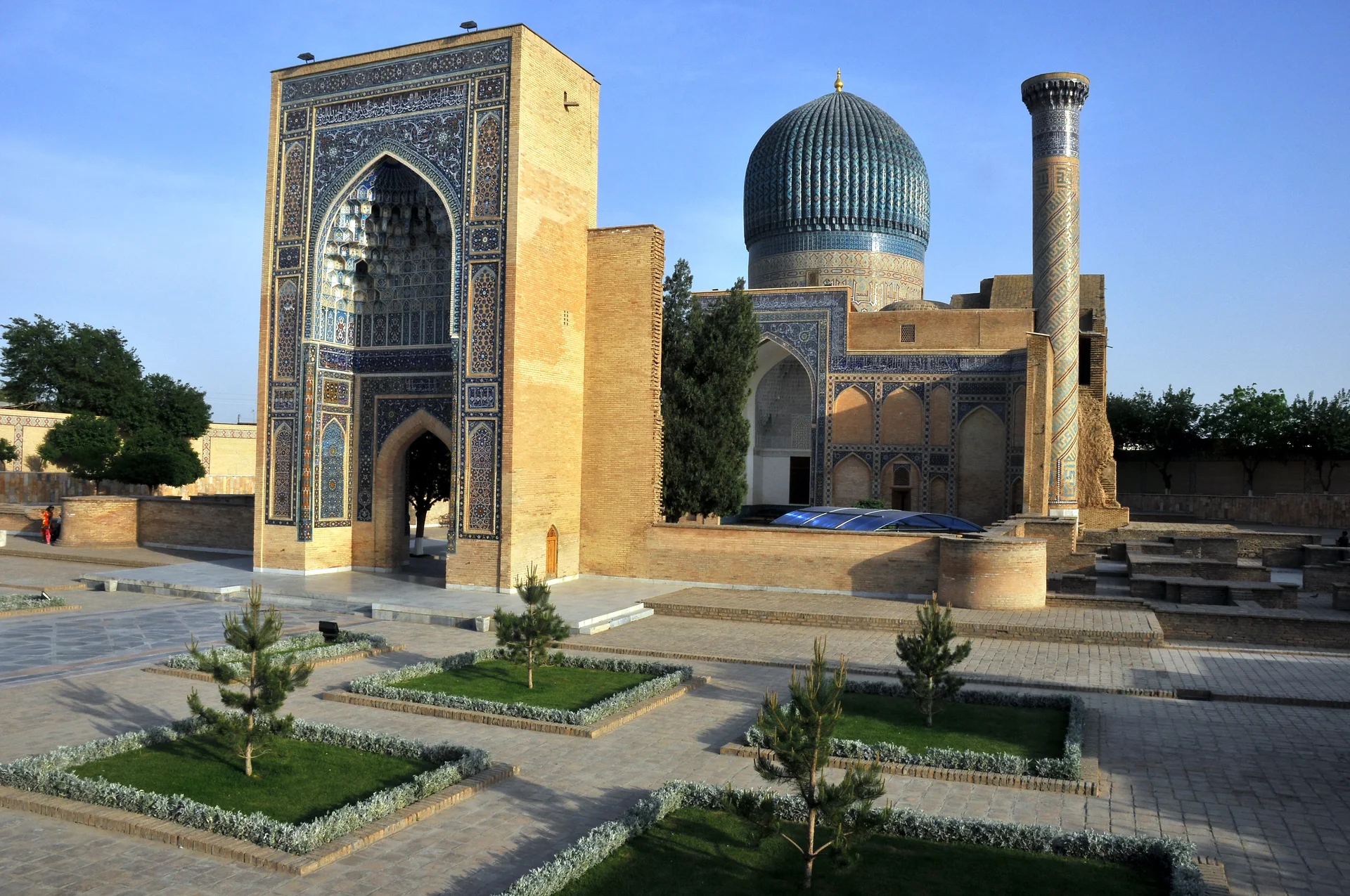
Gur-e-Amir Mausoleum
Timurid Architects and Artisans, c. 1404
🏛️ Samarkand, Uzbekistan
The mausoleum of Timur and his descendants in Samarkand, renowned for its fluted azure dome and sophisticated tilework representing the pinnacle of Timurid architecture.
Zafarnama Miniature: Battle of Ankara
Attributed to the School of Kamāl ud-Dīn Behzād, Late 15th - Early 16th century
🏛️ Topkapi Palace Museum, Istanbul
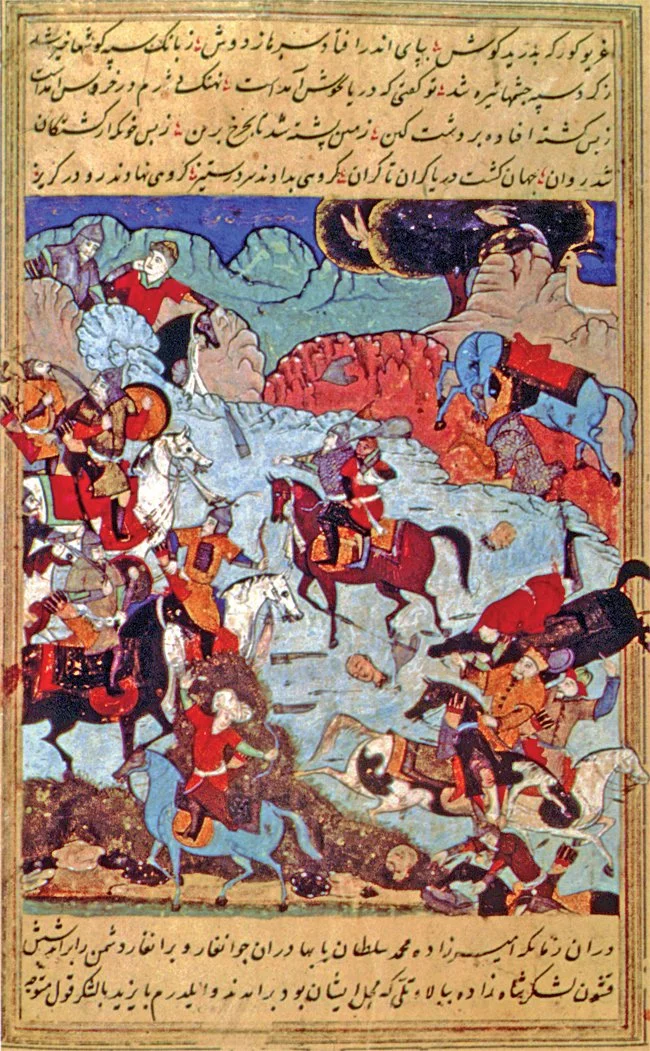
A detailed Persian miniature from the Zafarnama (Book of Victories) depicting Timur's forces overcoming the Ottoman army at the Battle of Ankara in 1402.
The Timur Ruby (Spinel Gemstone)
Ancient Persian and Central Asian Lapidaries, 14th - 17th century
🏛️ Royal Collection Trust, London
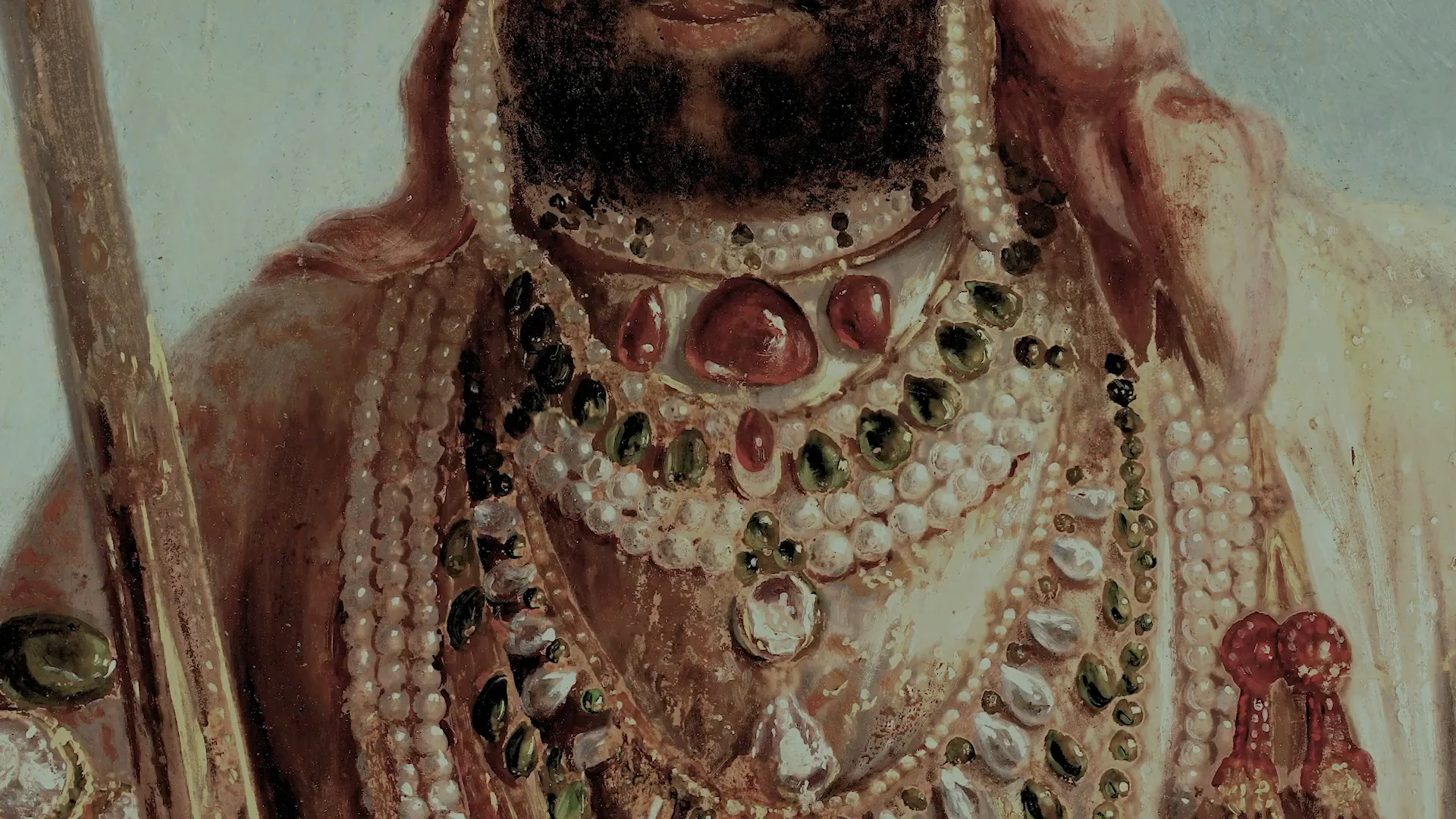
A famous 352-carat red spinel inscribed in Persian with the names of Timur, Ulugh Beg, and later Mughal emperors, symbolizing supreme dynastic prestige.
Related Videos
Rise of Timur - War against Toqtamish - MONGOL INVASIONS DOCUMENTARY