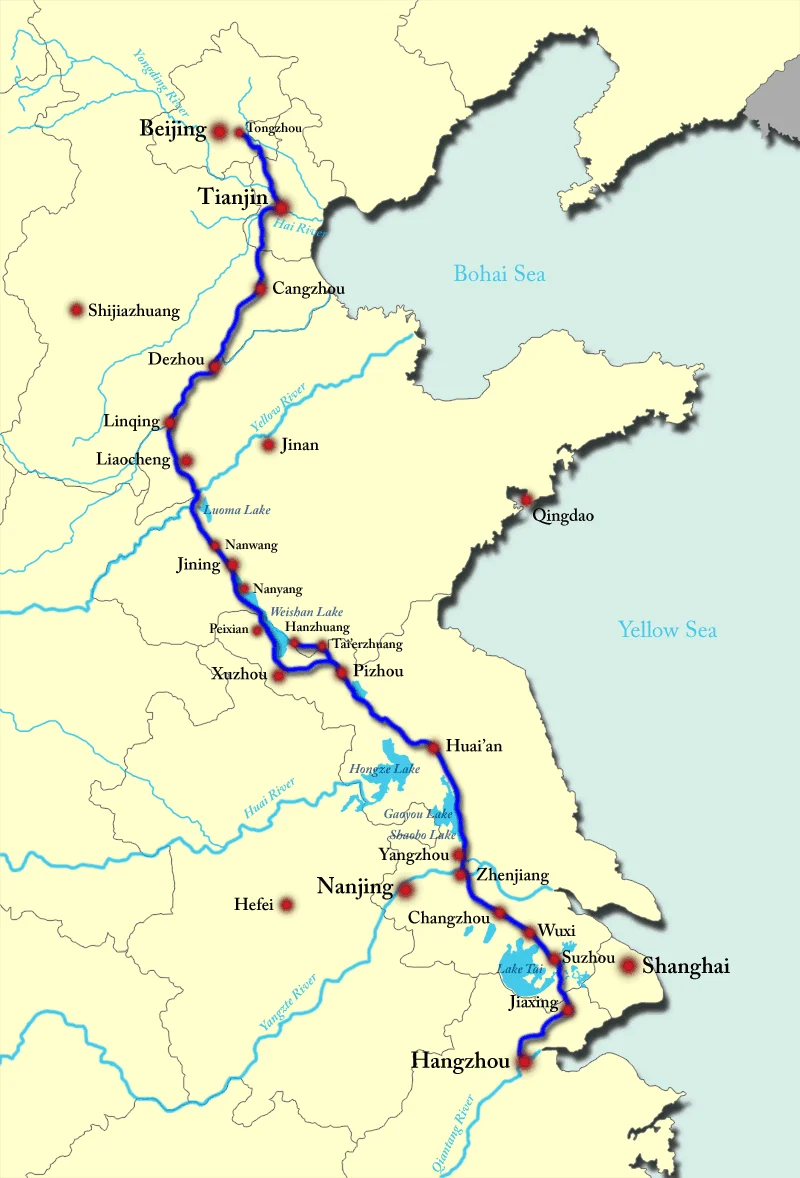
The lives of the people became very difficult due to Emperor Yang of Sui's unreasonable military campaigns against Goguryeo and massive construction projects like the Grand Canal. Unable to endure any longer, peasants and local soldiers started rebellions (uprisings to overthrow the government) everywhere. In 617, as the country was heavily shaken, Li Yuan, the Duke of Tang - A high-ranking noble title in ancient China. Li Yuan held the title of Duke of Tang under the Sui dynasty before he rebelled and founded the Tang dynasty. The name of his dynasty, Tang, was derived from this title., and his brilliant son Li Shimin - The second emperor of the Tang dynasty, renowned as one of China's greatest rulers and military strategists., who were guarding the important northern defense city of Taiyuan - Taiyuan is an important military city in northern China. Towards the end of the Sui Dynasty, Li Yuan and his son Li Shimin were tasked with guarding this city. As the country fell into chaos, the two gathered their army here in 617 to rise up and change the world. Legend has it that Li Yuan was originally hesitant to stand against the emperor, but his son Li Shimin secretly gathered talented people and persuaded his father to make the big decision here in Taiyuan. They marched from Taiyuan to capture the capital and eventually founded a new empire called the Tang Dynasty. Therefore, Taiyuan is remembered in history as the birthplace of the Tang Dynasty., gathered an army to restore order. They quickly marched south, persuading or defeating surrounding factions, and captured the capital, Chang'an. The following year, in 618, Emperor Yang, who had fled, was betrayed and killed by his own men, leading to the complete collapse of the Sui Dynasty - The Sui dynasty unified China in 589 AD after nearly four centuries of division. Emperor Wen and Emperor Yang carried out massive projects, most famously the Grand Canal, which connected the Yellow and Yangtze Rivers. Legend says the construction was so immense that thousands of workers died, and Emperor Yang was cursed by the spirit of the earth for disturbing its veins. This hubris and the disaster of the Goguryeo wars eventually caused the dynasty to collapse after only 37 years, but it paved the way for the Tang dynasty's glory.. Li Yuan then founded the new Tang Dynasty - The Tang dynasty is often considered the golden age of Chinese civilization. It was a cosmopolitan empire where different cultures and religions met along the Silk Road. Legend says the Tang emperors were descendants of the founder of Taoism, Laozi. This era saw the height of Chinese poetry with masters like Li Bai and Du Fu. The famous 'Journey to the West' (Sun Wukong) is based on the pilgrimage of the monk Xuanzang to India during the Tang dynasty. Its capital, Chang'an, was the most populous and advanced city in the world at the time. and became Emperor Gaozu - The founder and first emperor of the Tang dynasty..
Although the Tang Dynasty was established, the whole of China was not yet united. Several powerful warlords (military leaders who control specific regions), such as Wang Shichong - A powerful warlord who declared himself emperor during the fall of the Sui Dynasty but was defeated by the Tang. and Dou Jiande - A respected peasant uprising leader who established the Xia state but was defeated at the Battle of Hulao., threatened the Tang Dynasty from various places. During this early crisis, the military genius of his son Li Shimin shone brightly. In 621, Li Shimin faced a massive coalition army formed by Wang Shichong and Dou Jiande at a narrow and rugged fortress called Hulao Pass. Waiting patiently for the enemy's weakness, Li Shimin launched a brilliant surprise attack and won a great victory. With this triumph, the Tang Dynasty completely took over the North China Plain, the heartland of China, crossing the biggest hurdle towards unification.
The second son, Li Shimin, made the greatest contribution to defeating external enemies and unifying the country. However, the first in line to inherit the throne was his older brother, Crown Prince Li Jiancheng. This led to a fierce and scary power struggle between the brothers over who would become the next emperor. Believing that his older brother Li Jiancheng and younger brother Li Yuanji were plotting to harm him, Li Shimin eventually ambushed and killed them at the Xuanwu Gate, the northern gate of the imperial palace, in 626. This terrible event is known as the Xuanwu Gate Incident. Deeply shocked, his father Emperor Gaozu handed over the emperor's seat to Li Shimin shortly after, making him Emperor Taizong, the second emperor of the Tang Dynasty.
After becoming emperor, Tang Taizong (Li Shimin) practiced excellent politics and quickly stabilized the inside of the country. He then turned his attention to the Eastern Turkic Khaganate - A powerful nomadic empire established by the Gokturks, ruling the eastern Eurasian steppes. They were fierce warriors who clashed with the Sui and early Tang dynasties. Legend says the Turks originated from a boy who survived a massacre and a she-wolf who nurtured him, which became the sacred symbol of the wolf head on their banners. At its height, the Khaganate demanded tribute from Chinese dynasties and controlled vast trade routes, before being defeated by Emperor Taizong of Tang., a powerful nomadic empire in the north that had constantly harassed China since the Sui Dynasty. In 630, Taizong entrusted a large army to the great general Li Jing to attack the Eastern Turks. Amidst a fierce blizzard, the Tang army launched a lightning-fast surprise attack, completely destroying the Eastern Turks and capturing their supreme leader, the Khagan. With this victory, the Tang Dynasty gained control over the Silk Road - The Silk Road was a very long network of trade routes that connected the East and the West in ancient times. It got its name, which means 'route of silk,' because expensive and beautiful Chinese silk was traded along these paths starting from the Han Dynasty. Merchants traveled on camels across deserts and mountains, exchanging not only goods like spices and jewels, but also sharing different religions, new technologies, and interesting stories. Later, massive empires like the Tang Dynasty and the Mongol Empire gained incredible wealth and power by protecting and managing these important routes. (an important trade route connecting the East and the West) in Central Asia, opening a dazzling golden age that would last for hundreds of years.