In the mid-8th century, the Tang Dynasty - The Tang dynasty is often considered the golden age of Chinese civilization. It was a cosmopolitan empire where different cultures and religions met along the Silk Road. Legend says the Tang emperors were descendants of the founder of Taoism, Laozi. This era saw the height of Chinese poetry with masters like Li Bai and Du Fu. The famous 'Journey to the West' (Sun Wukong) is based on the pilgrimage of the monk Xuanzang to India during the Tang dynasty. Its capital, Chang'an, was the most populous and advanced city in the world at the time. reached its golden age under Emperor Xuanzong, boasting unprecedented economic prosperity and military might. Gao Xianzhi - A prominent Tang dynasty general of Goguryeo descent who led numerous successful campaigns in Central Asia before his defeat at the Battle of Talas., a brilliant general of Goguryeo descent and the Protector-General of the West, led daring campaigns across the Pamir Mountains, subjugating numerous kingdoms and extending Tang's reach deep into Central Asia. This relentless expansion eventually brought the Tang empire to the borders of Chach (modern-day Tashkent - An ancient oasis kingdom located in modern-day Tashkent, Uzbekistan. It was a crucial stop on the Silk Road, prospering from trade. In Chinese records, it was known as 'Shi' (石), meaning 'Stone'. Its history is marked by a tragic betrayal in 750 AD when the Tang General Gao Xianzhi broke a peace treaty and launched a surprise attack. Despite King Chabishi's peaceful surrender, Gao looted the capital and sent the king to Chang'an, where he was executed. This incident enraged Central Asian states and the King's son eventually sought help from the Abbasid Caliphate, leading to the pivotal Battle of Talas in 751.), a crucial node on the Silk Road - The Silk Road was a very long network of trade routes that connected the East and the West in ancient times. It got its name, which means 'route of silk,' because expensive and beautiful Chinese silk was traded along these paths starting from the Han Dynasty. Merchants traveled on camels across deserts and mountains, exchanging not only goods like spices and jewels, but also sharing different religions, new technologies, and interesting stories. Later, massive empires like the Tang Dynasty and the Mongol Empire gained incredible wealth and power by protecting and managing these important routes., setting the stage for a grand collision between the giants of the East and the West.
In 750 AD, Gao Xianzhi employed a ruthless tactic by signing a peace treaty with Chach to lower their guard, only to immediately break it and launch a surprise invasion. Although King Chabishi of Chach surrendered peacefully to avoid bloodshed, Gao ignored the surrender, arrested the king, and brutally looted the capital, seizing its vast treasures. The king was eventually sent to the Tang capital, Chang'an, where he was executed by order of Emperor Xuanzong despite having surrendered.
This incident became a fatal turning point for Tang influence in the West. The brutal execution of a surrendered monarch sent shockwaves through the Central Asian oasis states, causing them to turn their backs on the Tang in favor of new allies. The Prince of Chach, who narrowly escaped, fled to the newly rising Abbasid Caliphate - The Abbasid Caliphate was the third Islamic caliphate to succeed the Islamic prophet Muhammad. It was established by a dynasty descended from Muhammad's uncle, Abbas ibn Abd al-Muttalib. They overthrew the previous Umayyad Caliphate in the historic Abbasid Revolution. The coup was fueled by widespread dissatisfaction with the Umayyads, who favored Arab Muslims over non-Arab converts. By promising equality for all Muslims regardless of their ethnicity, the Abbasids successfully united various groups and established a new capital in Baghdad, Iraq. Baghdad was designed as a unique, perfectly circular city, often referred to as the Round City, which quickly grew into the cultural and intellectual hub of the medieval world. This era initiated the renowned Islamic Golden Age, a period where science, mathematics, philosophy, literature, and technology flourished dynamically. The caliphs believed that knowledge was the greatest treasure, prompting them to establish the House of Wisdom, a massive library and translation center in Baghdad. Scholars from all over the world, regardless of their religion, gathered here to translate ancient Greek, Persian, Indian, and Chinese texts into Arabic. Through this collective effort, major intellectual breakthroughs were achieved. For instance, the famous mathematician al-Khwarizmi laid the foundations of algebra (a word derived from al-jabr) and his latinized name gave us the word algorithm, which forms the basis of modern computer science. Scholars also accurately calculated the circumference of the Earth, advanced medicine, and introduced paper-making technology from China to the West. A famous legendary figure from this magnificent era is Caliph Harun al-Rashid, whose reign marked the zenith of Abbasid wealth and power. He is prominently featured in the folklore of the One Thousand and One Nights, a collection of Middle Eastern folk tales and magical myths. According to the legends, Harun al-Rashid would frequently disguise himself in the simple clothes of a commoner and roam the night streets of Baghdad alongside his vizier, aiming to witness the true conditions of his subjects and deliver justice directly to those in need. Stories of magical jinns, flying carpets, and hidden caves filled with treasures, such as the adventures of Aladdin and Ali Baba, were inspired by the vibrant, cosmopolitan atmosphere of Baghdad under Abbasid rule. Although the caliphate gradually weakened over centuries and finally came to a tragic end during the Mongol sack of Baghdad in 1258, its legacy remains one of the most brilliant and peaceful chapters in human intellectual history, leaving behind a wealth of knowledge that helped shape the modern world. to plead for help. What started as a local betrayal suddenly escalated into a massive international war between the Eastern superpower and the rising power of the West.
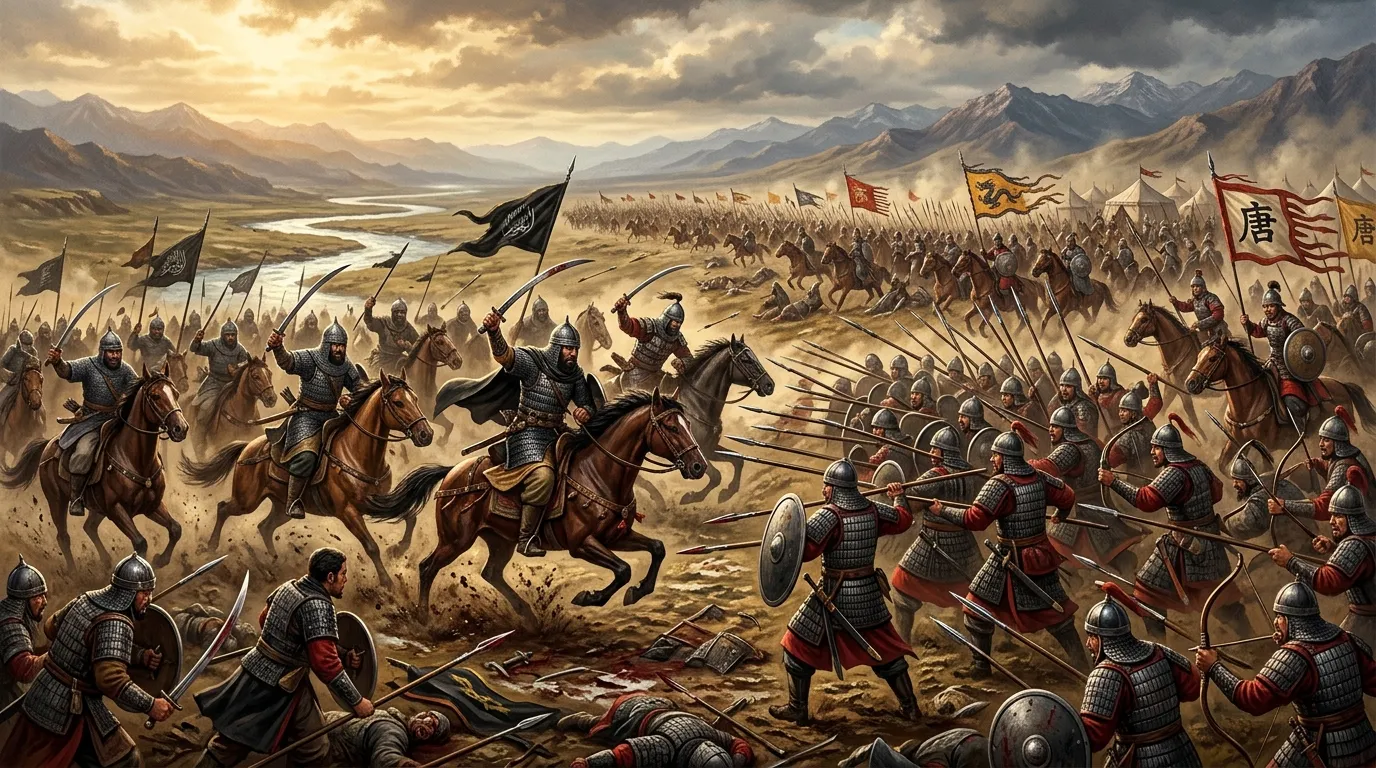
In 751, the two colossal armies clashed near the Talas River - A river that flows through modern-day Kyrgyzstan and Kazakhstan. It was the site of the historic Battle of Talas in 751 AD, where the Abbasid Caliphate defeated the Tang dynasty, marking the end of Tang expansion to the west and the beginning of the spread of Islam in Central Asia.. The Tang army, numbering around 30,000 to 70,000 soldiers, faced a massive Islamic coalition army that some estimate was up to 200,000 strong. Despite being outnumbered, the Tang forces fought fiercely, and the two sides engaged in a tense, deadlocked battle for five whole days without a clear winner.
The turning point came from within. The Karluk nomadic tribes, who had been fighting as mercenaries on the side of the Tang, secretly switched their allegiance. They were deeply resentful of Tang's aggressive expansion and horrified by the execution of the Chach king. At the most critical moment, they launched a surprise attack from the rear, crushing the Tang formation and handing the Abbasids a total victory.
The consequences of this battle were profound. The Tang lost control of Central Asia forever, and the region began its long process of Islamization. However, captured Chinese artisans transmitted the secret of papermaking to the Islamic world. This technology eventually reached Europe, laying the groundwork for the Renaissance and the global spread of knowledge.