In 1220, during the campaign against the Khwarazmian Empire, Genghis Khan ordered his brilliant generals Jebe - Brilliant Mongol general who helped lead long-range campaigns from Central Asia to Eastern Europe. and Subutai - One of the greatest military commanders in history. He directed more than twenty campaigns and conquered thirty-two nations, successfully invading armies from Europe to Asia. to take 20,000 cavalrymen and chase down the fleeing Sultan, Ala ad-Din Muhammad II - Khwarazmian sultan who expanded his empire widely but collapsed under the Mongol invasion.. Although the Sultan managed to escape to a small island in the Caspian Sea where he died of illness shortly after, Genghis Khan commanded them not to end the mission, but to transition into a scouting operation to gather geographical and military intelligence on the unknown western lands. Thus, the generals decided to return by circling around the Caspian Sea, embarking on an unprecedented reconnaissance raid deeper into Europe.
The Mongol army successfully crossed the formidable Caucasus Mountains - The Caucasus Mountains are a grand mountain range stretching between the Black Sea and the Caspian Sea, serving as a natural boundary dividing Asia and Europe. With many peaks towering over 5,000 meters, its rugged terrain was historically considered an impassable natural barrier for large armies. According to ancient Greek mythology, this is the legendary place where the Titan Prometheus was chained to a cold cliff as a punishment for stealing fire from the gods to give to humanity. He suffered there daily as an eagle ate his liver. It is also nicknamed the 'Mountain of Tongues' because its deep valleys isolated many different tribes, allowing them to preserve their own unique languages. Historically, these mountains acted as a formidable natural fortress. However, in 1222, the Mongol forces led by Jebe and Subutai accomplished the miraculous feat of crossing the snowy, rugged Caucasus Mountains. Their sudden emergence from the southern slopes shocked the Alans and Cumans living in the northern steppes., defeating the Kingdom of Georgia - The Kingdom of Georgia was a powerful and prosperous medieval kingdom that flourished in the Caucasus region from the 11th to the 13th century. Surrounded by deep valleys and rugged mountains, it possessed a strong natural defense. Under the reign of Tamar the Great, the kingdom reached its golden age of cultural and military strength. Many fascinating legends are preserved in Georgia. According to the founding legend of its capital, Tbilisi, King Vakhtang was hunting when his falcon fell into a warm hot spring while chasing a pheasant. Impressed by the hot springs, the king founded a city there and named it 'Tbilisi,' which means 'warm place.' Furthermore, Queen Tamar was so deeply revered that folk legends claimed she rode a mythical winged horse at night to defeat her enemies. However, in 1221, the kingdom faced a severe crisis when the Mongol generals Jebe and Subutai arrived. Although the brave Georgian knights fought fiercely, they were defeated by the Mongols' deceptive tactics, marking the beginning of the kingdom's gradual decline. in a series of engagements. After descending into the Pontic steppe, they faced a coalition of Alans and Cumans - The Cumans were a nomadic Turkic people of the Eurasian Steppe, known for their migration to the west and their influence on Medieval European history. They ruled a vast grassland territory north of the Black Sea known as Cumania. According to local nomadic legends, the Cumans highly revered the wolf as their ancestor and sacred totem; it was said that their warriors could communicate by mimicking wolf howls at night to coordinate surprise attacks, believing the wolf spirits guided them in battle.. Showing great strategic cunning, Subutai approached the Cumans, pointing out that both peoples were nomads and brothers, and offered them gold to break their alliance with the Alans. Once the Cumans withdrew, the Mongols - The Mongol Empire existed during the 13th and 14th centuries and was the largest contiguous land empire in history. Originating in present-day Mongolia in East Asia, the Mongol Empire at its height st... crushed the Alans, and subsequently pursued and defeated the unsuspecting Cumans as they retreated.
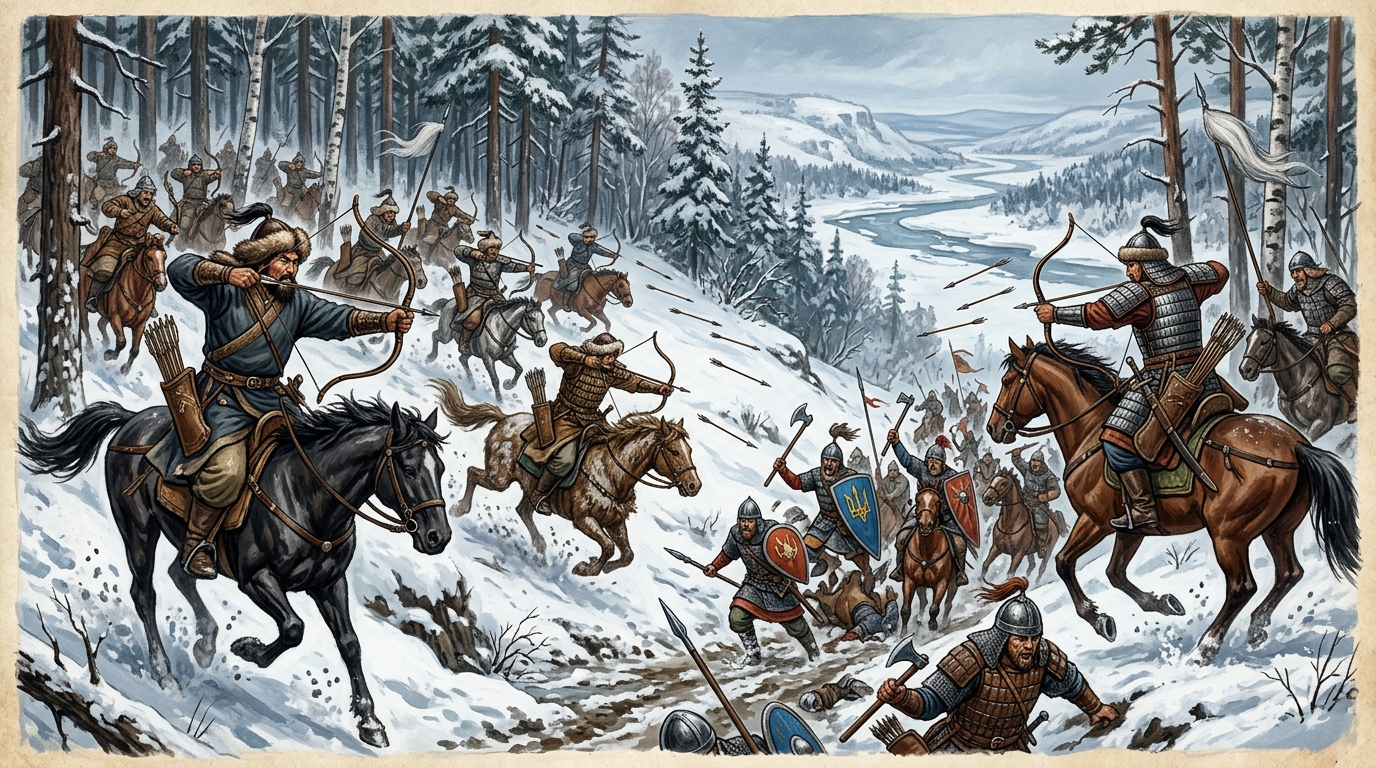
Terrified by the Mongol onslaught, the fleeing Cumans turned to the princes of Kyivan Rus' - Kyivan Rus' was a grand, loose federation of East Slavic and Finno-Ugric peoples that flourished from the late 9th to the mid-13th century, encompassing modern-day Ukraine, Belarus, and western Russia. Situated along the major river routes linking the Baltic Sea to the Black Sea, it prospered greatly through international trade and cultural exchanges. Rich legendary stories define the history of Kyivan Rus'. According to the Primary Chronicle, Slavic tribes invited the Varangian (Viking) chieftain Rurik to bring order to their lands. His successor, Oleg, captured Kyiv and proclaimed it the 'mother of all Rus' cities.' Another famous legend surrounds Volodymyr the Great's adoption of Christianity. When his envoys visited Constantinople's Hagia Sophia, they were so awed by the beauty of the service that they reported, 'We knew not whether we were in heaven or on earth.' Captivated by this description, the Grand Prince baptized the entire nation into the Orthodox faith. During its golden age, Kyivan Rus' established its first legal code, the Russkaya Pravda, and fostered a brilliant Slavic-Byzantine culture. However, succession disputes among local princes gradually fractured the federation. Ultimately, starting with the devastating defeat at the Battle of the Kalka River in 1223, the Mongol invasions shattered the state, leading to the destruction of Kyiv in 1240. Despite its tragic fall, Kyivan Rus' remains the shared cultural and historical ancestor of modern Ukraine, Belarus, and Russia. for help. Sensing the danger, a grand alliance of several Rus' princes and Cuman remnants gathered an army of around 80,000 warriors. In 1223, this massive force marched to confront the Mongols. Rather than fighting them head-on, Subutai employed a feigned retreat strategy, luring the overconfident enemy toward the Kalka River - The Kalka River is a small river flowing through southeastern Ukraine, known today as the Kalchyk River. While it appears peaceful, it is highly famous as the site of the tragic Battle of the Kalka River in 1223 between the allied Rus' principalities and the Mongol Empire. According to ancient Russian oral epics called 'Bylinas,' legendary giant hero knights, including Ilya Muromets and his brave companions, fought their final battle near this river and tragically turned into stone. Another Christian folklore tells that because the Rus' princes were greedy and divided, God sent a mysterious and fearsome army (the Mongols) to the Kalka River to punish them. In actual history, the Rus' princes failed to unite and fought separately, falling into a trap laid by the Mongol general Subutai. Their massive army of 80,000 was completely annihilated, marking the grim beginning of the Mongol dominance over the Rus' lands.. The open steppe surrounding the river provided the perfect terrain for the swift Mongol horse archers to maneuver freely and execute encirclement tactics.
Furthermore, as the allied forces rushed across the river in pursuit, their vanguard became widely separated from the rear, breaking their formation. Seizing this moment, Subutai and Jebe suddenly wheeled around and launched a devastating counterattack. Surrounded on the wide plains under a hail of arrows, the disorganized coalition was completely annihilated. After this stunning victory, the generals returned eastward to Genghis Khan, leaving behind strategic intelligence that would pave the way for the later conquest of Eastern Europe.