The war erupted in 572 when Justin II - Justin II (c. abrogated the peace treaty of his predecessor and refused to pay the humiliating annual tribute to Khosrow I - Khosrow I (r.. However, early Byzantine offensives faltered, and in 573, the vital fortress of Dara - A strategically important Eastern Roman fortress city in northern Mesopotamia (modern Turkey). Built by Emperor Anastasius I in 505 AD to counter the nearby Persian stronghold of Nisibis, it served as a key military base and was frequently besieged during the Byzantine-Sasanian wars. Its capture by the Persians in 573 was a major blow to the Byzantines. fell to the Persia - The Sasanian Empire was the last Persian imperial dynasty before the Muslim conquest. Founded by Ardashir I in 224 AD, it revived Iranian traditions and Zoroastrianism, becoming a superpower alongside...ns. Dara was Byzantium's principal stronghold on the Mesopotamia - A historical region in Western Asia situated within the Tigris–Euphrates river system. The name means 'land between rivers'. It is often called the 'cradle of civilization' as it was home to some of the earliest human civilizations, including Sumer, Akkad, Babylonia, and Assyria.n frontier, designed to counter nearby Nisibis and secure key military supply routes. Around this time, Justin II developed a severe mental illness, rendering him incapable of ruling. With the emperor incapacitated, Tiberius II stepped in as regent to manage the crisis.
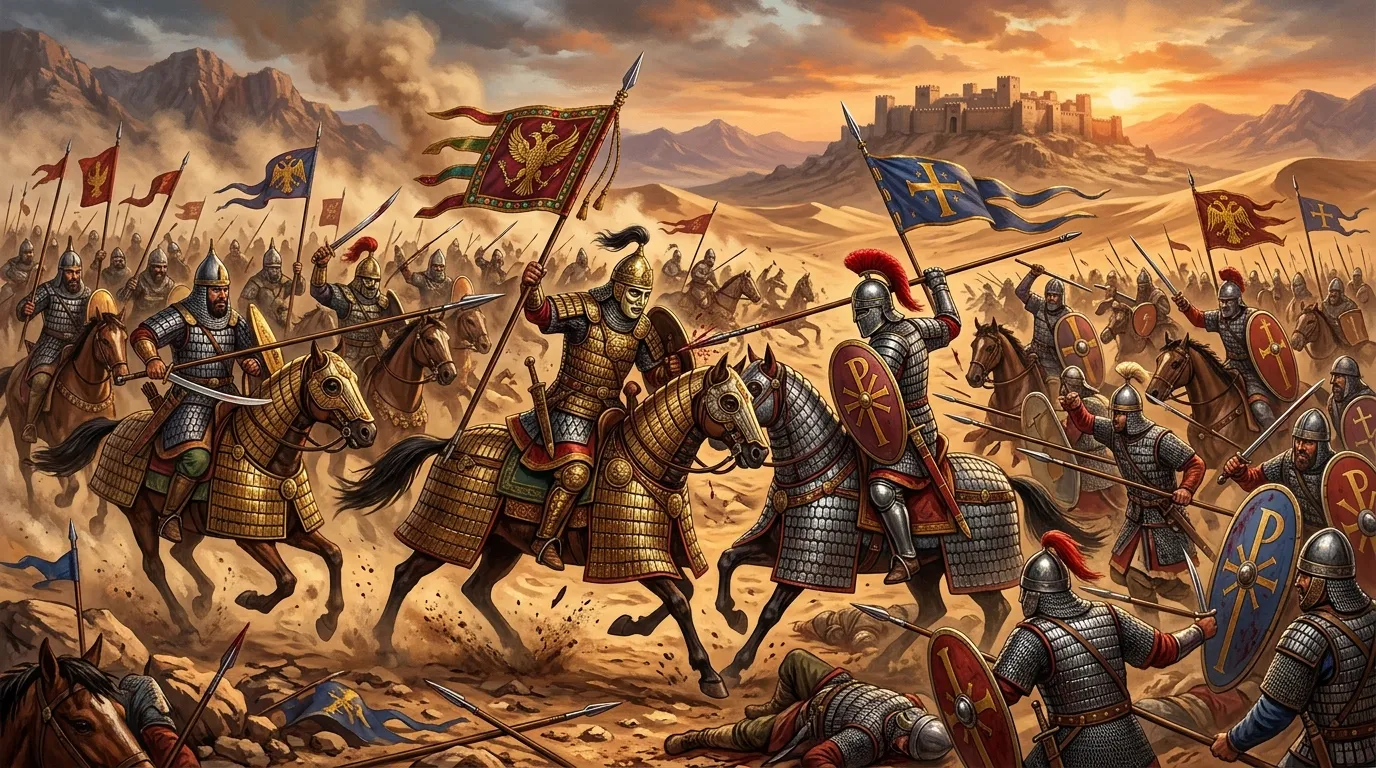
Under Tiberius II and his capable general Maurice - Maurice (539–602 AD) was Byzantine Emperor from 582 to 602 and one of the most capable rulers of late antiquity., the Byzantines stabilized the crumbling front. The conflict devolved into a grueling war of attrition, with raids and counter-raids trading blows across Mesopotamia and Armenia - The Kingdom of Armenia, situated in the rugged Armenian Highlands, was a formidable power in the ancient Near East. Emerging from the ashes of the Iron Age kingdom of Urartu, it reached its zenith under Tigranes the Great (r. 95–55 BC). Tigranes expanded the kingdom into a vast empire stretching from the Caspian Sea to the Mediterranean, earning the title 'King of Kings' and building a magnificent new capital, Tigranocerta.. In 586, the new Byzantine commander Philippicus achieved a major tactical victory at the Battle of Solachon. By cutting off the Sasanian cavalry's water supply, the Byzantines decisively defeated them, successfully halting further massive Persian offensives in Mesopotamia and greatly restoring the shattered morale of the Byzantine army. However, a strategic breakthrough remained elusive for both empires, and the long war of attrition continued.
The deadlock was broken not on the battlefield, but by a civil war within the Sasanian Empire. In 590, the Persian general Bahram Chobin - Bahram Chobin (died 591 AD) was a famous Sasanian general from the noble House of Mihran. rebelled, deposing King Hormizd IV and seizing the throne. Hormizd's son, Khosrow II - Khosrow II (r., fled for his life to the court of his traditional enemy, the Byzantine Empire - The medieval continuation of the Roman Empire in the East, centered on Constantinople. For over a millennium, it served as a bastion of Christianity and Roman law, preserving ancient knowledge until its fall in 1453., pleading for Emperor Maurice's aid.
Maurice seized this opportunity to end the war on favorable terms. He agreed to support Khosrow II in exchange for significant territorial concessions. In 591, a combined Byzantine-Persian loyalist army defeated the usurper Bahram Chobin and restored Khosrow to his throne. True to his word, Khosrow ceded Dara, Martyropolis - An ancient city in Upper Mesopotamia (modern Silvan, Turkey), also known as Tigranocerta. It was a strategically important border city between the Byzantine and Sasanian empires and was frequently contested. It was ceded to Byzantium by Khosrow II in 591., and most of Persarmenia and Iberia - A Caucasian Georgian kingdom centered on Kartli, whose borders shifted repeatedly between Roman/Byzantine and Sasanian influence. to Maurice. The war concluded with a resounding Byzantine victory, extending the empire's eastern frontier to its greatest extent in centuries.