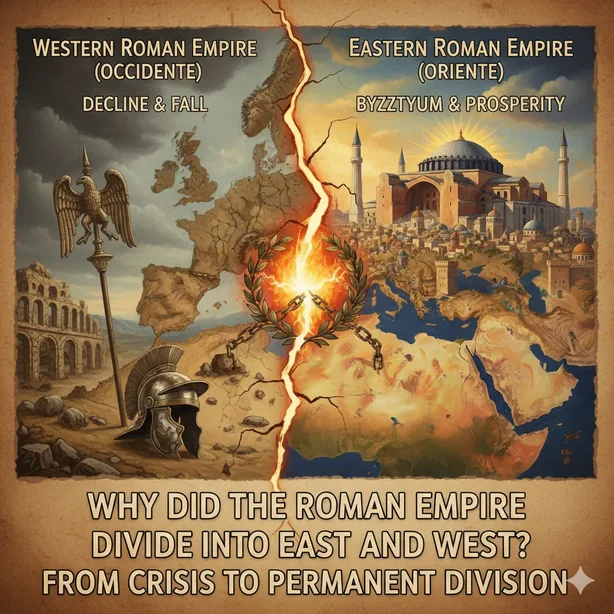
Why did the Roman Empire split?
From Crisis to Permanent Division
Read Article →
Embark on a journey through the brilliant heritage of the world.
Abbasid Revolution
A catastrophic war for the Eastern Roman Empire that began with a mass migration of Goths fleeing the Huns and culminated in the Battle of Adrianople, where the Roman army was destroyed and an emperor killed.
The series of events and battles led by Prophet Muhammad that resulted in the unification of Arabia under Islam. Starting from his first revelation in Mecca, it includes the Hijra to Medina, the defensive battles against the Quraysh, and the eventual peaceful conquest of Mecca.
A massive civil war in the Tang dynasty initiated by the generals An Lushan and Shi Siming, which devastated the empire and marked its permanent decline.
When Abu Sa'id, the last Ilkhan, died suddenly without an heir in 1335, the Ilkhanate fell into twenty-two years of civil war. Rival general families each raised their own puppet khan, and the realm broke apart into the Jalayirids, Chobanids and other successor states. In 1357 the Golden Horde seized Tabriz, and the name of the Ilkhanate disappeared.
A transformative period triggered by the westward expansion of the Huns, causing Germanic tribes to migrate into the Roman Empire. This era saw the sack of Rome, the collapse of the Western Roman Empire, and the rise of new Germanic kingdoms that laid the foundations of medieval Europe.
The rapid collapse of the once-dominant Khitan Liao Empire due to the rise of the Jurchen Jin Dynasty under Wanyan Aguda and a joint military alliance with the Song Dynasty.