Historical Map
Font Size
Language
Theme

Loading Map...

Map Height
Scroll Sensitivity1.0
537 AD (Approx.)
Americas · Ancient 537 AD – 744 AD

Tikal–Calakmul Wars

A two-century series of hegemonic conflicts fought between the rival Classic Maya - An ancient American civilization of rainforest city-states renowned for its hieroglyphic script, astronomy, and towering pyramid temples superpowers of southern Tikal - Tikal (known in ancient Mayan as Yax Mutul) was the largest metropolis of the Classic Maya civilization and the capital of its primary southern superpower, located deep within the rainforests of northern Guatemala's Petén Basin. At its 8th-century zenith, the city supported up to 100,000 inhabitants and was crowned by steep limestone stepped pyramids rising above the jungle canopy. Although built on porous limestone hills without permanent rivers or lakes, Tikal flourished thanks to advanced hydraulic engineering. Its builders paved vast public plazas with waterproof stucco at slight angles to channel seasonal monsoon rains into more than ten massive artificial reservoirs, purifying the water with sand and volcanic zeolite filters to sustain the population through the dry season. Following a 378 CE military intervention by the central Mexican metropolis of Teotihuacan that installed a new dynasty, Tikal rose to dominate the southern Maya lowlands and waged two centuries of hegemonic warfare against northern rival Calakmul. After enduring a 130-year hiatus following its 562 CE defeat, Tikal achieved a dramatic resurgence in 695 CE under King Jasaw Chan K'awiil I, who defeated Calakmul and erected the iconic Temple of the Great Jaguar (Temple I). (the Mutul Kingdom) and northern Calakmul - Calakmul (ancient Mayan name Ox Te' Tuun, 'Three Stones') was the capital of the premier northern superpower of the Classic Maya civilization, located deep in the rainforests of southern Campeche, Mexico, at the base of the Yucatán Peninsula. Meaning 'City of the Two Adjacent Pyramid Mounds' in modern Mayan, it served as the seat of the powerful Kaan ('Snake') Kingdom. The city's ceremonial core is dominated by Structure II, a colossal pyramid rising 55 meters high with a 140-meter base that makes it one of the largest by volume in the Maya world. Archaeologists have mapped over 6,750 ancient structures and 117 carved Maya Stelae—more than in any other Maya city—alongside 13 vast reservoirs that sustained over 50,000 residents. After relocating its capital southward from Dzibanché to Calakmul in the mid-6th century, the Kaan dynasty forged a ring of royal marriage and military alliances with Caracol, Naranjo, Dos Pilas, and Waka' to encircle its southern arch-rival Tikal. Following its 562 CE victory over Tikal, Calakmul reigned as the supreme hegemon of the Maya lowlands for 130 years until its defeat in 695 CE. (the Kaan or 'Snake' Kingdom) and their extensive networks of allied city-states for mastery over the Maya lowlands and inland trade routes.

LocationSouthern Yucatán Peninsula - The Yucatán Peninsula is a vast landmass projecting northward between the Gulf of Mexico and the Caribbean Sea, encompassing southeastern Mexico (the states of Yucatán, Campeche, and Quintana Roo), northern Guatemala's Petén region, and Belize as the overarching geographic stage of the Maya civilization. Formed of a massive flat limestone shelf, the northern peninsula lacks surface rivers; instead, ancient Maya communities relied on natural sinkholes called cenotes—formed where limestone caverns collapsed to expose groundwater—both for drinking water and as sacred portals to the underworld. The southern base of the peninsula is covered in dense tropical rainforests and seasonal wetlands. During the Classic Period (250–900 CE), the superpowers of Calakmul and Tikal at the southern base of the peninsula contested mastery over the Maya world. Following the 9th-century decline of the southern lowland cities due to prolonged warfare and drought, the center of Maya civilization shifted to northern peninsular cities such as Chichén Itzá, Uxmal, and Mayapán., Petén Basin - The Petén Basin is a vast tropical limestone lowland spanning northern Guatemala, southeastern Mexico, and western Belize that served as the geographic and cultural heartland of the Classic Maya civilization. Characterized by dense rainforests, seasonal wetlands (bajos), and Lake Petén Itzá, the region sits at an average elevation of 100 to 300 meters. Although the porous karst limestone bedrock allowed surface water to drain rapidly underground, the ancient Maya quarried the abundant limestone to erect monumental pyramid temples and lined vast plazas and reservoirs with waterproof lime stucco, sustaining millions of inhabitants across the lowlands. Home to the great city-states of Tikal, Calakmul, Naranjo, and Waka', the Petén Basin formed the strategic crossroads linking highland trade in jade and obsidian with northern coastal salt and cotton, making it the primary theater of the two-century Tikal–Calakmul Wars. (Guatemala), Belize, and Southeastern Mexico (Classic Maya - An ancient American civilization of rainforest city-states renowned for its hieroglyphic script, astronomy, and towering pyramid temples Lowlands)
BelligerentsKingdom of Tikal - The southern Classic Maya superpower in Guatemala's Petén Basin, renowned for its towering Temple of the Great Jaguar (Mutul - Tikal (known in ancient Mayan as Yax Mutul) was the largest metropolis of the Classic Maya civilization and the capital of its primary southern superpower, located deep within the rainforests of northern Guatemala's Petén Basin. At its 8th-century zenith, the city supported up to 100,000 inhabitants and was crowned by steep limestone stepped pyramids rising above the jungle canopy. Although built on porous limestone hills without permanent rivers or lakes, Tikal flourished thanks to advanced hydraulic engineering. Its builders paved vast public plazas with waterproof stucco at slight angles to channel seasonal monsoon rains into more than ten massive artificial reservoirs, purifying the water with sand and volcanic zeolite filters to sustain the population through the dry season. Following a 378 CE military intervention by the central Mexican metropolis of Teotihuacan that installed a new dynasty, Tikal rose to dominate the southern Maya lowlands and waged two centuries of hegemonic warfare against northern rival Calakmul. After enduring a 130-year hiatus following its 562 CE defeat, Tikal achieved a dramatic resurgence in 695 CE under King Jasaw Chan K'awiil I, who defeated Calakmul and erected the iconic Temple of the Great Jaguar (Temple I). Kingdom) and Pro-Tikal Allies (Early Caracol - Caracol (ancient Mayan name Oxwitza', 'Three-Hill Water') was a major Classic Maya city-state situated on a 500-meter plateau in the foothills of the Maya Mountains in western Belize. Its monumental centerpiece, the Caana ('Sky Place') pyramid complex, rises 43 meters high and remains the tallest human-made structure in Belize today. Supported by hundreds of square kilometers of hillside agricultural terraces and a radiating network of raised limestone causeways (sacbeob) connecting outlying settlements to the urban core, Caracol grew into a demographic and military powerhouse with over 100,000 inhabitants at its 7th-century peak. Originally a subordinate ally of Tikal—whose king sponsored the accession of Caracol's ruler Yajaw Te' K'inich II in 553 CE—Caracol switched allegiance to northern rival Calakmul after Tikal attacked Caracol in 556 CE. On April 29, 562 CE, Caracol and Calakmul launched a decisive Star War that conquered Tikal, propelling Caracol into a century of golden-age prosperity., Palenque - Palenque (ancient Mayan name Lakamha', 'Big Water') was the capital of the western Classic Maya kingdom of B'aakal, nestled in the lush foothills of Chiapas in southern Mexico. Renowned for its aqueduct-channeled mountain streams, refined stucco bas-reliefs, and extensive Maya Hieroglyphic inscriptions, it was an artistic jewel of the Maya world. Because Palenque maintained friendly ties with Tikal and anchored the western Maya lowlands, it became a prime target for the northern superpower Calakmul. Marching hundreds of kilometers across rivers and dense jungle, Calakmul and its allies launched daring long-range expeditions that sacked Palenque twice, in 599 CE and 611 CE, devastating its royal court. Out of this dynastic crisis rose K'inich Janaab Pakal I ('Pakal the Great'), who ascended the throne at age twelve in 615 CE and reigned for 68 years, restoring Palenque to unprecedented architectural splendor. His monumental Temple of the Inscriptions, housing his subterranean crypt, jade funerary mask, and intricately carved sarcophagus lid, remains one of the greatest masterpieces of ancient American archaeology., etc.), Kingdom of Calakmul - The northern Classic Maya superpower symbolized by the Snake Emblem Glyph that dominated the Maya world through masterstroke alliance diplomacy (Kaan / 'Snake' Kingdom) and the Serpent Alliance Network (Caracol - Caracol (ancient Mayan name Oxwitza', 'Three-Hill Water') was a major Classic Maya city-state situated on a 500-meter plateau in the foothills of the Maya Mountains in western Belize. Its monumental centerpiece, the Caana ('Sky Place') pyramid complex, rises 43 meters high and remains the tallest human-made structure in Belize today. Supported by hundreds of square kilometers of hillside agricultural terraces and a radiating network of raised limestone causeways (sacbeob) connecting outlying settlements to the urban core, Caracol grew into a demographic and military powerhouse with over 100,000 inhabitants at its 7th-century peak. Originally a subordinate ally of Tikal—whose king sponsored the accession of Caracol's ruler Yajaw Te' K'inich II in 553 CE—Caracol switched allegiance to northern rival Calakmul after Tikal attacked Caracol in 556 CE. On April 29, 562 CE, Caracol and Calakmul launched a decisive Star War that conquered Tikal, propelling Caracol into a century of golden-age prosperity., Dos Pilas - Dos Pilas (Spanish for 'Two Wells') was a militaristic Classic Maya city-state in the Petexbatún region of northern Guatemala, strategically situated near the Pasión and Salinas rivers to control the vital riverine trade routes of the southern Maya lowlands. Founded around 629 CE by Tikal to secure highland trade in jade, obsidian, and quetzal feathers while bypassing Calakmul's northern blockade, the outpost was placed under the rule of four-year-old Tikal prince B'alaj Chan K'awiil. The rulers of Dos Pilas adopted Tikal's own 'Mutul' emblem glyph, claiming to be the true rightful line of the Tikal royal house. In 650 CE, however, Calakmul's Great King Yuknoom Ch'een II conquered Dos Pilas and co-opted B'alaj Chan K'awiil into a loyal vassal of the Kaan Kingdom, turning Tikal's southern outpost into a spear aimed at its own heart. The ensuing 20-year fratricidal war between B'alaj Chan K'awiil and his brother, Tikal King Nuun Ujol Chaak—culminating in the latter's defeat and death in 679 CE—is vividly chronicled on Dos Pilas's famous Hieroglyphic Stairway., Naranjo - Naranjo (ancient Mayan name Sa'al) was a major Classic Maya city-state situated in the eastern Petén Basin of northeastern Guatemala near the modern border with Belize. Controlling the river valleys directly east of Tikal, Naranjo stood on the front lines of the centuries-long struggle between Tikal and Calakmul. Brought into Calakmul's orbit in 546 CE when the Kaan king installed its ruler, Naranjo later broke away and was conquered by a combined Calakmul–Caracol force in 631 CE. In 682 CE, the city experienced a dramatic revival when Lady Six Sky (Ix Wak Chan Jalam Lem) arrived from Dos Pilas to re-establish the royal dynasty, governing as a formidable warrior queen and regent loyal to the Calakmul alliance. Under Lady Six Sky and her son K'ak' Tiliw Chan Chaak, Naranjo launched repeated campaigns against Tikal's eastern borderlands. However, in 744 CE, Tikal's warrior king Yik'in Chan K'awiil stormed Naranjo, capturing its ruler Yax Mayuy Chan Chaak and seizing its sacred royal palanquin, permanently shattering Calakmul's eastern flank., Waka' - Waka' (modern archaeological site name El Perú) was a strategic Classic Maya city-state perched on an escarpment overlooking the San Pedro Mártir River in the western Petén Basin of Guatemala. Its location commanded the vital east–west riverine trade routes linking the Gulf Coast to the central Petén heartland around Tikal. So strategically critical that Teotihuacan's general Siyaj K'ak' stopped here in 378 CE eight days before entering Tikal, Waka' later became the western anchor of Calakmul's alliance network encircling Tikal. In the 7th century, Calakmul's Great King Yuknoom Ch'een II cemented this bond by marrying his royal daughter, Lady K'abel, to the king of Waka'. Invested with the supreme military title of Kaloomte'—outranking even her husband—Lady K'abel governed Waka' as a formidable warrior queen for over twenty years, threatening Tikal's western frontier. In 743 CE, however, Tikal King Yik'in Chan K'awiil stormed Waka', capturing its ruler Bahlam Tz'am and seizing its sacred patron effigy, breaking Calakmul's western stronghold., etc.)
Neighboring StatesTeotihuacan - The monumental highland metropolis of the Pyramids of the Sun and Moon that projected obsidian trade and military power across Mesoamerica
💡 Historical Significance

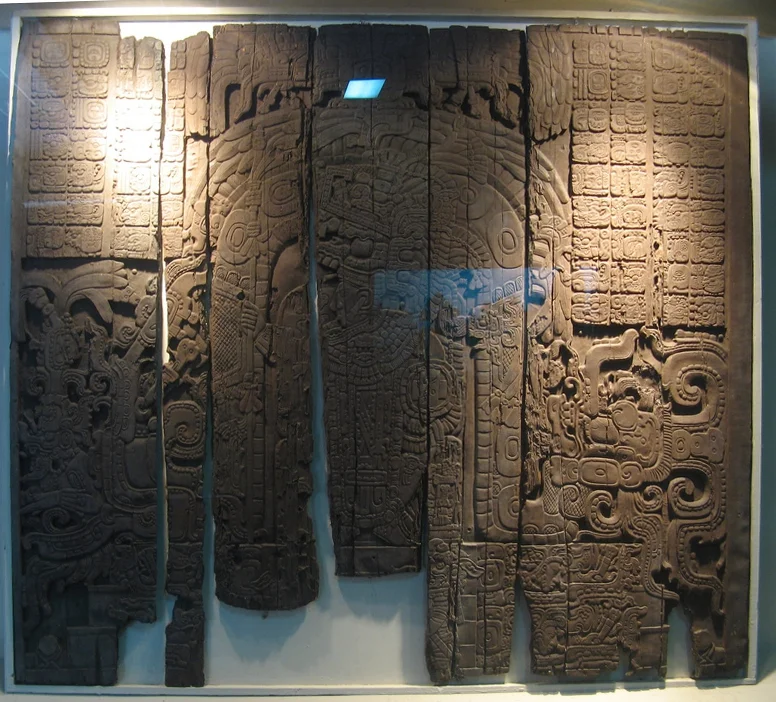
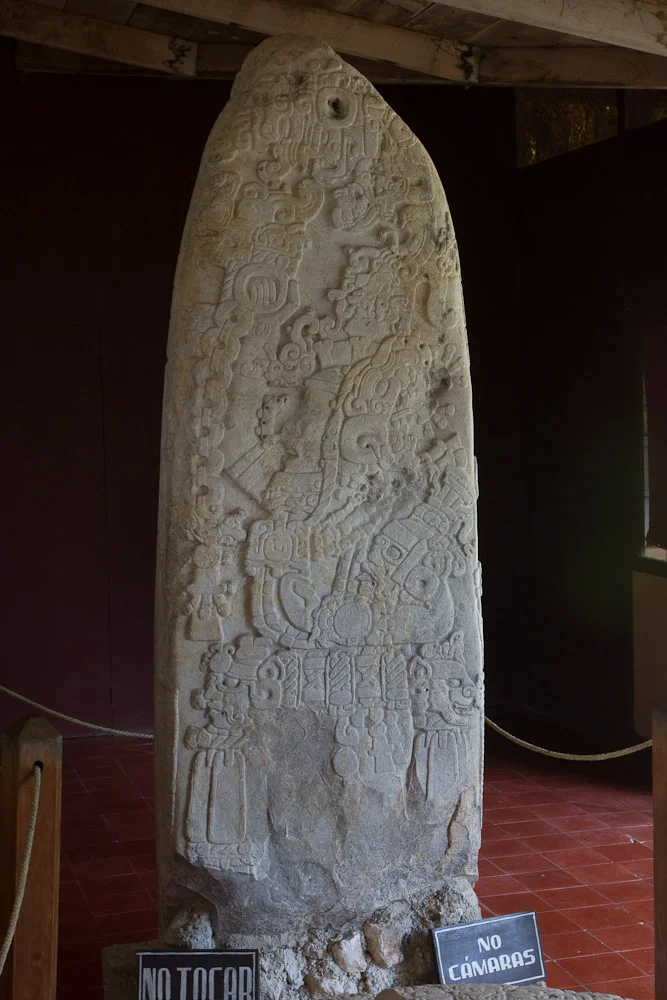
The Tikal - Tikal (known in ancient Mayan as Yax Mutul) was the largest metropolis of the Classic Maya civilization and the capital of its primary southern superpower, located deep within the rainforests of northern Guatemala's Petén Basin. At its 8th-century zenith, the city supported up to 100,000 inhabitants and was crowned by steep limestone stepped pyramids rising above the jungle canopy. Although built on porous limestone hills without permanent rivers or lakes, Tikal flourished thanks to advanced hydraulic engineering. Its builders paved vast public plazas with waterproof stucco at slight angles to channel seasonal monsoon rains into more than ten massive artificial reservoirs, purifying the water with sand and volcanic zeolite filters to sustain the population through the dry season. Following a 378 CE military intervention by the central Mexican metropolis of Teotihuacan that installed a new dynasty, Tikal rose to dominate the southern Maya lowlands and waged two centuries of hegemonic warfare against northern rival Calakmul. After enduring a 130-year hiatus following its 562 CE defeat, Tikal achieved a dramatic resurgence in 695 CE under King Jasaw Chan K'awiil I, who defeated Calakmul and erected the iconic Temple of the Great Jaguar (Temple I).–Calakmul - Calakmul (ancient Mayan name Ox Te' Tuun, 'Three Stones') was the capital of the premier northern superpower of the Classic Maya civilization, located deep in the rainforests of southern Campeche, Mexico, at the base of the Yucatán Peninsula. Meaning 'City of the Two Adjacent Pyramid Mounds' in modern Mayan, it served as the seat of the powerful Kaan ('Snake') Kingdom. The city's ceremonial core is dominated by Structure II, a colossal pyramid rising 55 meters high with a 140-meter base that makes it one of the largest by volume in the Maya world. Archaeologists have mapped over 6,750 ancient structures and 117 carved Maya Stelae—more than in any other Maya city—alongside 13 vast reservoirs that sustained over 50,000 residents. After relocating its capital southward from Dzibanché to Calakmul in the mid-6th century, the Kaan dynasty forged a ring of royal marriage and military alliances with Caracol, Naranjo, Dos Pilas, and Waka' to encircle its southern arch-rival Tikal. Following its 562 CE victory over Tikal, Calakmul reigned as the supreme hegemon of the Maya lowlands for 130 years until its defeat in 695 CE. Wars fundamentally transformed the Classic Maya - An ancient American civilization of rainforest city-states renowned for its hieroglyphic script, astronomy, and towering pyramid temples political landscape from a mosaic of autonomous city-states into two rival hegemonic alliance blocs governed by supreme overlords (Kaloomte' - Kaloomte' was the highest imperial title in the Classic Maya world, reserved for paramount rulers who commanded subordinate divine kings (K'uhul Ajaw) across multiple vassal city-states. Functioning like a 'King of Kings' or 'Supreme Overlord,' it stood a rank above ordinary royal titles. Emerging prominently after Teotihuacan's 4th-century intervention in the Maya lowlands, the title was frequently paired with cardinal directions—such as 'West Kaloomte'' or 'South Kaloomte''—to proclaim regional hegemony. Between the 6th and 8th centuries, the great kings of Tikal and Calakmul fought relentlessly over who could claim this supreme title. In rare cases, formidable royal women who wielded military and diplomatic authority—such as Lady K'abel of Waka'—also bore the title of Kaloomte'.). Traditional border raids escalated into full-scale Star Wars - A 'Star War' is the modern epigraphic term for a full-scale, decisive military campaign waged between Classic Maya city-states aimed at conquering an enemy capital, toppling its ruling dynasty, or reducing the defeated kingdom to vassalage. The name derives from the distinctive Maya Hieroglyph used to record such campaigns: a star symbol (representing the planet Venus) showering droplets of liquid or blood over the earth or the defeated city's emblem glyph. Regarding brilliant Venus as the celestial patron of warfare, Maya rulers and court astronomers timed their most consequential invasions to coincide with key stations in the synodic cycle of Venus. Unlike small-scale border raids fought for tribute or individual captives, a Star War resulted in the sacking of plazas, the capture and sacrifice of the defeated king, and the seizure of patron deity effigies. Famous Star Wars include the April 29, 562 CE conquest of Tikal by Calakmul and Caracol, and the 679 CE defeat and death of Tikal King Nuun Ujol Chaak at the hands of Dos Pilas and Calakmul. timed to the astronomical cycle of Venus aimed at toppling enemy dynasties, while victorious rulers channeled captured tribute and labor into erecting the Temple of the Great Jaguar - The Temple of the Great Jaguar (Tikal Temple I) is a 47-meter-high, nine-tiered limestone stepped pyramid rising on the eastern side of Tikal's Great Plaza in Guatemala, standing as the architectural masterpiece of the Classic Maya and the enduring symbol of Tikal's late-Classic renaissance. Planned by the 26th ruler Jasaw Chan K'awiil I to commemorate his decisive August 5, 695 CE victory over arch-rival Calakmul—which ended the 130-year Tikal Hiatus—the pyramid was completed around 734 CE as his royal mausoleum by his son Yik'in Chan K'awiil. Deep beneath the plaza floor, archaeologists uncovered Jasaw Chan K'awiil's vaulted tomb filled with jade regalia, jaguar pelts, and incised bone carvings. Spanning the doorways of the summit sanctuary were intricately carved wooden lintels made of rot-resistant sapodilla wood. Lintel 3 famously depicts Jasaw Chan K'awiil I seated in triumph beneath the towering effigy of the giant jaguar patron deity palanquin captured from Calakmul in 695 CE, giving the pyramid its modern name., Tikal Temple IV - Tikal Temple IV (also known as the Temple of the Two-Headed Serpent) is a colossal stepped limestone pyramid rising roughly 70 meters (230 feet) high on the western side of Tikal in Guatemala, standing as the tallest pyramid structure in the Classic Maya world and one of the tallest pre-Columbian monuments in the Americas. Commissioned between 741 and 746 CE by Tikal's 27th ruler, the warrior king Yik'in Chan K'awiil, the monument was built using the wealth and tribute secured from his decisive victories over Calakmul (736 CE), western Waka' (743 CE), and eastern Naranjo (744 CE). Towering high above the Petén rainforest canopy, the summit sanctuary housed carved sapodilla-wood doorway lintels (Lintels 2 and 3) depicting Yik'in Chan K'awiil seated in triumph upon the captured royal deity palanquins of Waka' and Naranjo., towering pyramid complexes, carved Maya Stelae - A Maya stela (plural stelae; called lakamtuun or 'big stone' in ancient Mayan) is a tall, sculpted stone shaft erected by Classic Maya rulers in public plazas before pyramid temples to commemorate their reigns, rituals, and military triumphs in bas-relief and Maya Hieroglyphs. Typically standing 2 to 5 meters tall (with the largest exceeding 10 meters), the front face of a stela portrayed the divine king (K'uhul Ajaw) in resplendent quetzal-feather headdresses and jade regalia, often standing over bound royal captives. The sides and back recorded exact Long Count Calendar dates detailing royal births, accessions, marriage alliances, and Star War victories. Whereas nearly all bark-paper Maya codices perished in the humid tropics or were burned during the 16th-century Spanish conquest, thousands of carved limestone stelae survived intact in the jungle for over a millennium. Their modern decipherment has allowed historians to reconstruct the diplomatic and military history of the Tikal–Calakmul Wars down to the exact calendar day., and hieroglyphic stairways - The Hieroglyphic Stairway of Dos Pilas is an 18-step carved limestone staircase on the facade of Structure L5-49 at Dos Pilas in northern Guatemala, whose vertical stone risers are inscribed with extensive Maya Hieroglyphs and reliefs of bound captives. Commissioned by Dos Pilas's founding king B'alaj Chan K'awiil, the stairway chronicles his birth as a royal prince of Tikal in 625 CE, his subjugation and alliance with Calakmul's Great King Yuknoom Ch'een II in 650 CE, and his bitter 20-year fratricidal war against his brother, Tikal King Nuun Ujol Chaak. When heavy rains in the early 2000s uncovered previously buried steps on the staircase, epigraphers deciphered a dramatic first-person account of the Tikal–Calakmul Wars, culminating in the 679 CE Star War victory in which 'blood pooled and the skulls of the people of Mutul were piled into mountains.' that marked the zenith of Maya writing and architecture. Yet two centuries of relentless proxy warfare and total mobilization disrupted vital trade arteries like the Pasión River - The Pasión River rises in the northern highland mountains of Guatemala and winds northward and westward through the rainforests of the southwestern Petén Basin before joining the Usumacinta River, forming the primary river artery of the southern Maya lowlands. In the ancient Maya world—where dense jungle and the absence of draft animals made overland transport arduous—the Pasión River served as a vital aquatic highway for dugout canoes. Precious highland commodities including jadeite, volcanic obsidian, and iridescent quetzal feathers all traveled down this river corridor to the great lowland cities. In 629 CE, Tikal founded the fortress city of Dos Pilas near the Pasión River to secure this lucrative trade artery and bypass Calakmul's northern blockade. When Calakmul's Great King Yuknoom Ch'een II conquered Dos Pilas in 650 CE and seized control of the Pasión River trade, Tikal suffered a severe economic and strategic blow., concentrated refugee populations into fortified centers, and accelerated deforestation for lime-stucco production—leaving the southern Maya lowlands ecologically and politically fragile ahead of the 9th-century Classic Maya Collapse - The Classic Maya Collapse refers to the dramatic 8th- and 9th-century decline and abandonment of the great Classic Maya pyramid cities across the southern lowlands—including Tikal, Calakmul, Palenque, and Dos Pilas—which were reclaimed by the tropical rainforest. Historians and archaeologists attribute the collapse to a convergence of human and environmental pressures: first, endemic total warfare following the Tikal–Calakmul Wars disrupted trade routes and forced rural populations into overcrowded fortified centers; second, widespread deforestation to burn lime plaster for monumental pyramids caused severe soil erosion. When a series of severe, multi-decade megadroughts struck Mesoamerica in the 9th century, the reservoir-dependent southern lowland kingdoms suffered crop failure and dynastic breakdown. Rather than vanishing entirely, however, Maya populations migrated northward to cenote-fed cities of the northern Yucatán Peninsula such as Chichén Itzá and Uxmal..
Context & Background

250 CE – 4th Century

Fragmented Classic Maya City-States and Rivalry Over Obsidian and Jade Routes

Rather than forming a single unified empire, the Classic Maya civilization - An ancient American civilization of rainforest city-states renowned for its hieroglyphic script, astronomy, and towering pyramid temples across the Yucatán Peninsula - The Yucatán Peninsula is a vast landmass projecting northward between the Gulf of Mexico and the Caribbean Sea, encompassing southeastern Mexico (the states of Yucatán, Campeche, and Quintana Roo), northern Guatemala's Petén region, and Belize as the overarching geographic stage of the Maya civilization. Formed of a massive flat limestone shelf, the northern peninsula lacks surface rivers; instead, ancient Maya communities relied on natural sinkholes called cenotes—formed where limestone caverns collapsed to expose groundwater—both for drinking water and as sacred portals to the underworld. The southern base of the peninsula is covered in dense tropical rainforests and seasonal wetlands. During the Classic Period (250–900 CE), the superpowers of Calakmul and Tikal at the southern base of the peninsula contested mastery over the Maya world. Following the 9th-century decline of the southern lowland cities due to prolonged warfare and drought, the center of Maya civilization shifted to northern peninsular cities such as Chichén Itzá, Uxmal, and Mayapán. and the Petén Basin - The Petén Basin is a vast tropical limestone lowland spanning northern Guatemala, southeastern Mexico, and western Belize that served as the geographic and cultural heartland of the Classic Maya civilization. Characterized by dense rainforests, seasonal wetlands (bajos), and Lake Petén Itzá, the region sits at an average elevation of 100 to 300 meters. Although the porous karst limestone bedrock allowed surface water to drain rapidly underground, the ancient Maya quarried the abundant limestone to erect monumental pyramid temples and lined vast plazas and reservoirs with waterproof lime stucco, sustaining millions of inhabitants across the lowlands. Home to the great city-states of Tikal, Calakmul, Naranjo, and Waka', the Petén Basin formed the strategic crossroads linking highland trade in jade and obsidian with northern coastal salt and cotton, making it the primary theater of the two-century Tikal–Calakmul Wars. consisted of dozens of independent city-states. Each polity was governed by a divine king known as a K'uhul Ajaw - K'uhul Ajaw ('Divine Lord' or 'Sacred King') was the supreme royal title borne by the rulers of Classic Maya city-states, signifying that the monarch served not merely as a secular leader, but as the living cosmic intermediary between the gods, royal ancestors, and human society. Each ruler paired this title with their polity's unique emblem glyph. A K'uhul Ajaw was spiritually responsible for securing seasonal rains, abundant maize harvests, and military victory for the kingdom. To nourish the gods and summon ancestral visions, the king and queen regularly performed sacred bloodletting rituals—piercing their tongues or ears with stingray spines or obsidian lancets and burning the blood-soaked bark paper in ceremonial braziers. From the 6th century onward, the rulers of superpowers such as Tikal and Calakmul—who elevated and commanded subordinate K'uhul Ajaw kings across multiple vassal states—adopted the even higher imperial title of Kaloomte' ('Supreme Warrior' or 'Overlord') as they contested hegemony over the Maya lowlands. and shared a sophisticated culture of Maya Hieroglyphs - Maya Hieroglyphs formed the only fully developed writing system in the pre-Columbian Americas capable of recording any spoken sentence or phonetic sound completely and accurately. Arranged in paired vertical columns of intricate square glyph blocks, the script combined high calligraphy with linguistic precision. Although visually resembling elaborate pictorial art, the script functioned as a logosyllabic system combining roughly 800 signs: logograms (signs representing whole words or concepts) and phonetic syllabograms (signs representing consonant-vowel syllables). Maya scribes could write the same word either as a single logogram, purely phonetically with syllable signs, or a combination of both. After knowledge of the script was lost following the 16th-century Spanish conquest, scholars long assumed the carvings recorded only astronomical tables and mythical time. In the late 20th century, breakthroughs by Yuri Knorozov, Tatiana Proskouriakoff, and other epigraphers unlocked the script's phonetic and historical nature, revealing the dramatic royal dynasties, alliances, and battles of the Tikal–Calakmul Wars. and the Long Count Calendar - The Long Count Calendar was a linear timekeeping system used by the Classic Maya to record historical dates unambiguously across millennia by counting the exact number of days elapsed since a mythical creation zero-date corresponding to August 11, 3114 BCE. Unlike the 52-year cyclical Calendar Round whose dates repeated every half-century, the Long Count expressed dates using a five-place modified base-20 (vigesimal) notation: k'in (1 day), winal (20 days), tun (360 days), k'atun (7,200 days, or about 20 years), and b'ak'tun (144,000 days, or about 394 years), enabled by the independent Maya invention of a shell-shaped symbol for zero. Because Classic Maya rulers inscribed Long Count dates on Maya Stelae and hieroglyphic stairways to commemorate their battles and accessions, modern historians can convert a carved date such as '9.6.8.4.2' on Caracol Altar 21 directly into the Gregorian calendar as April 29, 562 CE with single-day precision..

Because the porous limestone lowlands lacked volcanic rock or metal ores, the military and economic survival of every Maya city depended on controlling inland river corridors such as the Pasión River - The Pasión River rises in the northern highland mountains of Guatemala and winds northward and westward through the rainforests of the southwestern Petén Basin before joining the Usumacinta River, forming the primary river artery of the southern Maya lowlands. In the ancient Maya world—where dense jungle and the absence of draft animals made overland transport arduous—the Pasión River served as a vital aquatic highway for dugout canoes. Precious highland commodities including jadeite, volcanic obsidian, and iridescent quetzal feathers all traveled down this river corridor to the great lowland cities. In 629 CE, Tikal founded the fortress city of Dos Pilas near the Pasión River to secure this lucrative trade artery and bypass Calakmul's northern blockade. When Calakmul's Great King Yuknoom Ch'een II conquered Dos Pilas in 650 CE and seized control of the Pasión River trade, Tikal suffered a severe economic and strategic blow., through which razor-sharp volcanic obsidian - Obsidian is a naturally occurring black or dark green volcanic glass formed when felsic lava extruded from a volcano cools rapidly with minimal crystal growth. In ancient Maya and Mesoamerican civilizations, which did not smelt bronze or iron for weaponry, obsidian served as the indispensable strategic equivalent of steel. By carefully pressure-flaking an obsidian core with antler tines or hammerstones, skilled artisans produced prismatic blades with cutting edges approaching molecular thinness—sharper than modern surgical steel scalpels. The Maya mounted these razor-sharp edges onto spears, atlatl darts, daggers, and ritual bloodletting blades, as well as everyday agricultural and carving tools. Because the limestone lowlands of the Petén Basin and Yucatán Peninsula lacked volcanoes, every piece of obsidian had to be imported hundreds of kilometers from the volcanic highlands of Guatemala or central Mexico (Teotihuacan). Controlling the river and overland trade routes that supplied obsidian—such as the Pasión River corridor—was therefore vital to the military survival of every Maya city-state. for weapons, royal jadeite, and quetzal feathers were transported by canoe from the southern highlands.

January 16, 378 CE

Teotihuacan's Military Intervention and Tikal's Rise

In the late 4th century, the balance of power in the Maya lowlands was overturned when the central Mexican highland metropolis of Teotihuacan - The monumental highland metropolis of the Pyramids of the Sun and Moon that projected obsidian trade and military power across Mesoamerica intervened directly in the Petén trade corridors. On January 16, 378 CE, General Siyaj K'ak' led a force armed with the highland atlatl (spear-thrower - The atlatl (a Nahuatl word for 'spear-thrower') is a wooden shaft measuring roughly 50 to 60 centimeters long with a spur or socket at its rear tip, designed to use leverage to hurl long, flexible darts with far greater velocity and range than a hand-thrown spear. By gripping the handle of the atlatl and resting the butt of a 1.5-to-2-meter obsidian-tipped dart against the rear hook, a warrior effectively doubled the length of their throwing arm. Whipped forward with a snap of the wrist, the atlatl propelled darts at speeds exceeding 150 kilometers per hour, capable of piercing padded cotton armor and wooden shields. Originally the signature battlefield weapon of the highland metropolis of Teotihuacan, the atlatl was introduced into Classic Maya warfare during the 378 CE 'Arrival of Fire' expedition to Tikal. Tikal Stela 31 famously depicts King Yax Nuun Ayiin I dressed as a Teotihuacan warrior holding an ornate atlatl raised in his right hand.) and rectangular shields through the western gateway of Waka' - Waka' (modern archaeological site name El Perú) was a strategic Classic Maya city-state perched on an escarpment overlooking the San Pedro Mártir River in the western Petén Basin of Guatemala. Its location commanded the vital east–west riverine trade routes linking the Gulf Coast to the central Petén heartland around Tikal. So strategically critical that Teotihuacan's general Siyaj K'ak' stopped here in 378 CE eight days before entering Tikal, Waka' later became the western anchor of Calakmul's alliance network encircling Tikal. In the 7th century, Calakmul's Great King Yuknoom Ch'een II cemented this bond by marrying his royal daughter, Lady K'abel, to the king of Waka'. Invested with the supreme military title of Kaloomte'—outranking even her husband—Lady K'abel governed Waka' as a formidable warrior queen for over twenty years, threatening Tikal's western frontier. In 743 CE, however, Tikal King Yik'in Chan K'awiil stormed Waka', capturing its ruler Bahlam Tz'am and seizing its sacred patron effigy, breaking Calakmul's western stronghold. into Tikal - Tikal (known in ancient Mayan as Yax Mutul) was the largest metropolis of the Classic Maya civilization and the capital of its primary southern superpower, located deep within the rainforests of northern Guatemala's Petén Basin. At its 8th-century zenith, the city supported up to 100,000 inhabitants and was crowned by steep limestone stepped pyramids rising above the jungle canopy. Although built on porous limestone hills without permanent rivers or lakes, Tikal flourished thanks to advanced hydraulic engineering. Its builders paved vast public plazas with waterproof stucco at slight angles to channel seasonal monsoon rains into more than ten massive artificial reservoirs, purifying the water with sand and volcanic zeolite filters to sustain the population through the dry season. Following a 378 CE military intervention by the central Mexican metropolis of Teotihuacan that installed a new dynasty, Tikal rose to dominate the southern Maya lowlands and waged two centuries of hegemonic warfare against northern rival Calakmul. After enduring a 130-year hiatus following its 562 CE defeat, Tikal achieved a dramatic resurgence in 695 CE under King Jasaw Chan K'awiil I, who defeated Calakmul and erected the iconic Temple of the Great Jaguar (Temple I)..

Tikal - The southern Classic Maya superpower in Guatemala's Petén Basin, renowned for its towering Temple of the Great Jaguar's ruling king died on that same day, and a son of Teotihuacan's ruler was installed on the throne to found a new dynasty. Backed by Teotihuacan's military technology and trade network, Tikal rapidly rose to become the dominant superpower of the southern Maya lowlands.

Early 6th Century – 560 CE

Southward Expansion of the Kaan Kingdom (Calakmul) and the Serpent Web of Alliances

To challenge Tikal's dominance, the Kaan ('Snake') Kingdom—identified by its grinning serpent emblem glyph—emerged as a formidable northern rival at the base of the Yucatán Peninsula. Relocating their capital southward from Dzibanché - Dzibanché (modern Mayan for 'Writing on Wood') was a major Early Classic Maya city in the rainforests of southern Quintana Roo, Mexico, that served as the original royal capital of the Kaan ('Snake') dynasty before its relocation to Calakmul. Flourishing from the 4th to the mid-6th century CE, the site features monumental stepped pyramids including the Temple of the Owl and the Temple of the Cormorants, as well as the Temple of the Captives, whose carved stone steps depict bound war prisoners and early military victories of the Kaan kings. In the mid-6th century, seeking a closer strategic position to challenge southern rival Tikal for mastery over the Petén Basin trade routes, the Kaan dynasty transferred its seat of power roughly 130 kilometers southwest from Dzibanché to the metropolis of Calakmul. to the massive metropolis of Calakmul - Calakmul (ancient Mayan name Ox Te' Tuun, 'Three Stones') was the capital of the premier northern superpower of the Classic Maya civilization, located deep in the rainforests of southern Campeche, Mexico, at the base of the Yucatán Peninsula. Meaning 'City of the Two Adjacent Pyramid Mounds' in modern Mayan, it served as the seat of the powerful Kaan ('Snake') Kingdom. The city's ceremonial core is dominated by Structure II, a colossal pyramid rising 55 meters high with a 140-meter base that makes it one of the largest by volume in the Maya world. Archaeologists have mapped over 6,750 ancient structures and 117 carved Maya Stelae—more than in any other Maya city—alongside 13 vast reservoirs that sustained over 50,000 residents. After relocating its capital southward from Dzibanché to Calakmul in the mid-6th century, the Kaan dynasty forged a ring of royal marriage and military alliances with Caracol, Naranjo, Dos Pilas, and Waka' to encircle its southern arch-rival Tikal. Following its 562 CE victory over Tikal, Calakmul reigned as the supreme hegemon of the Maya lowlands for 130 years until its defeat in 695 CE., just 100 kilometers north of Tikal, the Kaan rulers set out to contest control of the lowland trade routes.

Rather than risking an early frontal clash with Tikal, Calakmul - The northern Classic Maya superpower symbolized by the Snake Emblem Glyph that dominated the Maya world through masterstroke alliance diplomacy's kings wove a diplomatic web of royal marriages and sponsored accessions among Tikal's neighbors. After capturing a lord of Yaxchilán - Yaxchilán (Mayan for 'Green Stones') was a powerful Classic Maya riverine city-state perched on a steep limestone bluff inside a horseshoe-shaped oxbow bend of the Usumacinta River along the modern border of Chiapas, Mexico, and Guatemala. Protected on three sides by the river and commanding the Usumacinta trade artery, Yaxchilán is celebrated for its dozens of exquisitely carved stone doorway lintels depicting royal bloodletting rituals, ancestral visions, and the capture of war prisoners. Drawn into the superpower struggle around 537 CE when Calakmul forces captured one of its subsidiary lords, Yaxchilán navigated shifting alliances between Tikal and Calakmul before reaching its architectural and military zenith in the 8th century under kings Itzamnaaj Bahlam III ('Shield Jaguar III') and Bird Jaguar IV. around 537 CE and installing a pro-Calakmul king at eastern Naranjo - Naranjo (ancient Mayan name Sa'al) was a major Classic Maya city-state situated in the eastern Petén Basin of northeastern Guatemala near the modern border with Belize. Controlling the river valleys directly east of Tikal, Naranjo stood on the front lines of the centuries-long struggle between Tikal and Calakmul. Brought into Calakmul's orbit in 546 CE when the Kaan king installed its ruler, Naranjo later broke away and was conquered by a combined Calakmul–Caracol force in 631 CE. In 682 CE, the city experienced a dramatic revival when Lady Six Sky (Ix Wak Chan Jalam Lem) arrived from Dos Pilas to re-establish the royal dynasty, governing as a formidable warrior queen and regent loyal to the Calakmul alliance. Under Lady Six Sky and her son K'ak' Tiliw Chan Chaak, Naranjo launched repeated campaigns against Tikal's eastern borderlands. However, in 744 CE, Tikal's warrior king Yik'in Chan K'awiil stormed Naranjo, capturing its ruler Yax Mayuy Chan Chaak and seizing its sacred royal palanquin, permanently shattering Calakmul's eastern flank. in 546 CE, Calakmul steadily tightened a strategic ring of encirclement around Tikal.

The Narrative

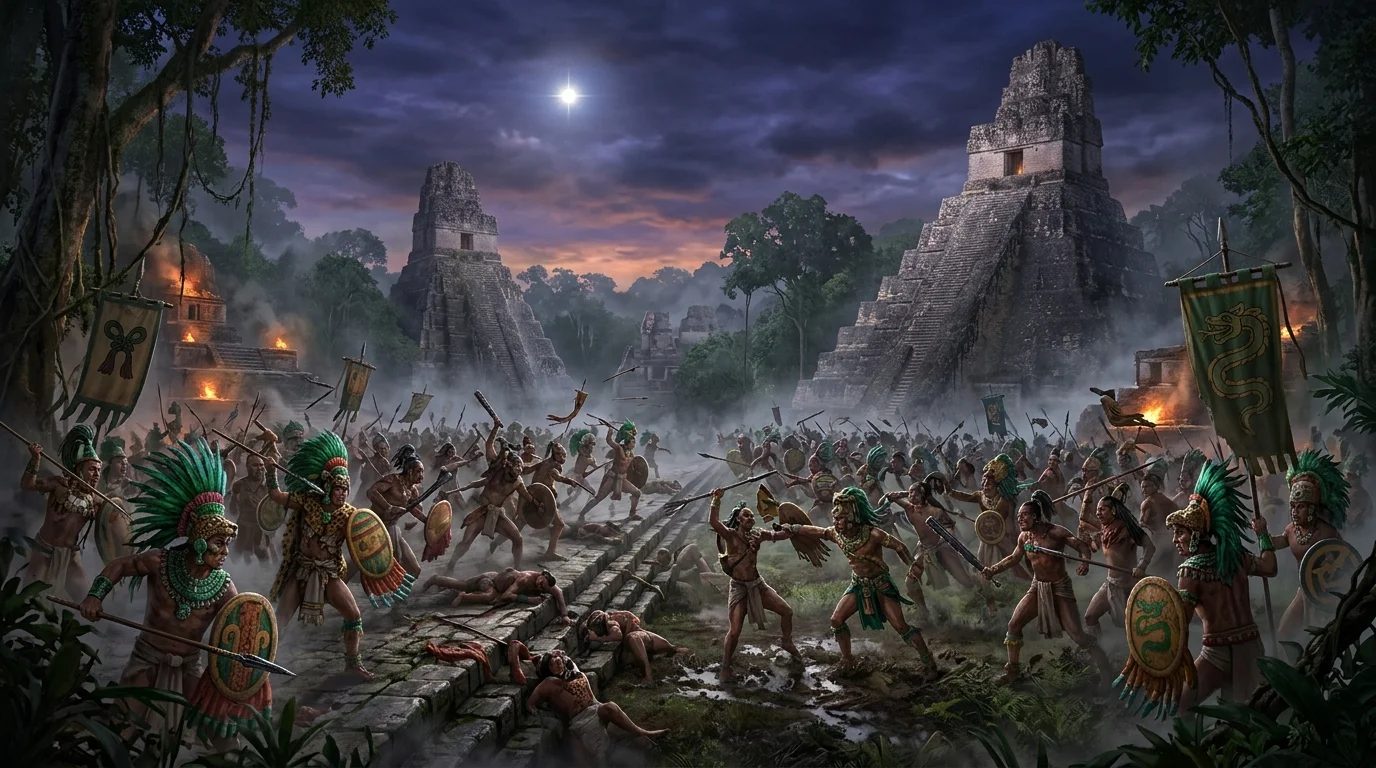
By the mid-6th century, tensions between Tikal - Tikal (known in ancient Mayan as Yax Mutul) was the largest metropolis of the Classic Maya civilization and the capital of its primary southern superpower, located deep within the rainforests of northern Guatemala's Petén Basin. At its 8th-century zenith, the city supported up to 100,000 inhabitants and was crowned by steep limestone stepped pyramids rising above the jungle canopy. Although built on porous limestone hills without permanent rivers or lakes, Tikal flourished thanks to advanced hydraulic engineering. Its builders paved vast public plazas with waterproof stucco at slight angles to channel seasonal monsoon rains into more than ten massive artificial reservoirs, purifying the water with sand and volcanic zeolite filters to sustain the population through the dry season. Following a 378 CE military intervention by the central Mexican metropolis of Teotihuacan that installed a new dynasty, Tikal rose to dominate the southern Maya lowlands and waged two centuries of hegemonic warfare against northern rival Calakmul. After enduring a 130-year hiatus following its 562 CE defeat, Tikal achieved a dramatic resurgence in 695 CE under King Jasaw Chan K'awiil I, who defeated Calakmul and erected the iconic Temple of the Great Jaguar (Temple I).—which dominated the central Petén Basin - The Petén Basin is a vast tropical limestone lowland spanning northern Guatemala, southeastern Mexico, and western Belize that served as the geographic and cultural heartland of the Classic Maya civilization. Characterized by dense rainforests, seasonal wetlands (bajos), and Lake Petén Itzá, the region sits at an average elevation of 100 to 300 meters. Although the porous karst limestone bedrock allowed surface water to drain rapidly underground, the ancient Maya quarried the abundant limestone to erect monumental pyramid temples and lined vast plazas and reservoirs with waterproof lime stucco, sustaining millions of inhabitants across the lowlands. Home to the great city-states of Tikal, Calakmul, Naranjo, and Waka', the Petén Basin formed the strategic crossroads linking highland trade in jade and obsidian with northern coastal salt and cotton, making it the primary theater of the two-century Tikal–Calakmul Wars. crossroad—and the rising northern superpower of Calakmul - Calakmul (ancient Mayan name Ox Te' Tuun, 'Three Stones') was the capital of the premier northern superpower of the Classic Maya civilization, located deep in the rainforests of southern Campeche, Mexico, at the base of the Yucatán Peninsula. Meaning 'City of the Two Adjacent Pyramid Mounds' in modern Mayan, it served as the seat of the powerful Kaan ('Snake') Kingdom. The city's ceremonial core is dominated by Structure II, a colossal pyramid rising 55 meters high with a 140-meter base that makes it one of the largest by volume in the Maya world. Archaeologists have mapped over 6,750 ancient structures and 117 carved Maya Stelae—more than in any other Maya city—alongside 13 vast reservoirs that sustained over 50,000 residents. After relocating its capital southward from Dzibanché to Calakmul in the mid-6th century, the Kaan dynasty forged a ring of royal marriage and military alliances with Caracol, Naranjo, Dos Pilas, and Waka' to encircle its southern arch-rival Tikal. Following its 562 CE victory over Tikal, Calakmul reigned as the supreme hegemon of the Maya lowlands for 130 years until its defeat in 695 CE. reached a breaking point. Ascending the throne of Calakmul - The northern Classic Maya superpower symbolized by the Snake Emblem Glyph that dominated the Maya world through masterstroke alliance diplomacy in 561 CE, King Sky Witness - The ruler of Calakmul (the Kaan Kingdom) who forged a diplomatic alliance with Tikal's former ally Caracol and crushed Tikal in the 562 CE Star War, inaugurating 130 years of Calakmul hegemony. executed a diplomatic masterstroke to complete Tikal - The southern Classic Maya superpower in Guatemala's Petén Basin, renowned for its towering Temple of the Great Jaguar's encirclement. To the southeast of Tikal lay the powerful city-state of Caracol - Caracol (ancient Mayan name Oxwitza', 'Three-Hill Water') was a major Classic Maya city-state situated on a 500-meter plateau in the foothills of the Maya Mountains in western Belize. Its monumental centerpiece, the Caana ('Sky Place') pyramid complex, rises 43 meters high and remains the tallest human-made structure in Belize today. Supported by hundreds of square kilometers of hillside agricultural terraces and a radiating network of raised limestone causeways (sacbeob) connecting outlying settlements to the urban core, Caracol grew into a demographic and military powerhouse with over 100,000 inhabitants at its 7th-century peak. Originally a subordinate ally of Tikal—whose king sponsored the accession of Caracol's ruler Yajaw Te' K'inich II in 553 CE—Caracol switched allegiance to northern rival Calakmul after Tikal attacked Caracol in 556 CE. On April 29, 562 CE, Caracol and Calakmul launched a decisive Star War that conquered Tikal, propelling Caracol into a century of golden-age prosperity., whose ruler Yajaw Te' K'inich II had originally been crowned under Tikal's sponsorship in 553 CE. However, after Tikal launched a targeted 'axe-war' strike against Caracol in 556 CE to curb its growing autonomy, Caracol broke away. Sky Witness immediately forged a military alliance with Yajaw Te' K'inich II of Caracol, surrounding Tikal from the north (Calakmul), east (Naranjo - Naranjo (ancient Mayan name Sa'al) was a major Classic Maya city-state situated in the eastern Petén Basin of northeastern Guatemala near the modern border with Belize. Controlling the river valleys directly east of Tikal, Naranjo stood on the front lines of the centuries-long struggle between Tikal and Calakmul. Brought into Calakmul's orbit in 546 CE when the Kaan king installed its ruler, Naranjo later broke away and was conquered by a combined Calakmul–Caracol force in 631 CE. In 682 CE, the city experienced a dramatic revival when Lady Six Sky (Ix Wak Chan Jalam Lem) arrived from Dos Pilas to re-establish the royal dynasty, governing as a formidable warrior queen and regent loyal to the Calakmul alliance. Under Lady Six Sky and her son K'ak' Tiliw Chan Chaak, Naranjo launched repeated campaigns against Tikal's eastern borderlands. However, in 744 CE, Tikal's warrior king Yik'in Chan K'awiil stormed Naranjo, capturing its ruler Yax Mayuy Chan Chaak and seizing its sacred royal palanquin, permanently shattering Calakmul's eastern flank.), and southeast (Caracol). On April 29, 562 CE (Long Count - The Long Count Calendar was a linear timekeeping system used by the Classic Maya to record historical dates unambiguously across millennia by counting the exact number of days elapsed since a mythical creation zero-date corresponding to August 11, 3114 BCE. Unlike the 52-year cyclical Calendar Round whose dates repeated every half-century, the Long Count expressed dates using a five-place modified base-20 (vigesimal) notation: k'in (1 day), winal (20 days), tun (360 days), k'atun (7,200 days, or about 20 years), and b'ak'tun (144,000 days, or about 394 years), enabled by the independent Maya invention of a shell-shaped symbol for zero. Because Classic Maya rulers inscribed Long Count dates on Maya Stelae and hieroglyphic stairways to commemorate their battles and accessions, modern historians can convert a carved date such as '9.6.8.4.2' on Caracol Altar 21 directly into the Gregorian calendar as April 29, 562 CE with single-day precision. 9.6.8.4.2), timed to the auspicious station of the war planet Venus, Sky Witness and Caracol launched a coordinated full-scale Star War - A 'Star War' is the modern epigraphic term for a full-scale, decisive military campaign waged between Classic Maya city-states aimed at conquering an enemy capital, toppling its ruling dynasty, or reducing the defeated kingdom to vassalage. The name derives from the distinctive Maya Hieroglyph used to record such campaigns: a star symbol (representing the planet Venus) showering droplets of liquid or blood over the earth or the defeated city's emblem glyph. Regarding brilliant Venus as the celestial patron of warfare, Maya rulers and court astronomers timed their most consequential invasions to coincide with key stations in the synodic cycle of Venus. Unlike small-scale border raids fought for tribute or individual captives, a Star War resulted in the sacking of plazas, the capture and sacrifice of the defeated king, and the seizure of patron deity effigies. Famous Star Wars include the April 29, 562 CE conquest of Tikal by Calakmul and Caracol, and the 679 CE defeat and death of Tikal King Nuun Ujol Chaak at the hands of Dos Pilas and Calakmul. against Tikal. Caught in a two-front pincer assault, Tikal's defenses collapsed, and its 21st king, Wak Chan K'awiil, was captured and executed in ritual sacrifice. Earlier monuments in Tikal's Great Plaza were smashed, and the defeated metropolis plunged into the 130-year Tikal Hiatus - The Tikal Hiatus (562–692 CE) was a 130-year period of political stagnation and cultural disruption at Tikal following its catastrophic military defeat by the allied forces of Calakmul and Caracol, during which no new carved Maya Stelae or major pyramid temples were dedicated in the city. For decades, archaeologists were puzzled as to why Tikal abruptly ceased erecting dated stone monuments between 557 CE (Stela 17) and 692 CE (Stela 30), and why many earlier monuments in the Great Plaza were intentionally smashed. The mystery was solved when epigraphers deciphered Altar 21 at Caracol, revealing that on April 29, 562 CE, Calakmul and Caracol conquered Tikal in a decisive Star War and sacrificed its king, Wak Chan K'awiil. Hemmed in by Calakmul's ring of allied city-states and cut off from lucrative trade routes, Tikal endured over a century of eclipsed influence while struggling to survive. The hiatus finally ended when the 26th ruler, Jasaw Chan K'awiil I, dedicated Stela 30 in 692 CE and decisively defeated Calakmul's main army in 695 CE, ushering in Tikal's late-Classic golden age., during which not a single new carved Maya Stela - A Maya stela (plural stelae; called lakamtuun or 'big stone' in ancient Mayan) is a tall, sculpted stone shaft erected by Classic Maya rulers in public plazas before pyramid temples to commemorate their reigns, rituals, and military triumphs in bas-relief and Maya Hieroglyphs. Typically standing 2 to 5 meters tall (with the largest exceeding 10 meters), the front face of a stela portrayed the divine king (K'uhul Ajaw) in resplendent quetzal-feather headdresses and jade regalia, often standing over bound royal captives. The sides and back recorded exact Long Count Calendar dates detailing royal births, accessions, marriage alliances, and Star War victories. Whereas nearly all bark-paper Maya codices perished in the humid tropics or were burned during the 16th-century Spanish conquest, thousands of carved limestone stelae survived intact in the jungle for over a millennium. Their modern decipherment has allowed historians to reconstruct the diplomatic and military history of the Tikal–Calakmul Wars down to the exact calendar day. or major temple was erected.

Assuming the supreme imperial title of Kaloomte' - Kaloomte' was the highest imperial title in the Classic Maya world, reserved for paramount rulers who commanded subordinate divine kings (K'uhul Ajaw) across multiple vassal city-states. Functioning like a 'King of Kings' or 'Supreme Overlord,' it stood a rank above ordinary royal titles. Emerging prominently after Teotihuacan's 4th-century intervention in the Maya lowlands, the title was frequently paired with cardinal directions—such as 'West Kaloomte'' or 'South Kaloomte''—to proclaim regional hegemony. Between the 6th and 8th centuries, the great kings of Tikal and Calakmul fought relentlessly over who could claim this supreme title. In rare cases, formidable royal women who wielded military and diplomatic authority—such as Lady K'abel of Waka'—also bore the title of Kaloomte'., the rulers of Calakmul expanded their hegemony across the breadth of the Maya lowlands. Determined to subdue the western Maya kingdom of Palenque - Palenque (ancient Mayan name Lakamha', 'Big Water') was the capital of the western Classic Maya kingdom of B'aakal, nestled in the lush foothills of Chiapas in southern Mexico. Renowned for its aqueduct-channeled mountain streams, refined stucco bas-reliefs, and extensive Maya Hieroglyphic inscriptions, it was an artistic jewel of the Maya world. Because Palenque maintained friendly ties with Tikal and anchored the western Maya lowlands, it became a prime target for the northern superpower Calakmul. Marching hundreds of kilometers across rivers and dense jungle, Calakmul and its allies launched daring long-range expeditions that sacked Palenque twice, in 599 CE and 611 CE, devastating its royal court. Out of this dynastic crisis rose K'inich Janaab Pakal I ('Pakal the Great'), who ascended the throne at age twelve in 615 CE and reigned for 68 years, restoring Palenque to unprecedented architectural splendor. His monumental Temple of the Inscriptions, housing his subterranean crypt, jade funerary mask, and intricately carved sarcophagus lid, remains one of the greatest masterpieces of ancient American archaeology.—a prestigious polity friendly to Tikal—Calakmul and its allies marched hundreds of kilometers across rivers and dense jungle to sack Palenque twice, in 599 CE and 611 CE. Meanwhile, seeking a way to bypass Calakmul's northern blockade and secure the southern highland waterborne trade in obsidian - Obsidian is a naturally occurring black or dark green volcanic glass formed when felsic lava extruded from a volcano cools rapidly with minimal crystal growth. In ancient Maya and Mesoamerican civilizations, which did not smelt bronze or iron for weaponry, obsidian served as the indispensable strategic equivalent of steel. By carefully pressure-flaking an obsidian core with antler tines or hammerstones, skilled artisans produced prismatic blades with cutting edges approaching molecular thinness—sharper than modern surgical steel scalpels. The Maya mounted these razor-sharp edges onto spears, atlatl darts, daggers, and ritual bloodletting blades, as well as everyday agricultural and carving tools. Because the limestone lowlands of the Petén Basin and Yucatán Peninsula lacked volcanoes, every piece of obsidian had to be imported hundreds of kilometers from the volcanic highlands of Guatemala or central Mexico (Teotihuacan). Controlling the river and overland trade routes that supplied obsidian—such as the Pasión River corridor—was therefore vital to the military survival of every Maya city-state. and jade along the Pasión River - The Pasión River rises in the northern highland mountains of Guatemala and winds northward and westward through the rainforests of the southwestern Petén Basin before joining the Usumacinta River, forming the primary river artery of the southern Maya lowlands. In the ancient Maya world—where dense jungle and the absence of draft animals made overland transport arduous—the Pasión River served as a vital aquatic highway for dugout canoes. Precious highland commodities including jadeite, volcanic obsidian, and iridescent quetzal feathers all traveled down this river corridor to the great lowland cities. In 629 CE, Tikal founded the fortress city of Dos Pilas near the Pasión River to secure this lucrative trade artery and bypass Calakmul's northern blockade. When Calakmul's Great King Yuknoom Ch'een II conquered Dos Pilas in 650 CE and seized control of the Pasión River trade, Tikal suffered a severe economic and strategic blow., Tikal founded the strategic fortress city of Dos Pilas - Dos Pilas (Spanish for 'Two Wells') was a militaristic Classic Maya city-state in the Petexbatún region of northern Guatemala, strategically situated near the Pasión and Salinas rivers to control the vital riverine trade routes of the southern Maya lowlands. Founded around 629 CE by Tikal to secure highland trade in jade, obsidian, and quetzal feathers while bypassing Calakmul's northern blockade, the outpost was placed under the rule of four-year-old Tikal prince B'alaj Chan K'awiil. The rulers of Dos Pilas adopted Tikal's own 'Mutul' emblem glyph, claiming to be the true rightful line of the Tikal royal house. In 650 CE, however, Calakmul's Great King Yuknoom Ch'een II conquered Dos Pilas and co-opted B'alaj Chan K'awiil into a loyal vassal of the Kaan Kingdom, turning Tikal's southern outpost into a spear aimed at its own heart. The ensuing 20-year fratricidal war between B'alaj Chan K'awiil and his brother, Tikal King Nuun Ujol Chaak—culminating in the latter's defeat and death in 679 CE—is vividly chronicled on Dos Pilas's famous Hieroglyphic Stairway. in 629 CE and dispatched four-year-old Tikal prince B'alaj Chan K'awiil - A Tikal royal prince dispatched to rule the southern outpost of Dos Pilas who switched allegiance to Calakmul's Great King Yuknoom Ch'een II, waging a 20-year civil war against his brother, Tikal King Nuun Ujol Chaak, and defeating him in 679 CE. to govern it. Yet Calakmul's greatest monarch, Yuknoom Ch'een II - Known as 'Yuknoom the Great,' he ruled Calakmul for fifty years at the zenith of its empire, co-opting Tikal's prince B'alaj Chan K'awiil at Dos Pilas and conquering Tikal itself to reign as supreme Overlord (Kaloomte') of the Maya world. (reigned 636–686 CE), moved swiftly to sever Tikal's southern lifeline. In 650 CE, Yuknoom Ch'een II marched south and conquered Dos Pilas. Rather than executing the young Tikal prince B'alaj Chan K'awiil, the Calakmul king recognized him as a legitimate divine king (K'uhul Ajaw - K'uhul Ajaw ('Divine Lord' or 'Sacred King') was the supreme royal title borne by the rulers of Classic Maya city-states, signifying that the monarch served not merely as a secular leader, but as the living cosmic intermediary between the gods, royal ancestors, and human society. Each ruler paired this title with their polity's unique emblem glyph. A K'uhul Ajaw was spiritually responsible for securing seasonal rains, abundant maize harvests, and military victory for the kingdom. To nourish the gods and summon ancestral visions, the king and queen regularly performed sacred bloodletting rituals—piercing their tongues or ears with stingray spines or obsidian lancets and burning the blood-soaked bark paper in ceremonial braziers. From the 6th century onward, the rulers of superpowers such as Tikal and Calakmul—who elevated and commanded subordinate K'uhul Ajaw kings across multiple vassal states—adopted the even higher imperial title of Kaloomte' ('Supreme Warrior' or 'Overlord') as they contested hegemony over the Maya lowlands.) under Kaan protection and pledged full military support, turning Tikal's own prince into Calakmul's southern ally.

Yuknoom Ch'een II's political gambit fractured the Tikal royal house into a bitter fratricidal civil war. When B'alaj Chan K'awiil at Dos Pilas displayed Tikal's own 'Mutul' royal emblem glyph and claimed to be the true rightful king of the dynasty, his brother at Tikal, King Nuun Ujol Chaak, faced a severe two-front crisis between Calakmul in the north and Dos Pilas in the south. In 657 CE, Yuknoom Ch'een II personally led a Star War invasion that overran Tikal itself, forcing Nuun Ujol Chaak to temporarily withdraw from his capital and acknowledge Calakmul's overlordship. After rebuilding his forces, Nuun Ujol Chaak launched a major counteroffensive in 672 CE that stormed Dos Pilas and drove his brother B'alaj Chan K'awiil into a five-year exile. However, in 677 CE, a powerful Calakmul army restored B'alaj Chan K'awiil to his throne, and in 679 CE the combined forces of Dos Pilas and Calakmul enveloped and crushed Tikal's army in a decisive Star War. As recorded on the Hieroglyphic Stairway of Dos Pilas - The Hieroglyphic Stairway of Dos Pilas is an 18-step carved limestone staircase on the facade of Structure L5-49 at Dos Pilas in northern Guatemala, whose vertical stone risers are inscribed with extensive Maya Hieroglyphs and reliefs of bound captives. Commissioned by Dos Pilas's founding king B'alaj Chan K'awiil, the stairway chronicles his birth as a royal prince of Tikal in 625 CE, his subjugation and alliance with Calakmul's Great King Yuknoom Ch'een II in 650 CE, and his bitter 20-year fratricidal war against his brother, Tikal King Nuun Ujol Chaak. When heavy rains in the early 2000s uncovered previously buried steps on the staircase, epigraphers deciphered a dramatic first-person account of the Tikal–Calakmul Wars, culminating in the 679 CE Star War victory in which 'blood pooled and the skulls of the people of Mutul were piled into mountains.', 'blood pooled and the skulls of the people of Mutul were piled into mountains,' and King Nuun Ujol Chaak perished. By marrying his daughter Lady K'abel into western Waka' (El Perú - Waka' (modern archaeological site name El Perú) was a strategic Classic Maya city-state perched on an escarpment overlooking the San Pedro Mártir River in the western Petén Basin of Guatemala. Its location commanded the vital east–west riverine trade routes linking the Gulf Coast to the central Petén heartland around Tikal. So strategically critical that Teotihuacan's general Siyaj K'ak' stopped here in 378 CE eight days before entering Tikal, Waka' later became the western anchor of Calakmul's alliance network encircling Tikal. In the 7th century, Calakmul's Great King Yuknoom Ch'een II cemented this bond by marrying his royal daughter, Lady K'abel, to the king of Waka'. Invested with the supreme military title of Kaloomte'—outranking even her husband—Lady K'abel governed Waka' as a formidable warrior queen for over twenty years, threatening Tikal's western frontier. In 743 CE, however, Tikal King Yik'in Chan K'awiil stormed Waka', capturing its ruler Bahlam Tz'am and seizing its sacred patron effigy, breaking Calakmul's western stronghold.) and sending B'alaj Chan K'awiil's daughter Wak Chanil Ajaw to eastern Naranjo, Yuknoom Ch'een II stood at the pinnacle of an alliance empire of over twenty city-states.

Following this severe defeat, however, a major resurgence began at Tikal. Crowned as Tikal's 26th ruler in 682 CE after his father's death in battle, Jasaw Chan K'awiil I - The 26th ruler of Tikal who ascended the throne after his father's death in battle, ended the 130-year Tikal Hiatus by crushing Calakmul's main army in 695 CE, and initiated the construction of the Temple of the Great Jaguar. quietly rebuilt Tikal's military forces. Reviving the venerable warrior traditions, rectangular shields, and atlatl (spear-thrower - The atlatl (a Nahuatl word for 'spear-thrower') is a wooden shaft measuring roughly 50 to 60 centimeters long with a spur or socket at its rear tip, designed to use leverage to hurl long, flexible darts with far greater velocity and range than a hand-thrown spear. By gripping the handle of the atlatl and resting the butt of a 1.5-to-2-meter obsidian-tipped dart against the rear hook, a warrior effectively doubled the length of their throwing arm. Whipped forward with a snap of the wrist, the atlatl propelled darts at speeds exceeding 150 kilometers per hour, capable of piercing padded cotton armor and wooden shields. Originally the signature battlefield weapon of the highland metropolis of Teotihuacan, the atlatl was introduced into Classic Maya warfare during the 378 CE 'Arrival of Fire' expedition to Tikal. Tikal Stela 31 famously depicts King Yax Nuun Ayiin I dressed as a Teotihuacan warrior holding an ornate atlatl raised in his right hand.) and obsidian lance weaponry associated with 4th-century Teotihuacan - The monumental highland metropolis of the Pyramids of the Sun and Moon that projected obsidian trade and military power across Mesoamerica, he restored his soldiers' morale. In 692 CE, he broke the 130-year silence of the Tikal Hiatus by dedicating Stela 30 in Tikal's plaza, openly challenging Calakmul, where the aged Yuknoom Ch'een II had died at age eighty-six after a 50-year reign and been succeeded by Yuknoom Yich'aak K'ak'. On August 5, 695 CE, Jasaw Chan K'awiil I led Tikal's army into a decisive showdown against Yuknoom Yich'aak K'ak''s main royal host. Amid a hail of obsidian-tipped darts and fierce close-quarters combat, Tikal's warriors 'brought down the flint spear and shield' of the Calakmul king, routing his army and capturing Calakmul's massive patron deity effigy palanquin, Yax Hal Chaak (the Great Jaguar). Stripped of its sacred war palanquin, Calakmul's authority was deeply shaken. Carried in triumph into Tikal's Great Plaza atop the captured jaguar litter, Jasaw Chan K'awiil I commissioned the 47-meter-high Temple of the Great Jaguar - The Temple of the Great Jaguar (Tikal Temple I) is a 47-meter-high, nine-tiered limestone stepped pyramid rising on the eastern side of Tikal's Great Plaza in Guatemala, standing as the architectural masterpiece of the Classic Maya and the enduring symbol of Tikal's late-Classic renaissance. Planned by the 26th ruler Jasaw Chan K'awiil I to commemorate his decisive August 5, 695 CE victory over arch-rival Calakmul—which ended the 130-year Tikal Hiatus—the pyramid was completed around 734 CE as his royal mausoleum by his son Yik'in Chan K'awiil. Deep beneath the plaza floor, archaeologists uncovered Jasaw Chan K'awiil's vaulted tomb filled with jade regalia, jaguar pelts, and incised bone carvings. Spanning the doorways of the summit sanctuary were intricately carved wooden lintels made of rot-resistant sapodilla wood. Lintel 3 famously depicts Jasaw Chan K'awiil I seated in triumph beneath the towering effigy of the giant jaguar patron deity palanquin captured from Calakmul in 695 CE, giving the pyramid its modern name. (Tikal Temple I) to commemorate his victory.

Having ended the 130-year Tikal Hiatus, Tikal moved to dismantle Calakmul's surrounding alliance network under Jasaw Chan K'awiil I's son and successor, Yik'in Chan K'awiil - The 27th ruler of Tikal and son of Jasaw Chan K'awiil I who defeated Calakmul again in 736 CE and conquered its key allies Waka' (743 CE) and Naranjo (744 CE), permanently dismantling Calakmul's encirclement and completing Tikal's golden age., who ascended the throne in 734 CE. In 736 CE, Yik'in Chan K'awiil struck north and defeated Calakmul's King Yuknoom Took' K'awiil, capturing high-ranking Kaan lords and neutralizing Calakmul's ability to project power southward. He then turned on the two powerful flank allies that still hemmed in Tikal: in July 743 CE, he stormed western Waka' (El Perú) in a Star War and seized its sacred jaguar palanquin, and just six months later, in February 744 CE, he marched east to conquer Naranjo and capture its king, Yax Mayuy Chan Chaak. After two hundred years, the Serpent Alliance network was completely dismantled, and Yik'in Chan K'awiil consolidated Tikal's hegemony over the Petén Basin by erecting the 70-meter-high Tikal Temple IV - Tikal Temple IV (also known as the Temple of the Two-Headed Serpent) is a colossal stepped limestone pyramid rising roughly 70 meters (230 feet) high on the western side of Tikal in Guatemala, standing as the tallest pyramid structure in the Classic Maya world and one of the tallest pre-Columbian monuments in the Americas. Commissioned between 741 and 746 CE by Tikal's 27th ruler, the warrior king Yik'in Chan K'awiil, the monument was built using the wealth and tribute secured from his decisive victories over Calakmul (736 CE), western Waka' (743 CE), and eastern Naranjo (744 CE). Towering high above the Petén rainforest canopy, the summit sanctuary housed carved sapodilla-wood doorway lintels (Lintels 2 and 3) depicting Yik'in Chan K'awiil seated in triumph upon the captured royal deity palanquins of Waka' and Naranjo.—the tallest pyramid of the Maya world. Yet two centuries of total warfare and proxy conflicts left deep structural scars across the southern lowlands: war refugees overcrowded fortified cities, and extensive deforestation to burn lime plaster for towering pyramids triggered soil erosion and magnified severe droughts, ultimately leading both victorious Tikal and defeated Calakmul to be abandoned to the jungle during the 9th-century Classic Maya Collapse - The Classic Maya Collapse refers to the dramatic 8th- and 9th-century decline and abandonment of the great Classic Maya pyramid cities across the southern lowlands—including Tikal, Calakmul, Palenque, and Dos Pilas—which were reclaimed by the tropical rainforest. Historians and archaeologists attribute the collapse to a convergence of human and environmental pressures: first, endemic total warfare following the Tikal–Calakmul Wars disrupted trade routes and forced rural populations into overcrowded fortified centers; second, widespread deforestation to burn lime plaster for monumental pyramids caused severe soil erosion. When a series of severe, multi-decade megadroughts struck Mesoamerica in the 9th century, the reservoir-dependent southern lowland kingdoms suffered crop failure and dynastic breakdown. Rather than vanishing entirely, however, Maya populations migrated northward to cenote-fed cities of the northern Yucatán Peninsula such as Chichén Itzá and Uxmal..
Chronology

546 AD – 556 AD

Calakmul - Calakmul (ancient Mayan name Ox Te' Tuun, 'Three Stones') was the capital of the premier northern superpower of the Classic Maya civilization, located deep in the rainforests of southern Campeche, Mexico, at the base of the Yucatán Peninsula. Meaning 'City of the Two Adjacent Pyramid Mounds' in modern Mayan, it served as the seat of the powerful Kaan ('Snake') Kingdom. The city's ceremonial core is dominated by Structure II, a colossal pyramid rising 55 meters high with a 140-meter base that makes it one of the largest by volume in the Maya world. Archaeologists have mapped over 6,750 ancient structures and 117 carved Maya Stelae—more than in any other Maya city—alongside 13 vast reservoirs that sustained over 50,000 residents. After relocating its capital southward from Dzibanché to Calakmul in the mid-6th century, the Kaan dynasty forged a ring of royal marriage and military alliances with Caracol, Naranjo, Dos Pilas, and Waka' to encircle its southern arch-rival Tikal. Following its 562 CE victory over Tikal, Calakmul reigned as the supreme hegemon of the Maya lowlands for 130 years until its defeat in 695 CE.'s Diplomatic Encirclement and Defection of Caracol - Caracol (ancient Mayan name Oxwitza', 'Three-Hill Water') was a major Classic Maya city-state situated on a 500-meter plateau in the foothills of the Maya Mountains in western Belize. Its monumental centerpiece, the Caana ('Sky Place') pyramid complex, rises 43 meters high and remains the tallest human-made structure in Belize today. Supported by hundreds of square kilometers of hillside agricultural terraces and a radiating network of raised limestone causeways (sacbeob) connecting outlying settlements to the urban core, Caracol grew into a demographic and military powerhouse with over 100,000 inhabitants at its 7th-century peak. Originally a subordinate ally of Tikal—whose king sponsored the accession of Caracol's ruler Yajaw Te' K'inich II in 553 CE—Caracol switched allegiance to northern rival Calakmul after Tikal attacked Caracol in 556 CE. On April 29, 562 CE, Caracol and Calakmul launched a decisive Star War that conquered Tikal, propelling Caracol into a century of golden-age prosperity.

📍Naranjo (Guatemala) and Caracol (Belize) (Map)

Seeking to isolate southern rival Tikal - Tikal (known in ancient Mayan as Yax Mutul) was the largest metropolis of the Classic Maya civilization and the capital of its primary southern superpower, located deep within the rainforests of northern Guatemala's Petén Basin. At its 8th-century zenith, the city supported up to 100,000 inhabitants and was crowned by steep limestone stepped pyramids rising above the jungle canopy. Although built on porous limestone hills without permanent rivers or lakes, Tikal flourished thanks to advanced hydraulic engineering. Its builders paved vast public plazas with waterproof stucco at slight angles to channel seasonal monsoon rains into more than ten massive artificial reservoirs, purifying the water with sand and volcanic zeolite filters to sustain the population through the dry season. Following a 378 CE military intervention by the central Mexican metropolis of Teotihuacan that installed a new dynasty, Tikal rose to dominate the southern Maya lowlands and waged two centuries of hegemonic warfare against northern rival Calakmul. After enduring a 130-year hiatus following its 562 CE defeat, Tikal achieved a dramatic resurgence in 695 CE under King Jasaw Chan K'awiil I, who defeated Calakmul and erected the iconic Temple of the Great Jaguar (Temple I)., the northern superpower Calakmul - Calakmul (ancient Mayan name Ox Te' Tuun, 'Three Stones') was the capital of the premier northern superpower of the Classic Maya civilization, located deep in the rainforests of southern Campeche, Mexico, at the base of the Yucatán Peninsula. Meaning 'City of the Two Adjacent Pyramid Mounds' in modern Mayan, it served as the seat of the powerful Kaan ('Snake') Kingdom. The city's ceremonial core is dominated by Structure II, a colossal pyramid rising 55 meters high with a 140-meter base that makes it one of the largest by volume in the Maya world. Archaeologists have mapped over 6,750 ancient structures and 117 carved Maya Stelae—more than in any other Maya city—alongside 13 vast reservoirs that sustained over 50,000 residents. After relocating its capital southward from Dzibanché to Calakmul in the mid-6th century, the Kaan dynasty forged a ring of royal marriage and military alliances with Caracol, Naranjo, Dos Pilas, and Waka' to encircle its southern arch-rival Tikal. Following its 562 CE victory over Tikal, Calakmul reigned as the supreme hegemon of the Maya lowlands for 130 years until its defeat in 695 CE. (the Kaan Kingdom - The northern Classic Maya superpower symbolized by the Snake Emblem Glyph that dominated the Maya world through masterstroke alliance diplomacy) wove a diplomatic ring of allied city-states around the Petén Basin - The Petén Basin is a vast tropical limestone lowland spanning northern Guatemala, southeastern Mexico, and western Belize that served as the geographic and cultural heartland of the Classic Maya civilization. Characterized by dense rainforests, seasonal wetlands (bajos), and Lake Petén Itzá, the region sits at an average elevation of 100 to 300 meters. Although the porous karst limestone bedrock allowed surface water to drain rapidly underground, the ancient Maya quarried the abundant limestone to erect monumental pyramid temples and lined vast plazas and reservoirs with waterproof lime stucco, sustaining millions of inhabitants across the lowlands. Home to the great city-states of Tikal, Calakmul, Naranjo, and Waka', the Petén Basin formed the strategic crossroads linking highland trade in jade and obsidian with northern coastal salt and cotton, making it the primary theater of the two-century Tikal–Calakmul Wars.. After installing a client ruler at eastern Naranjo - Naranjo (ancient Mayan name Sa'al) was a major Classic Maya city-state situated in the eastern Petén Basin of northeastern Guatemala near the modern border with Belize. Controlling the river valleys directly east of Tikal, Naranjo stood on the front lines of the centuries-long struggle between Tikal and Calakmul. Brought into Calakmul's orbit in 546 CE when the Kaan king installed its ruler, Naranjo later broke away and was conquered by a combined Calakmul–Caracol force in 631 CE. In 682 CE, the city experienced a dramatic revival when Lady Six Sky (Ix Wak Chan Jalam Lem) arrived from Dos Pilas to re-establish the royal dynasty, governing as a formidable warrior queen and regent loyal to the Calakmul alliance. Under Lady Six Sky and her son K'ak' Tiliw Chan Chaak, Naranjo launched repeated campaigns against Tikal's eastern borderlands. However, in 744 CE, Tikal's warrior king Yik'in Chan K'awiil stormed Naranjo, capturing its ruler Yax Mayuy Chan Chaak and seizing its sacred royal palanquin, permanently shattering Calakmul's eastern flank. in 546 CE, Calakmul forged a secret military pact with southeastern Caracol - Caracol (ancient Mayan name Oxwitza', 'Three-Hill Water') was a major Classic Maya city-state situated on a 500-meter plateau in the foothills of the Maya Mountains in western Belize. Its monumental centerpiece, the Caana ('Sky Place') pyramid complex, rises 43 meters high and remains the tallest human-made structure in Belize today. Supported by hundreds of square kilometers of hillside agricultural terraces and a radiating network of raised limestone causeways (sacbeob) connecting outlying settlements to the urban core, Caracol grew into a demographic and military powerhouse with over 100,000 inhabitants at its 7th-century peak. Originally a subordinate ally of Tikal—whose king sponsored the accession of Caracol's ruler Yajaw Te' K'inich II in 553 CE—Caracol switched allegiance to northern rival Calakmul after Tikal attacked Caracol in 556 CE. On April 29, 562 CE, Caracol and Calakmul launched a decisive Star War that conquered Tikal, propelling Caracol into a century of golden-age prosperity. after Tikal - The southern Classic Maya superpower in Guatemala's Petén Basin, renowned for its towering Temple of the Great Jaguar attacked Caracol in 556 CE, completing Tikal's encirclement.

Truce / Interlude (6 years)
562 AD

First Star War Against Tikal (562 CE)

📍Tikal, Petén Basin (Guatemala) (Map)

Having completed the diplomatic encirclement, Calakmul's King Sky Witness - The ruler of Calakmul (the Kaan Kingdom) who forged a diplomatic alliance with Tikal's former ally Caracol and crushed Tikal in the 562 CE Star War, inaugurating 130 years of Calakmul hegemony. joined forces with Caracol to launch a full-scale Star War - A 'Star War' is the modern epigraphic term for a full-scale, decisive military campaign waged between Classic Maya city-states aimed at conquering an enemy capital, toppling its ruling dynasty, or reducing the defeated kingdom to vassalage. The name derives from the distinctive Maya Hieroglyph used to record such campaigns: a star symbol (representing the planet Venus) showering droplets of liquid or blood over the earth or the defeated city's emblem glyph. Regarding brilliant Venus as the celestial patron of warfare, Maya rulers and court astronomers timed their most consequential invasions to coincide with key stations in the synodic cycle of Venus. Unlike small-scale border raids fought for tribute or individual captives, a Star War resulted in the sacking of plazas, the capture and sacrifice of the defeated king, and the seizure of patron deity effigies. Famous Star Wars include the April 29, 562 CE conquest of Tikal by Calakmul and Caracol, and the 679 CE defeat and death of Tikal King Nuun Ujol Chaak at the hands of Dos Pilas and Calakmul. timed to the cycle of Venus on April 29, 562 CE. Caught between converging armies, Tikal was conquered and its 21st ruler Wak Chan K'awiil was sacrificed, plunging Tikal into the 130-year Tikal Hiatus - The Tikal Hiatus (562–692 CE) was a 130-year period of political stagnation and cultural disruption at Tikal following its catastrophic military defeat by the allied forces of Calakmul and Caracol, during which no new carved Maya Stelae or major pyramid temples were dedicated in the city. For decades, archaeologists were puzzled as to why Tikal abruptly ceased erecting dated stone monuments between 557 CE (Stela 17) and 692 CE (Stela 30), and why many earlier monuments in the Great Plaza were intentionally smashed. The mystery was solved when epigraphers deciphered Altar 21 at Caracol, revealing that on April 29, 562 CE, Calakmul and Caracol conquered Tikal in a decisive Star War and sacrificed its king, Wak Chan K'awiil. Hemmed in by Calakmul's ring of allied city-states and cut off from lucrative trade routes, Tikal endured over a century of eclipsed influence while struggling to survive. The hiatus finally ended when the 26th ruler, Jasaw Chan K'awiil I, dedicated Stela 30 in 692 CE and decisively defeated Calakmul's main army in 695 CE, ushering in Tikal's late-Classic golden age. without a single new carved Maya Stela - A Maya stela (plural stelae; called lakamtuun or 'big stone' in ancient Mayan) is a tall, sculpted stone shaft erected by Classic Maya rulers in public plazas before pyramid temples to commemorate their reigns, rituals, and military triumphs in bas-relief and Maya Hieroglyphs. Typically standing 2 to 5 meters tall (with the largest exceeding 10 meters), the front face of a stela portrayed the divine king (K'uhul Ajaw) in resplendent quetzal-feather headdresses and jade regalia, often standing over bound royal captives. The sides and back recorded exact Long Count Calendar dates detailing royal births, accessions, marriage alliances, and Star War victories. Whereas nearly all bark-paper Maya codices perished in the humid tropics or were burned during the 16th-century Spanish conquest, thousands of carved limestone stelae survived intact in the jungle for over a millennium. Their modern decipherment has allowed historians to reconstruct the diplomatic and military history of the Tikal–Calakmul Wars down to the exact calendar day..

Truce / Interlude (37 years)
599 AD – 611 AD

Calakmul's Long-Range Expeditions Against Palenque

📍Palenque, Chiapas (Mexico) (Map)

Having secured hegemony over the central lowlands, Calakmul launched unprecedented long-range military expeditions across hundreds of kilometers of jungle and rivers to subdue Tikal's western friend, the kingdom of Palenque - Palenque (ancient Mayan name Lakamha', 'Big Water') was the capital of the western Classic Maya kingdom of B'aakal, nestled in the lush foothills of Chiapas in southern Mexico. Renowned for its aqueduct-channeled mountain streams, refined stucco bas-reliefs, and extensive Maya Hieroglyphic inscriptions, it was an artistic jewel of the Maya world. Because Palenque maintained friendly ties with Tikal and anchored the western Maya lowlands, it became a prime target for the northern superpower Calakmul. Marching hundreds of kilometers across rivers and dense jungle, Calakmul and its allies launched daring long-range expeditions that sacked Palenque twice, in 599 CE and 611 CE, devastating its royal court. Out of this dynastic crisis rose K'inich Janaab Pakal I ('Pakal the Great'), who ascended the throne at age twelve in 615 CE and reigned for 68 years, restoring Palenque to unprecedented architectural splendor. His monumental Temple of the Inscriptions, housing his subterranean crypt, jade funerary mask, and intricately carved sarcophagus lid, remains one of the greatest masterpieces of ancient American archaeology.. Two surprise assaults in 599 CE and 611 CE sacked Palenque's capital and damaged its temples, extending Calakmul's reach to the western frontier.

Truce / Interlude (39 years)
650 AD – 657 AD

Subjugation of Dos Pilas and Yuknoom Ch'een II's Conquest of Tikal

📍Dos Pilas (Pasión River) and Tikal (Guatemala) (Map)

In 650 CE, Calakmul's King Yuknoom Ch'een II - Known as 'Yuknoom the Great,' he ruled Calakmul for fifty years at the zenith of its empire, co-opting Tikal's prince B'alaj Chan K'awiil at Dos Pilas and conquering Tikal itself to reign as supreme Overlord (Kaloomte') of the Maya world. seized Dos Pilas - Dos Pilas (Spanish for 'Two Wells') was a militaristic Classic Maya city-state in the Petexbatún region of northern Guatemala, strategically situated near the Pasión and Salinas rivers to control the vital riverine trade routes of the southern Maya lowlands. Founded around 629 CE by Tikal to secure highland trade in jade, obsidian, and quetzal feathers while bypassing Calakmul's northern blockade, the outpost was placed under the rule of four-year-old Tikal prince B'alaj Chan K'awiil. The rulers of Dos Pilas adopted Tikal's own 'Mutul' emblem glyph, claiming to be the true rightful line of the Tikal royal house. In 650 CE, however, Calakmul's Great King Yuknoom Ch'een II conquered Dos Pilas and co-opted B'alaj Chan K'awiil into a loyal vassal of the Kaan Kingdom, turning Tikal's southern outpost into a spear aimed at its own heart. The ensuing 20-year fratricidal war between B'alaj Chan K'awiil and his brother, Tikal King Nuun Ujol Chaak—culminating in the latter's defeat and death in 679 CE—is vividly chronicled on Dos Pilas's famous Hieroglyphic Stairway., a fortress founded by Tikal to control the Pasión River - The Pasión River rises in the northern highland mountains of Guatemala and winds northward and westward through the rainforests of the southwestern Petén Basin before joining the Usumacinta River, forming the primary river artery of the southern Maya lowlands. In the ancient Maya world—where dense jungle and the absence of draft animals made overland transport arduous—the Pasión River served as a vital aquatic highway for dugout canoes. Precious highland commodities including jadeite, volcanic obsidian, and iridescent quetzal feathers all traveled down this river corridor to the great lowland cities. In 629 CE, Tikal founded the fortress city of Dos Pilas near the Pasión River to secure this lucrative trade artery and bypass Calakmul's northern blockade. When Calakmul's Great King Yuknoom Ch'een II conquered Dos Pilas in 650 CE and seized control of the Pasión River trade, Tikal suffered a severe economic and strategic blow. trade corridor. Co-opting its ruler—Tikal prince B'alaj Chan K'awiil - A Tikal royal prince dispatched to rule the southern outpost of Dos Pilas who switched allegiance to Calakmul's Great King Yuknoom Ch'een II, waging a 20-year civil war against his brother, Tikal King Nuun Ujol Chaak, and defeating him in 679 CE.—into a Calakmul ally to open a two-front vise, Yuknoom Ch'een II launched a 657 CE Star War that overran Tikal and forced King Nuun Ujol Chaak into submission.

Truce / Interlude (15 years)
672 AD – 679 AD

Dos Pilas Fratricidal War and the Decisive Battle of 679 CE

📍Dos Pilas (Guatemala) (Map)

After Tikal King Nuun Ujol Chaak stormed Dos Pilas in 672 CE and drove his brother B'alaj Chan K'awiil into exile, a Calakmul relief army recaptured the city in 677 CE. In 679 CE, B'alaj Chan K'awiil and heavy Calakmul reinforcements enveloped and annihilated Tikal's main army in a decisive Star War, killing Nuun Ujol Chaak and cementing Calakmul's hegemony.

Truce / Interlude (16 years)
695 AD

Battle of 695 CE and Capture of the Great Jaguar Palanquin

📍Northern Frontier of Tikal, Petén Basin (Guatemala) (Map)

After rebuilding Tikal's army and erecting the first new stela in 130 years, Tikal's 26th king Jasaw Chan K'awiil I - The 26th ruler of Tikal who ascended the throne after his father's death in battle, ended the 130-year Tikal Hiatus by crushing Calakmul's main army in 695 CE, and initiated the construction of the Temple of the Great Jaguar. met Calakmul's King Yuknoom Yich'aak K'ak' in a decisive battle on August 5, 695 CE. Armed with atlatl spear-thrower - The atlatl (a Nahuatl word for 'spear-thrower') is a wooden shaft measuring roughly 50 to 60 centimeters long with a spur or socket at its rear tip, designed to use leverage to hurl long, flexible darts with far greater velocity and range than a hand-thrown spear. By gripping the handle of the atlatl and resting the butt of a 1.5-to-2-meter obsidian-tipped dart against the rear hook, a warrior effectively doubled the length of their throwing arm. Whipped forward with a snap of the wrist, the atlatl propelled darts at speeds exceeding 150 kilometers per hour, capable of piercing padded cotton armor and wooden shields. Originally the signature battlefield weapon of the highland metropolis of Teotihuacan, the atlatl was introduced into Classic Maya warfare during the 378 CE 'Arrival of Fire' expedition to Tikal. Tikal Stela 31 famously depicts King Yax Nuun Ayiin I dressed as a Teotihuacan warrior holding an ornate atlatl raised in his right hand.s and obsidian - Obsidian is a naturally occurring black or dark green volcanic glass formed when felsic lava extruded from a volcano cools rapidly with minimal crystal growth. In ancient Maya and Mesoamerican civilizations, which did not smelt bronze or iron for weaponry, obsidian served as the indispensable strategic equivalent of steel. By carefully pressure-flaking an obsidian core with antler tines or hammerstones, skilled artisans produced prismatic blades with cutting edges approaching molecular thinness—sharper than modern surgical steel scalpels. The Maya mounted these razor-sharp edges onto spears, atlatl darts, daggers, and ritual bloodletting blades, as well as everyday agricultural and carving tools. Because the limestone lowlands of the Petén Basin and Yucatán Peninsula lacked volcanoes, every piece of obsidian had to be imported hundreds of kilometers from the volcanic highlands of Guatemala or central Mexico (Teotihuacan). Controlling the river and overland trade routes that supplied obsidian—such as the Pasión River corridor—was therefore vital to the military survival of every Maya city-state. lances, Tikal routed Calakmul's main host and captured its sacred Great Jaguar deity palanquin, ending the Tikal Hiatus.

Truce / Interlude (41 years)
736 AD – 744 AD

Yik'in Chan K'awiil's Conquests of Calakmul, Waka', and Naranjo

📍Waka' (El Perú) and Naranjo (Guatemala) (Map)

To break the blockade on Tikal's east-west trade routes, Yik'in Chan K'awiil - The 27th ruler of Tikal and son of Jasaw Chan K'awiil I who defeated Calakmul again in 736 CE and conquered its key allies Waka' (743 CE) and Naranjo (744 CE), permanently dismantling Calakmul's encirclement and completing Tikal's golden age. defeated Calakmul's main army in 736 CE and captured its high nobles before striking its flank allies one by one. Storming western Waka' - Waka' (modern archaeological site name El Perú) was a strategic Classic Maya city-state perched on an escarpment overlooking the San Pedro Mártir River in the western Petén Basin of Guatemala. Its location commanded the vital east–west riverine trade routes linking the Gulf Coast to the central Petén heartland around Tikal. So strategically critical that Teotihuacan's general Siyaj K'ak' stopped here in 378 CE eight days before entering Tikal, Waka' later became the western anchor of Calakmul's alliance network encircling Tikal. In the 7th century, Calakmul's Great King Yuknoom Ch'een II cemented this bond by marrying his royal daughter, Lady K'abel, to the king of Waka'. Invested with the supreme military title of Kaloomte'—outranking even her husband—Lady K'abel governed Waka' as a formidable warrior queen for over twenty years, threatening Tikal's western frontier. In 743 CE, however, Tikal King Yik'in Chan K'awiil stormed Waka', capturing its ruler Bahlam Tz'am and seizing its sacred patron effigy, breaking Calakmul's western stronghold. to seize its war palanquin in 743 CE and capturing eastern Naranjo's king in 744 CE, he permanently dismantled Calakmul's two-century alliance network.

Art & Heritage

Carved Wooden Lintel 3 from Tikal Temple I (Temple of the Great Jaguar)

Carved Wooden Lintel 3 from Tikal Temple I (Temple of the Great Jaguar)

Classic Maya Royal Sculptors of Tikal, c. 695 – early 8th century CE

🏛️ Museum der Kulturen Basel, Switzerland

An intricately carved sapodilla-wood doorway lintel from the summit sanctuary of Tikal Temple I. It depicts Tikal's 26th ruler Jasaw Chan K'awiil I seated in triumph beneath the towering effigy of the Great Jaguar patron deity palanquin captured from Calakmul King Yuknoom Yich'aak K'ak' on August 5, 695 CE.

Tikal Stela 31

Tikal Stela 31

Classic Maya Royal Sculptors of Tikal, 445 CE (Long Count 9.0.10.0.0)

🏛️ Museo Sylvanus G. Morley, Tikal National Park, Guatemala

Dedicated in 445 CE by Tikal's 16th ruler Siyaj Chan K'awiil II, this limestone stela chronicles the January 16, 378 CE 'Arrival of Fire' led by Teotihuacan general Siyaj K'ak' and depicts his father, King Yax Nuun Ayiin I, flanked as a Teotihuacan warrior holding an ornate atlatl spear-thrower and rectangular shield.

Jade Mosaic Funerary Mask from Calakmul Structure II

Jade Mosaic Funerary Mask from Calakmul Structure II

Classic Maya Royal Lapidaries of the Kaan Dynasty, Late 7th century CE (Late Classic)

🏛️ Museo de Arquitectura Maya, Baluarte de la Soledad, Campeche, Mexico

Excavated from a royal tomb inside Calakmul's colossal Structure II pyramid and attributed to a 7th-century Kaan ruler (likely Yuknoom Ch'een II or Yuknoom Yich'aak K'ak'), this funerary mask of fitted green jadeite tesserae with obsidian and shell eyes embodies the wealth and divine authority of the Snake Kingdom.

Related Videos

Maya Star War: Tikal - Calakmul War

History Quiz

1 / 8

Introduced to the Maya world during the 378 CE 'Arrival of Fire' expedition from the central Mexican metropolis of Teotihuacan, what lever-like wooden weapon enabled warriors to hurl obsidian-tipped darts with far greater speed and penetrating power?