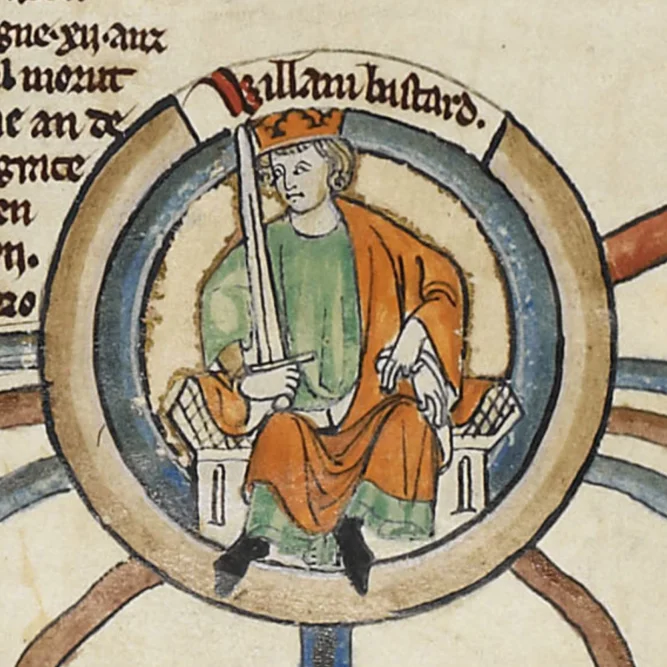
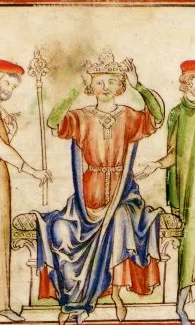
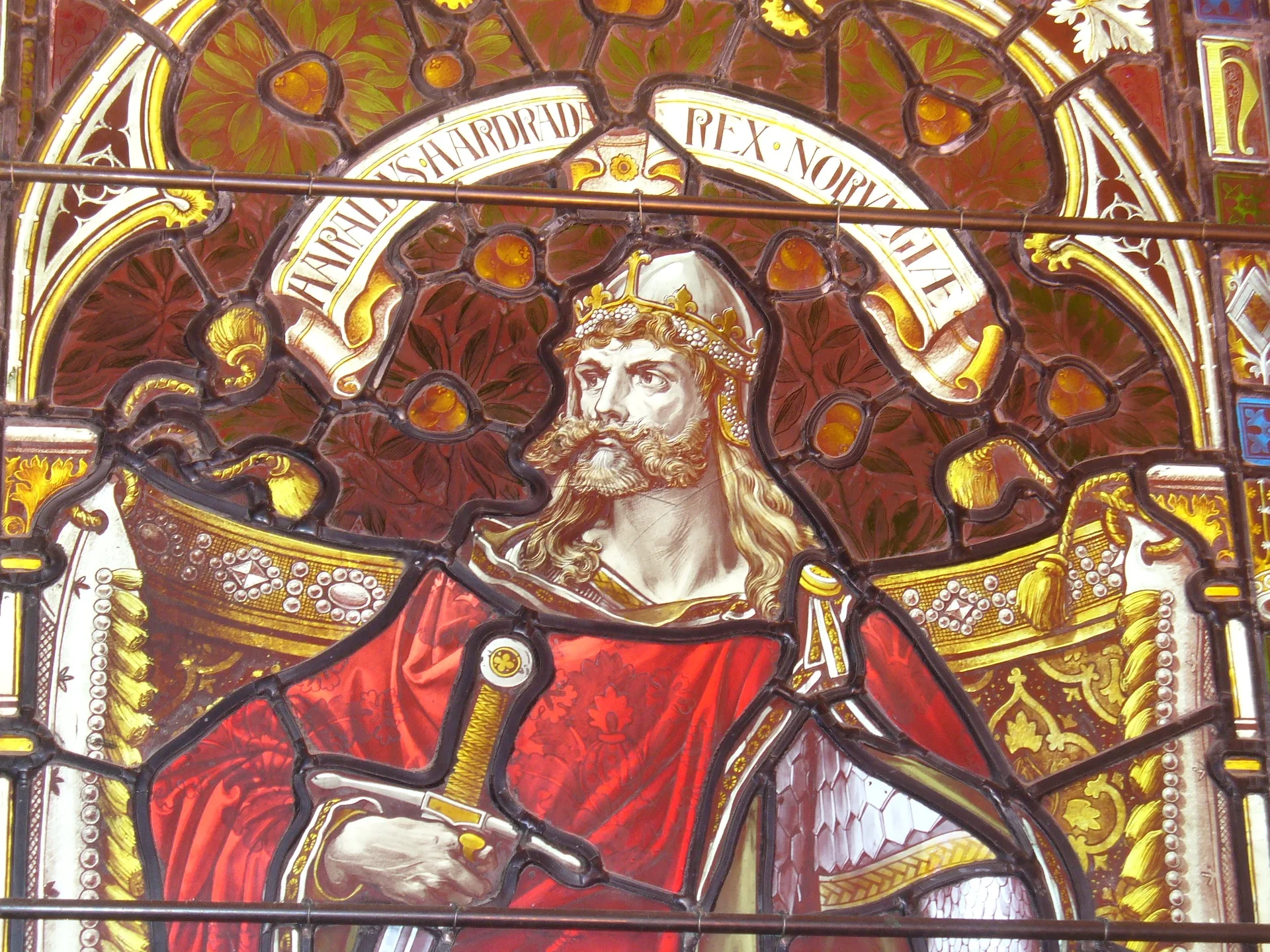
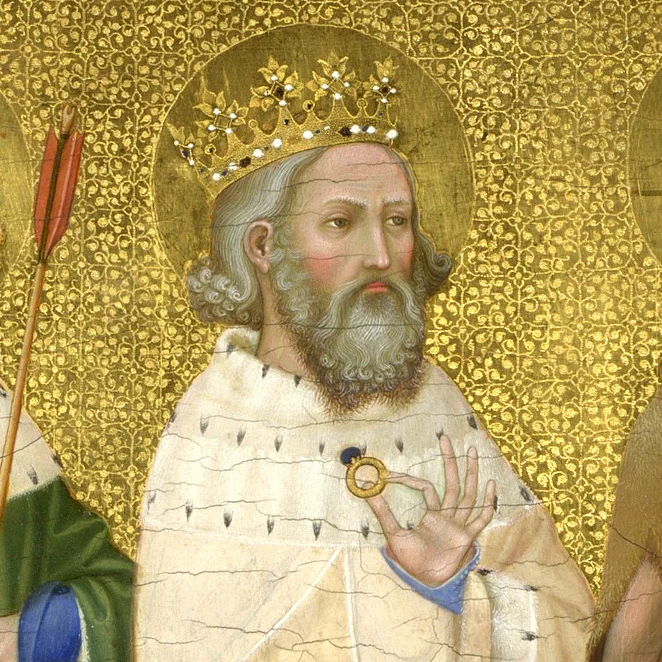
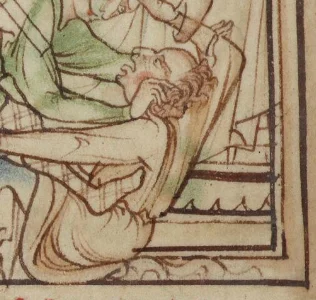
In January 1066, King Edward the Confessor - The devout Anglo-Saxon king who rebuilt Westminster Abbey and was later canonized as a saint. His death without a direct heir in January 1066 directly precipitated the Norman Conquest. of England died without leaving an heir after consecrating Westminster Abbey. The English royal council, the Witenagemot, promptly elected Harold Godwinson - The last crowned Anglo-Saxon king of England who annihilated a massive Norse invasion at Stamford Bridge in 1066, only to march south and die fighting Norman invaders at the Battle of Hastings., the powerful Earl of Wessex, as King Harold II. Across the English Channel, however, Duke William - The first Norman King of England who crossed the English Channel to win the Battle of Hastings in 1066. He transformed Anglo-Saxon England into a centralized feudal kingdom, commissioning the Tower of London and the Domesday Book. of Normandy - A historic coastal region in northwestern France bordering the English Channel. Characterized by lush rolling pastures, fertile farmland, and towering chalk cliffs, it encompasses the lower Seine River valley leading to the sea.The Duchy of Normandy originated in 911 through the Treaty of Saint-Clair-sur-Epte, when West Frankish King Charles the Simple ceded land to the Viking chieftain Rollo to halt Norse raids. Blending fierce Scandinavian maritime traditions with French feudalism, language, and heavy cavalry warfare, the Normans emerged as one of the most formidable warrior cultures in medieval Europe.Under Duke William II, Normandy launched the 1066 invasion of England, indelibly intertwining the destinies of Britain and France, and later served as the pivotal landing theater for Allied forces during World War II in 1944. along the lower Seine River - The Seine River is a major river of northwestern France, flowing approximately 777 km from the Langres plateau through the heart of Paris into the English Channel at Le Havre. Encircling the Île de la Cité, it has served as the vital economic artery, defensive boundary, and cradle of French civilization since antiquity. The river derives its name from Sequana, the ancient Celtic (Gallic) goddess of the river and healing springs. According to legend, Sequana rode the river in a duck-prowed boat to heal the sick. At the river's source, an ancient sanctuary dedicated to her once stood, where pilgrims deposited carved wooden ex-votos praying for divine healing. During the Middle Ages, Viking longships sailed up the Seine to lay siege to Paris in 845 and 885, prompting the French crown to grant the lower Seine basin to Rollo, founding the Duchy of Normandy in 911. Throughout history, the Seine remained a pivotal military corridor and commercial highway shaping France's destiny. was enraged, maintaining that Edward had previously promised him the crown and that Harold had personally sworn upon holy relics to support his claim. Simultaneously, King Harald Hardrada - The legendary Norse king and former commander of the Byzantine Varangian Guard whose death at the Battle of Stamford Bridge in 1066 brought a dramatic conclusion to the Viking Age. of Norway asserted his own claim to the English throne based on older Scandinavian royal treaties. Fueling the crisis, Harold's vengeful exiled brother Tostig - Son of Earl Godwin of Wessex and younger brother of King Harold II, he served as Earl of Northumbria until exiled following a popular rebellion, subsequently allying with King Harald Hardrada of Norway to invade England before falling at the Battle of Stamford Bridge. approached William before traveling north to convince Hardrada to invade, promising northern English support. Hardrada and William were not allies but fierce rivals competing for the sole possession of England, yet their overlapping ambitions trapped Harold II in an unprecedented two-front struggle against formidable overseas invaders.
In fact, Duke William had assembled an armada of 7,000 knights, foot soldiers, and warhorses by August, but unfavorable northerly winds trapped his fleet along the French coast for over a month. As King Harold was preparing to demobilize his southern coastal defense due to dwindling provisions, Hardrada and Tostig's 300 longships caught the northerly winds and struck northern England in mid-September. After Hardrada shattered northern English levies at Fulford and captured York, Harold II made a daring decision: he marched his army over 300 kilometers north from London - The capital of the United Kingdom and England, situated along the River Thames in southeastern Great Britain. Founded by the Romans around the 1st century AD as 'Londinium,' it rapidly became the commercial and administrative hub of the Roman province of Britannia.During the Middle Ages, Westminster Abbey and royal palaces established London as the perpetual seat of English monarchs. Following the Norman Conquest in 1066, William the Conqueror commissioned the formidable stone fortress known as the Tower of London (the White Tower) to dominate and protect the city.Surviving the Great Plague and the Great Fire of 1666, London evolved into the global capital of the British Empire, celebrated today for its enduring royal traditions, historic landmarks, and rich architectural heritage. to York in just four days. On September 25, Harold launched a surprise assault on the unarmored Norse camp at Stamford Bridge. Following savage hand-to-hand fighting along the River Derwent - The River Derwent is a scenic 115-kilometer river in Yorkshire, northern England, flowing from the North York Moors into the River Ouse. Its name derives from an ancient Celtic root meaning 'clear water of the oaks', and it has historically served as a vital waterway and agricultural lifeline east of York. On September 25, 1066, a narrow wooden bridge across the river became the site of the legendary Battle of Stamford Bridge. According to the Anglo-Saxon Chronicle, a lone giant Viking berserker held the bridge single-handedly against the entire English army, felling dozens of foes with a Dane axe until an English soldier floated beneath the bridge in a tub and thrust a spear up between the floorboards. King Harold II achieved a historic victory on the banks of the Derwent, slaying King Harald Hardrada of Norway and Earl Tostig to bring an end to the Viking Age in England. However, the savage casualties and grueling marches along the river severely depleted the English army, setting the stage for their catastrophic defeat at Hastings three weeks later., Hardrada and Tostig were slain and their army annihilated. The disaster was so complete that out of 300 invading ships, barely 24 were needed to carry the shattered survivors home, decimating an entire generation of Norway's warrior nobility. Combined with the ongoing Christianization and feudal transition of Scandinavia, this catastrophic defeat brought a definitive conclusion to two and a half centuries of large-scale Viking invasions in Britain.
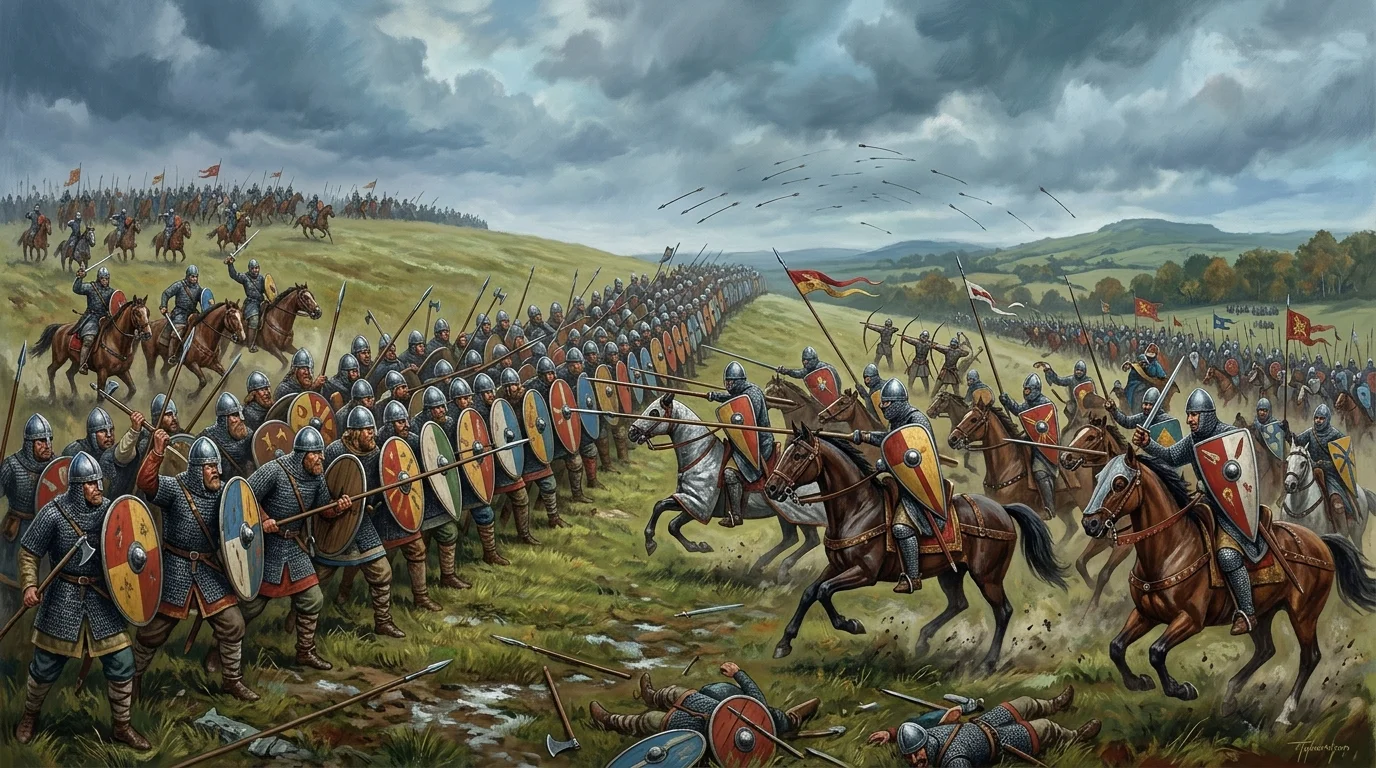
Harold had no time to celebrate his hard-fought triumph. Just days after the victory at Stamford Bridge, the winds across the English Channel miraculously shifted to a favorable southerly breeze, releasing William's armada to land unopposed at Pevensey on the undefended southern coast. With an exhausted and battered army, Harold immediately marched 400 kilometers back south. On October 14, 1066, the hosts collided at the Battle of Hastings on Senlac Hill. Anglo-Saxon infantry formed a resolute shield wall - A close-order infantry military formation in which warriors interlock or tightly overlap their shields to form an unbroken protective barrier. Known as the 'skjaldborg' among Scandinavian Norsemen, it formed the tactical bedrock of warfare among Anglo-Saxon and Viking armies throughout the early Middle Ages.Warriors in the front ranks overlapped round or kite-shaped shields to ward off arrows, javelins, and thrown axes, while men behind them thrust spears, swung heavy two-handed Dane axes, and replaced fallen comrades. As long as cohesion held, a disciplined shield wall could repel even devastating frontal cavalry charges.At the Battle of Hastings in 1066, King Harold's Anglo-Saxon shield wall atop Senlac Hill resisted repeated assaults by Norman cavalry and archers for hours. However, when defenders broke ranks to pursue retreating Norman units—susceptible to feigned retreat tactics—the wall fractured, allowing Norman horsemen to penetrate and crush the formation. that repelled repeated charges from Norman cavalry and archers for hours. Norman knights leveraged stirrups - A light frame or loop suspended by a strap from each side of a horse's saddle to support the rider's foot. Invented in ancient Asia and introduced to Europe around the 6th to 8th centuries by steppe nomadic peoples such as the Avars, it stands as one of the most transformative inventions in the history of warfare.Prior to the stirrup, riders had to grip the horse tightly with their thighs and knees to stay mounted, severely limiting their balance and combat effectiveness. Striking hard with a sword or thrusting with a spear risked knocking the rider backward off the horse. With stirrups, warriors could stand in the saddle, absorb violent impacts, and maneuver with unprecedented stability, firing bows or striking blows without losing balance.Combined with rigid high-cantled saddles, stirrups enabled mounted knights to lock their bodies to their warhorses, transforming the rider and mount into a single crushing projectile capable of devastating shock charges with couched lances. This technological breakthrough elevated heavy cavalry to absolute supremacy on medieval battlefields, fostering the rise of the knightly caste and feudal society across Europe. and rigid saddle - A heavy military saddle constructed over a solid wooden frame (the saddle tree), featuring a raised pommel in front and a high, supportive cantle behind to securely lock the rider into the seat. Evolving from Roman four-horned saddles, it became a cornerstone of medieval European heavy cavalry warfare.Unlike soft cloth or pad saddles, the rigid wooden tree distributed the rider's weight away from the horse's spine onto the broad ribcage, preventing spinal injuries and allowing horses to carry heavy armored warriors for sustained campaigns. Crucially, the tall curved cantle acted as a rigid backrest, bracing the rider against the immense kinetic recoil of lance impacts and preventing the knight from being driven backward out of the saddle.Paired with stirrups, the rigid saddle united horse, saddle, and armored warrior into a singular living projectile. Norman knights harnessed this system to master the 'couched lance' charge, tucking the heavy spear under the armpit and delivering unstoppable shock attacks that broke enemy formations at historic battles like Hastings in 1066.s to deliver devastating couched lance charges, yet the shield wall held firm. Recognizing the stalemate, William deployed feigned retreats, tricking eager English defenders into breaking ranks to pursue the fleeing Normans. When King Harold was fatally struck in the eye by an arrow, the disordered shield wall collapsed, granting William a decisive victory.
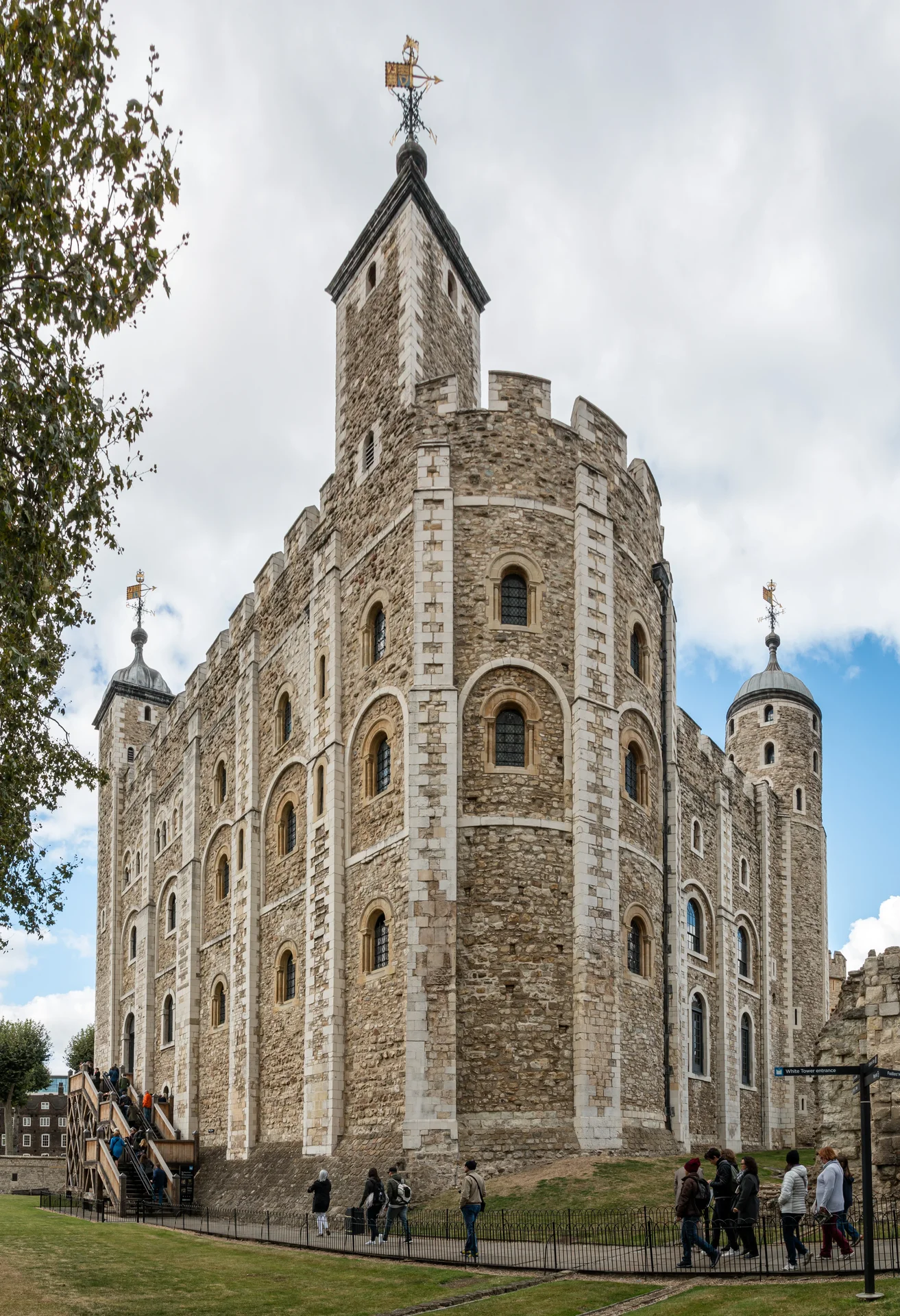
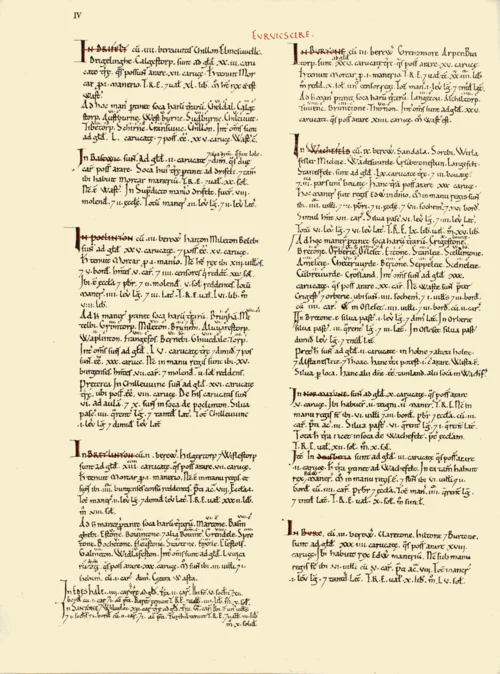
Following his triumph at Hastings, William secured London and was crowned King William I at Westminster Abbey on Christmas Day 1066, establishing the Norman Dynasty. Amidst the chaos of his coronation—where Norman guards mistook English cheers of acclamation for an uprising and set fire to surrounding houses—William moved ruthlessly to consolidate power. When rebellion flared in 1069, he unleashed the brutal 'Harrying of the North', laying waste to Yorkshire through systematic scorched-earth tactics that starved over 100,000 people and extinguished Anglo-Saxon resistance. Confiscating native estates, William distributed them among roughly 5,000 Norman knights, establishing the most centralized feudal monarchy in Europe through the Oath of Salisbury - The Oath of Salisbury was a landmark gathering and constitutional precedent established in August 1086, when King William I summoned all principal landholders, tenants-in-chief, and undertenants of England to Old Sarum (Salisbury) to swear unconditional fealty directly to the English Crown.Traditional continental feudalism adhered to the maxim 'the vassal of my vassal is not my vassal.' Under that system, sub-vassals owed allegiance exclusively to their immediate overlord, enabling powerful barons to command their own knightly retinues in rebellions against the sovereign. Seeking to eliminate this fundamental weakness, William decreed that every landholder's oath of fidelity to the King superseded their private feudal loyalties to any local noble.Combined with the completion of the Domesday Book survey that same year, the Oath of Salisbury forged the most centralized feudal monarchy in medieval western Europe. It curtailed baronial factionalism and ensured that England developed unified common laws and strong royal administration centuries ahead of its continental neighbors., which decreed that every vassal owed primary loyalty directly to the King. To police the conquest, he erected hundreds of stone fortresses across England, anchored by the White Tower of the Tower of London, and commissioned the monumental Domesday Book - A comprehensive statistical survey of landholding, wealth, and population across England commissioned by William the Conqueror in December 1085 and completed in 1086. Written in Medieval Latin on parchment, it stands as Europe's earliest and most thorough surviving national fiscal record.The English population dubbed the record 'Domesday' (Doomsday) because its judgments were final and inescapable, likening the king's royal commissioners to the Last Judgment itself. The survey cataloged ownership under Edward the Confessor in 1066 compared to current Norman tenants, recording ploughlands, woodlands, mills, livestock, and fishery rights across thousands of manors.The Domesday Book consolidated William's feudal authority, settled property disputes, and established an efficient taxation foundation that permanently cemented centralized royal governance in medieval England. It is preserved today in the National Archives at Kew. in 1086 to survey every manor, mill, and livestock head for national taxation. A profound linguistic transformation also took place as the conquerors' Anglo-Norman French blended with the commoners' Old English. Conquered Anglo-Saxon peasants who toiled in the fields raising livestock continued using Germanic Old English words like cow, pig, and sheep, while the ruling Norman nobility who enjoyed lavish feasts at castle tables referred to the prepared meats using French terms like beef (bœuf), pork (porc), and mutton (mouton). As these two linguistic worlds merged over centuries, living farm animals and culinary dishes permanently retained distinct names reflecting medieval social hierarchy, while thousands of French words for law, governance, and warfare were woven into the language, laying the foundations of modern English. Permanently severing England from the Scandinavian orbit and embedding it within continental European Christendom, William's dual status as both sovereign King of England and feudal Duke of Normandy sowed the seeds of Anglo-French dynastic rivalry that would ultimately ignite the Hundred Years' War.