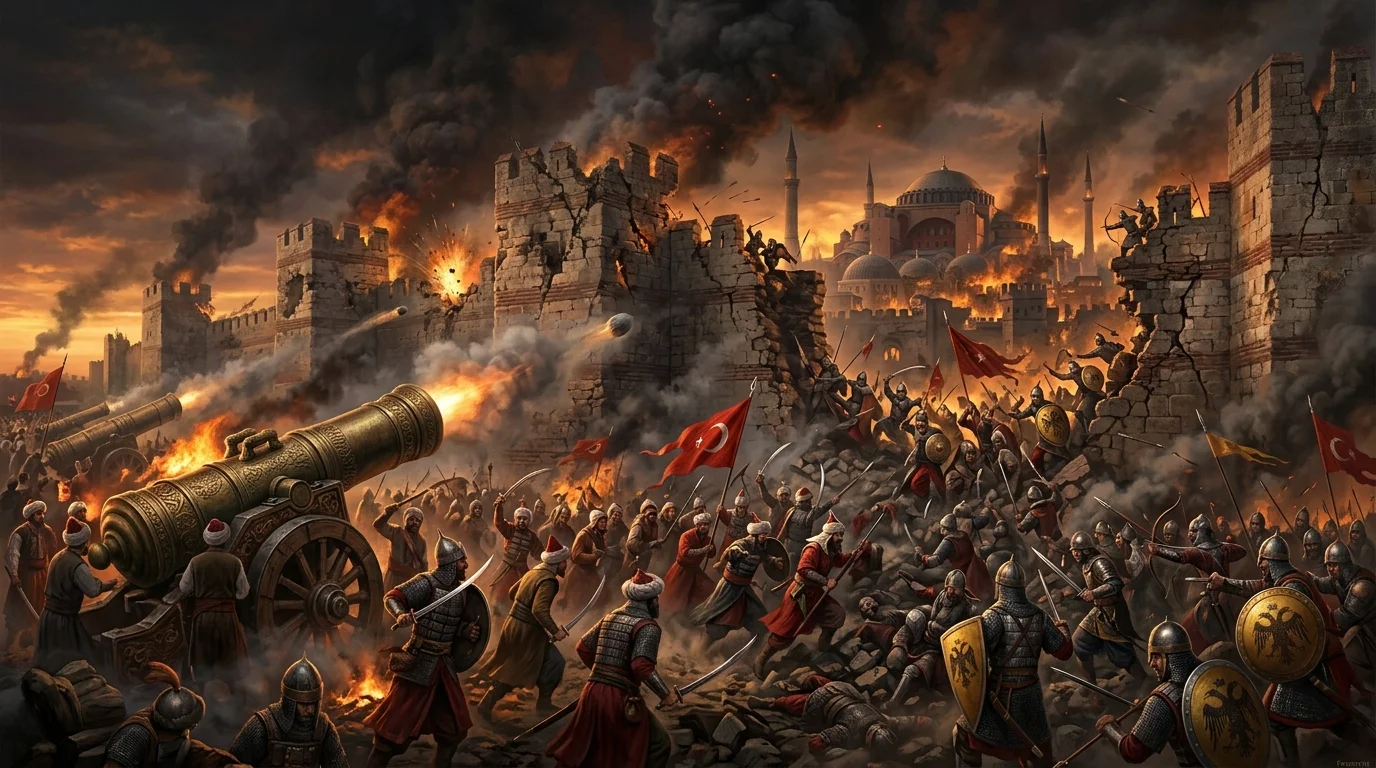
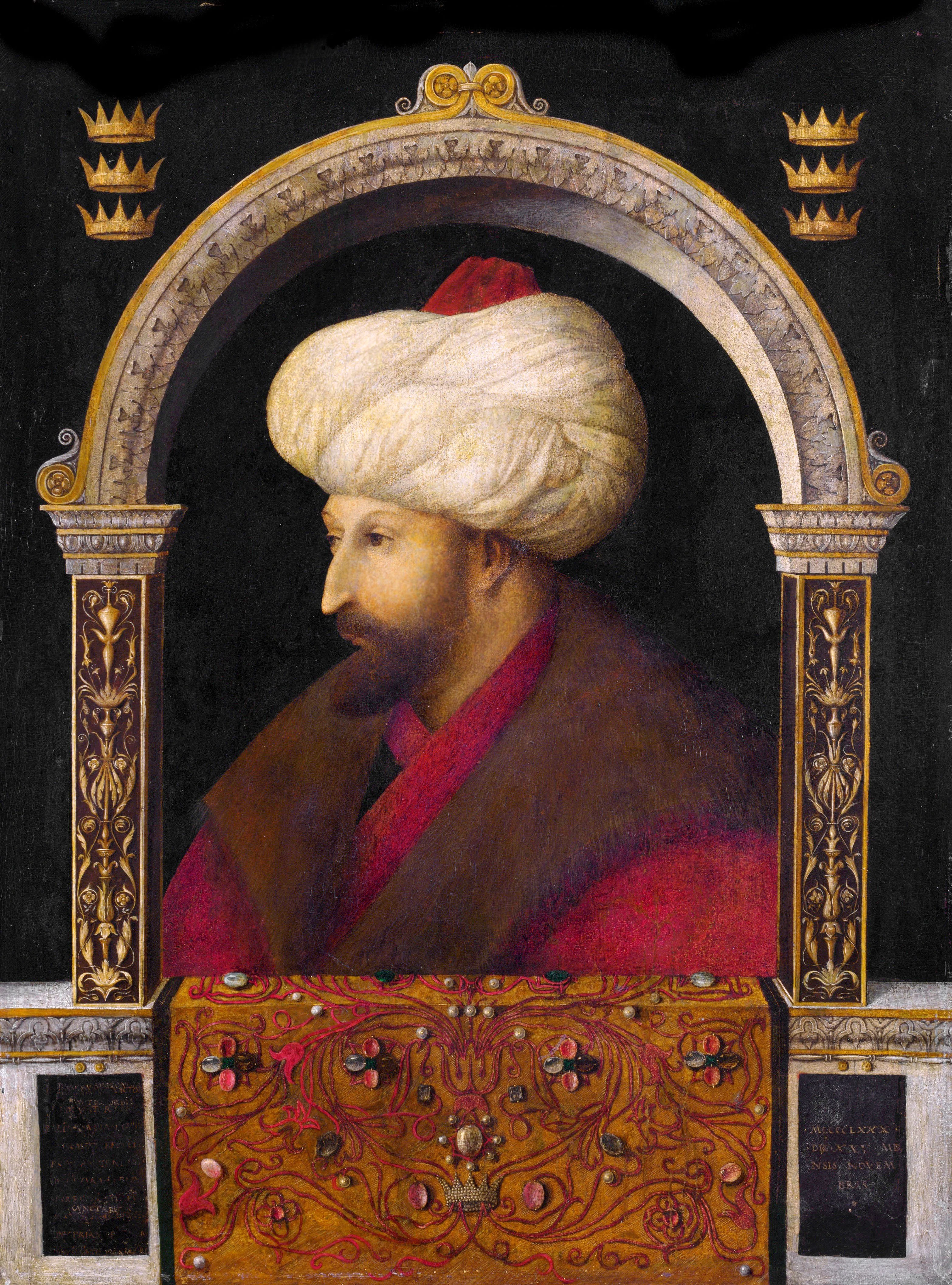
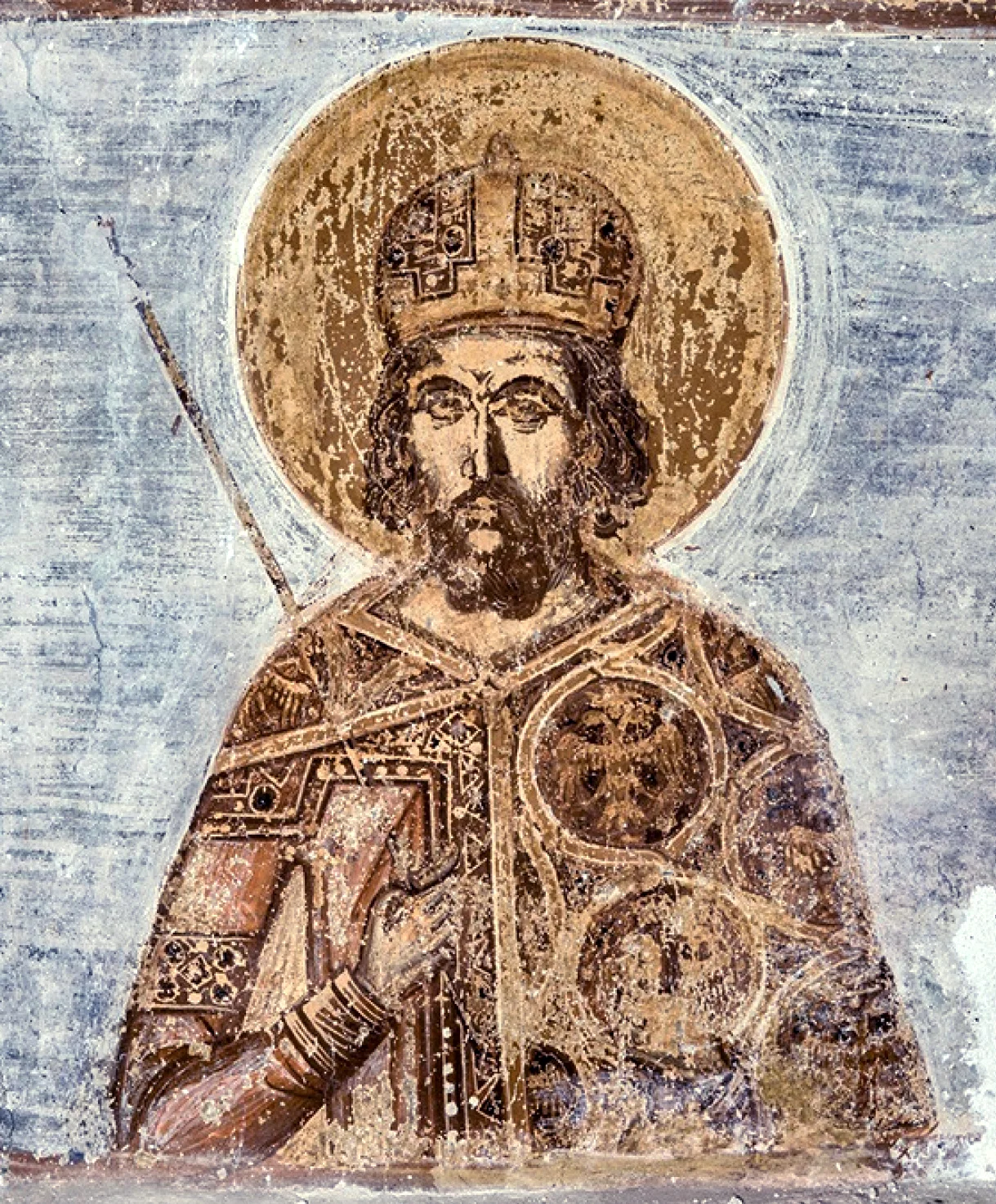
By 1453, the once-mighty Byzantine Empire (the Eastern Roman Empire - The medieval continuation of the Roman Empire in the East, centered on Constantinople. For over a millennium, it served as a bastion of Christianity and Roman law, preserving ancient knowledge until its fall in 1453.) had shrunk to little more than its capital city, Constantinople, and a few surrounding territories. The Ottoman Empire - The Ottoman Empire was a powerful Islamic state that began as a small Turkish tribe in Anatolia (present-day Turkey). Over six centuries, it grew into a massive superpower that stretched across three continents: Southeast Europe, Western Asia, and Northern Africa. It stood at the crossroads of the East and West, controlling vital trade routes.Osman's Dream and the FoundationLegend says the empire's founder, Osman I, had a miraculous dream in the late 13th century. He dreamed that a moon emerged from a holy man's chest and entered his own. Then, a massive tree grew from his navel, its branches covering the entire world. This dream was seen as a divine prophecy that Osman and his descendants were destined to rule a mighty empire.The Fall of ConstantinopleThe backbone of the Ottoman army was the Janissaries, elite infantry soldiers trained with intense discipline. Using these forces and massive gunpowder cannons, Sultan Mehmed II accomplished the impossible in 1453: he conquered Constantinople (present-day Istanbul). This historic victory ended the thousand-year-old Byzantine Empire, and the city became the glorious new capital of the Ottomans.The Golden AgeThe empire reached its absolute peak in the 16th century under the rule of Suleiman the Magnificent. He was not only a brilliant military commander who expanded the empire deep into Europe—even laying siege to Vienna—but also a great lawmaker and patron of the arts. During his reign, the empire was incredibly wealthy, and its culture, architecture, and science flourished.Decline and FallHowever, no empire lasts forever. Starting in the 17th century, the Ottoman Empire slowly began to weaken. It faced internal corruption, technological stagnation, and increasing pressure from rising European powers like the Russian and Habsburg Empires. By the 19th century, it was often called the 'Sick Man of Europe.' The final blow came during World War I (1914–1918), where the empire fought on the losing side. After the war, the vast empire was divided, leading to its official collapse in 1922 and the birth of the modern Republic of Turkey under the leadership of Mustafa Kemal Atatürk., led by the ambitious 21-year-old Sultan Mehmed II - The ambitious Ottoman Sultan who conquered Constantinople at the age of 21, ending the Byzantine Empire., completely surrounded the city and was determined to conquer it. Constantinople, however, was protected by the Theodosian Walls - The Theodosian Walls are a complex series of defensive stone walls that have surrounded and protected the city of Constantinople since antiquity. Built by Emperor Theodosius II in the 5th century, they were famous for their triple-layer defense system and were considered nearly impregnable. They successfully defended the Byzantine capital against numerous sieges for over a millennium, before finally being breached by the Crusaders in 1204 and by the Ottoman cannons in 1453., a massive triple-wall defense system that had successfully repelled countless sieges over the past thousand years. To break these legendary walls, Mehmed II brought a terrifying new technology to the battlefield: massive bronze cannon - A powerful weapon that uses gunpowder to launch heavy stone or metal balls. The core component, gunpowder, was accidentally invented in ancient China by alchemists searching for an elixir of immortality. Initially used in bamboo tubes as 'fire lances' to shoot flames, it eventually evolved into sturdy metal barrels, becoming the large cannons we recognize today. This terrifying new weapon spread rapidly from China to the Islamic world and Europe through the conquests of the Mongol Empire and the trade routes of the Silk Road. By the 15th century, cannons had become decisive weapons in major historical conflicts. In 1453, during the final Battle of Castillon of the Hundred Years' War, the French army successfully deployed early field artillery to obliterate the English forces. In that very same year (1453), the Ottoman Empire used massive super-sized cannons—most notably the 8-meter-long 'Basilica' designed by Orban—to shatter the impenetrable walls of Constantinople, conquering the Byzantine Empire. The introduction of cannons revolutionized warfare. They could easily smash through the thick stone walls of castles and easily defeat heavily armored knights, bringing an end to traditional medieval warfare.s, including a super-sized cannon known as the 'Basilica' designed by a Hungarian engineer named Orban.
The siege began in April 1453. The Ottoman cannons relentlessly bombarded the ancient walls, causing massive damage. However, the resilient Byzantine defenders, led by Emperor Constantine XI - The last reigning Emperor of the Byzantine Empire who died bravely fighting alongside his men as Constantinople fell., worked tirelessly every night to repair the breaches with timber and earth. The Ottomans also tried to attack from the sea, but the Byzantines had stretched a massive iron chain across the Golden Horn - The Golden Horn is a narrow, horn-shaped estuary that surrounds Constantinople (modern Istanbul). Because its deep and calm waters provided excellent protection from storms, it served as one of the finest natural harbors in the world. During the Byzantine Empire, it was the economic heart of the city, bustling with trade ships that brought immense wealth. It also served as a crucial defensive barrier. To prevent enemy fleets from entering, the Byzantines famously stretched a massive iron chain across its mouth, which played a key role during sieges like the Fall of Constantinople in 1453. (the city's primary harbor) to prevent enemy ships from entering. In a stroke of tactical genius, Mehmed II ordered his men to construct a greasy wooden runway over a hill and physically dragged his warships out of the water, over the land, and dropped them directly into the Golden Horn, bypassing the chain entirely. This forced the already exhausted Byzantine defenders to stretch their limited troops even thinner to defend the sea walls.
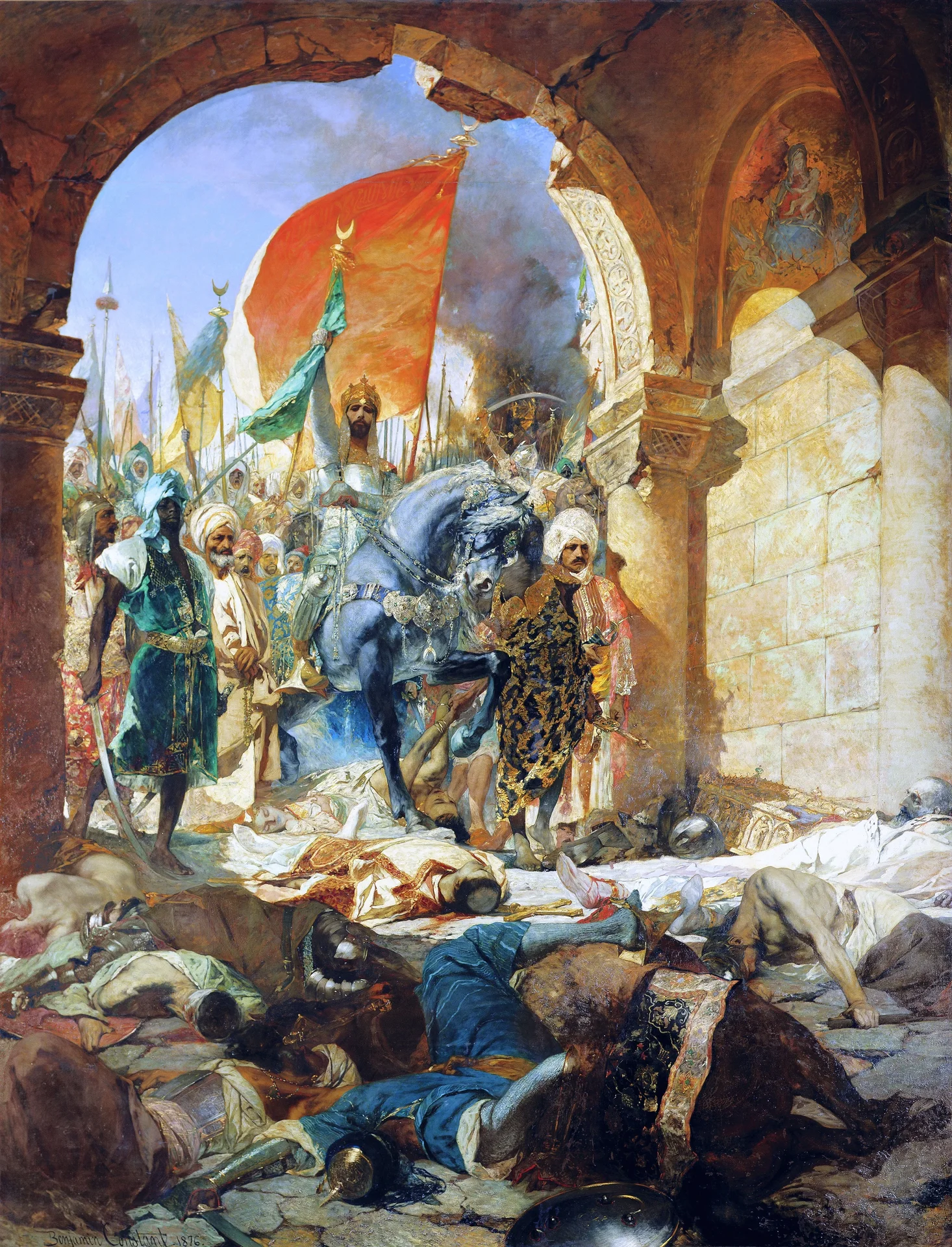
After weeks of relentless bombardment and several failed assaults, the Ottomans launched a massive final attack on May 29, 1453. Wave after wave of Ottoman soldiers crashed against the weakened defenses. Confusion erupted when a small gate was accidentally left unlocked, allowing Ottoman troops to infiltrate the walls, and the Byzantine commander was severely wounded. Seeing their defenses crumbling, Emperor Constantine XI reportedly threw off his royal insignia and plunged into the thickest of the fighting, dying alongside his men. The city fell, and Mehmed II rode victoriously into Constantinople, transforming the Hagia Sophia into a mosque and renaming the city Istanbul. This shocking event had two massive consequences. First, because the Byzantine Empire was the direct continuation of the ancient Roman Empire, its fall marked the absolute end of over 1,500 years of glorious Roman history. Second, the crucial trade routes that brought precious Asian spices and silk to the West were now firmly blocked by the Islamic Ottoman Empire. Desperate for these exotic goods, Europeans were forced to brave the uncharted oceans to find entirely new sea routes to Asia. This desperate search ultimately sparked the legendary 'Age of Discovery', leading explorers like Columbus to set sail and change the world forever.