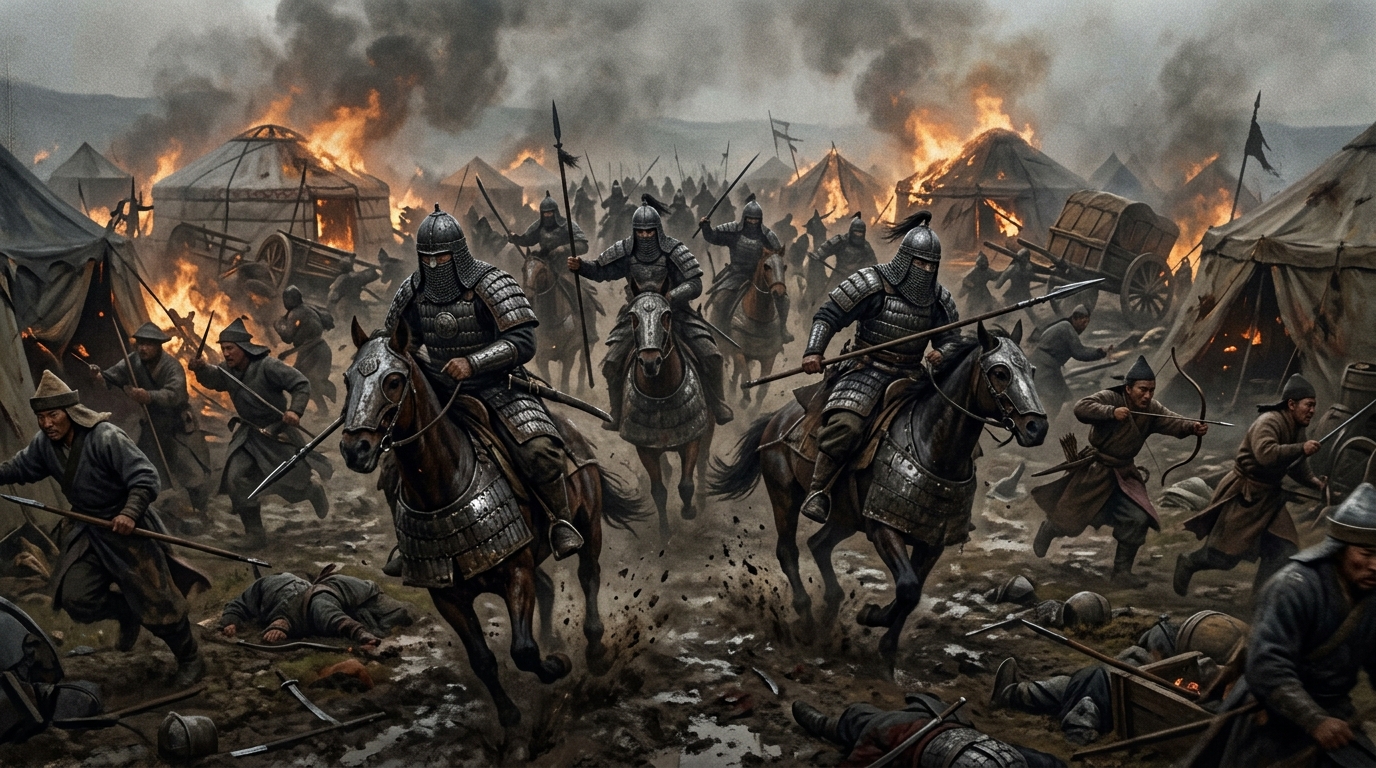
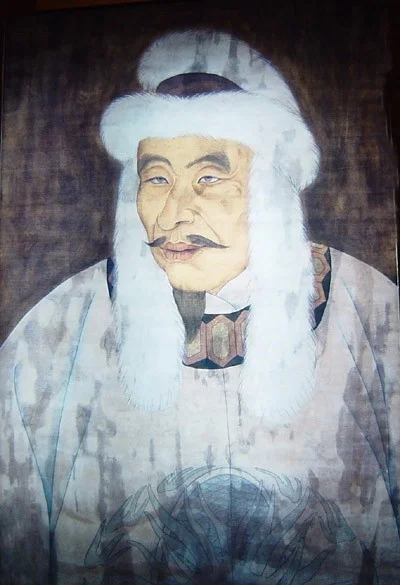
In 1114, Wanyan Aguda - The legendary founder and first emperor of the Jin Dynasty, who unified the Jurchen tribes and led a heroic rebellion against the oppressive Liao Dynasty. united the Jurchen tribes to rebel against the oppressive Liao Empire. Declaring the establishment of the Jin Dynasty - The Jin dynasty, officially the Great Jin, was an imperial dynasty of China led by the Jurchen people. It ruled Northern China and Northeast China from 1115 to 1234. Legend has it that the founder, Aguda, chose the name 'Jin' (Gold) because gold is unchanging and pure, unlike iron which rusts. The Jurchens were known for their fierce martial spirit and advanced iron technology before their eventual fall to the rising Mongol Empire. in 1115, he commanded a relatively small but highly disciplined army of fierce Jurchen cavalry. In 1115, as Emperor Tianzuo - The final emperor of the Khitan Liao Dynasty, whose excessive love for hunting and unstable rule contributed to the rapid collapse of his empire under the rise of the Jin Dynasty. personally led a massive campaign against the Jin, the Liao royal relative Yelu Zhangnu launched a major rebellion in the rear to depose the emperor. Panicked by this internal coup, the Liao army was ordered to retreat in disarray. Seizing this critical moment, Aguda launched a relentless pursuit, culminating in the Battle of Hubodagang. Here, Aguda's 20,000 cavalry crushed the demoralized Liao host (recorded up to 700,000 in Jin sources, or 150,000 in Khitan records) through lightning-fast shock tactics. The unstoppable Jin cavalry, protected by heavy armor and riding sturdy warhorses, shattered the Liao forces in battle after battle, storming their supreme capital, Shangjing, in 1120. Observing this rapid rise and eager to reclaim the lost Sixteen Prefectures - A strategic region along the southern edge of the Great Wall, including modern-day Beijing and Datong. It was ceded by Shi Jingtang of Later Jin to the Khitan Liao in 936 AD, depriving China of its natural northern defenses and becoming a major source of conflict for centuries. For the Song Dynasty, reclaiming this lost territory was a matter of national pride and survival, but several major military expeditions failed to dislodge the Liao from the region., the Song Dynasty - The Song dynasty was an imperial dynasty of China that began in 960 and lasted until 1279. It was founded by Emperor Taizu of Song following his usurpation of the throne of the Later Zhou, ending the ... initiated secret maritime negotiations, culminating in the 'Alliance on the Sea - The Alliance Conducted at Sea was a secret military pact made in 1120 between the Northern Song dynasty and the newly emerging Jin dynasty (Jurchens) to launch a joint attack against the Khitan-led Liao dynasty.Because the Liao dynasty lay between them, envoys from Song and Jin could not travel by land. Instead, they had to cross the Bohai Sea in secret, traveling from the Shandong Peninsula to the Liaodong Peninsula. This perilous sea route gave the treaty its name: the 'Alliance on the Sea'.The agreement stipulated that Song would pay Jin the massive annual tributes it previously paid to Liao, and in return, Song would recover its lost northern territories (the Sixteen Prefectures). However, the alliance backfired disastrously. The joint campaign exposed the sheer military incompetence of the Song army to the Jurchens, which ultimately provoked Jin to invade and conquer the Northern Song a few years later.' in 1120. They agreed to execute a joint pincer attack to destroy the Liao Empire, with Song striking from the south.
However, the joint campaign exposed the profound military weakness of the Song. General Tong Guan - A powerful eunuch general of the Northern Song Dynasty who controlled the military during the reign of Emperor Huizong, but suffered major defeats during the campaign against the Liao Dynasty. led a massive Song army to attack Liao's southern capital, Yanjing, but was repeatedly routed by a disintegrating Liao garrison. Incapable of taking the city, the Song humiliatingly paid the Jin to capture Yanjing on their behalf. This military embarrassment convinced the Jurchens that the wealthy Song Dynasty was militarily helpless and prime for conquest, laying the strategic groundwork for their invasion of the Song and the eventual Jingkang Incident - The catastrophic event in 1127 AD when the Jurchen Jin army captured the Song Dynasty capital of Kaifeng. This marked the dramatic end of the Northern Song Dynasty. The Jin forces looted the city and captured Emperor Qinzong and his father, Emperor Huizong, along with thousands of imperial family members, scholars, and artisans. They were dragged north into captivity, which was considered the greatest humiliation in Song history. The term 'Jingkang' was the era name of Emperor Qinzong. The tragic loss of the Northern capital and the capture of their beloved leaders left a deep wound in the hearts of the Song people, inspiring patriotic heroes like Yue Fei to fight to reclaim their lost homeland. This historic disaster forced the remaining Song court members to flee south, leading to the birth of the Southern Song..
Meanwhile, Jin armies relentlessly captured Liao's main capitals—Shangjing, Zhongjing, and Xijing. The last Liao ruler, Emperor Tianzuo, fled into the western desert, attempting to mount a desperate last stand. In 1125, Wanyan Loushi captured the fleeing emperor, formally ending the 210-year-old Liao Empire. While Prince Yalu Dashi escaped west to establish Qara Khitai (Western Liao), the collapse of Liao made the Jin the undisputed masters of Northern China, now directly bordering the vulnerable Song.